

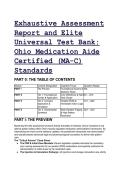
Exhaustive Assessment
Report and Elite
Universal Test Bank:
Ohio Medication Aide
Certified (MA-C)
Standards
PART 0: THE TABLE OF CONTENTS
Section Content Designation Cognitive Focus Question Range
PART I The Preview Foundational Axioms & N/A
Statutory Rules
PART II Tier 1: Foundational Core Definitions & Hard Q1 – Q10
Syntax & Application Deck Scope
PART II Tier 2: Complex Variable Shifts & Q11 – Q20
Application & Immediate Action Logic
Simulation
PART II Tier 3: Grandmaster Multi-Variable Triaging Q21 – Q30
Synthesis & High-Stakes
Resolution
PART I: THE PREVIEW
Mastering this elite assessment protocol directly translates to flawless clinical compliance and
optimal patient safety within Ohio's heavily regulated medication administration frameworks. By
internalizing the most current statutory updates, the practitioner transcends rote memorization
and operationalizes advanced legal and pharmacological boundaries to deliver elite patient
care.
The "Critical Axioms" Cheat Sheet:
● The PRN & Initial Dose Mandate: Recent legislative updates eliminate the mandatory
prior nursing assessment for as-needed (PRN) medications and explicitly authorize the
administration of initial doses by the medication aide.
● The Injection & Calculation Embargo: All injections and dosage calculations are strictly
, prohibited, with the singular exception of insulin administered via a pen device containing
a precise dosage indicator.
● The Schedule II Authorization: Practitioners are legally authorized to administer
Schedule II controlled substances, provided the administration is executed exclusively via
oral or topical routes.
● The Supervision Dichotomy: Nursing homes demand continuous on-site nursing
supervision, whereas residential care facilities permit legal supervision via continuous
telecommunication.
● The Absolute Sub-Delegation Ban: The certified practitioner may never delegate
medication administration tasks, alter physician orders, or administer medications via any
enteral pathway (e.g., gastrostomy or nasogastric tubes).
PART II: THE ELITE TEST BANK
Tier 1 - Foundational Syntax & Application
Q1: A resident in a residential care facility requests a mild over-the-counter analgesic
designated as an as-needed (PRN) medication in their chart. The supervising nurse is off-site
but available via telephone. Based on the principles of current Ohio statutory updates, which
action is the MOST ACCURATE? A) The practitioner must withhold the medication until the
nurse performs a comprehensive on-site physical assessment. B) The practitioner must require
the nurse to return to the facility to provide direct physical supervision prior to administration. C)
The practitioner may administer the PRN medication immediately without a prior nursing
assessment. D) The practitioner may administer the medication but only after delegating the
final documentation to a licensed practical nurse.
● The Answer: C (The practitioner may administer the PRN medication immediately
without a prior nursing assessment.)
● Distractor Analysis:
○ A is incorrect: Legacy regulations historically mandated a comprehensive, on-site
nursing assessment prior to the administration of any PRN therapeutic. However,
sweeping legislative reforms under Ohio Senate Bill 144 effectively dismantled this
barrier, empowering the aide to evaluate the resident's expression of discomfort and
autonomously initiate the PRN protocol.
○ B is incorrect: In a residential care facility, supervision is legally permitted via
telecommunication; on-site presence is strictly mandated only in nursing homes.
○ D is incorrect: A certified medication aide is strictly prohibited from delegating any
task, including documentation, to another practitioner.
The Mentor's Analysis: The core underlying principle is the statutory expansion of the aide's
scope regarding PRN medications. When facing PRN requests in eligible facilities, the
immediate priority is verifying the order parameters rather than awaiting a clinical assessment
that is no longer legally mandated. By utilizing updated telecommunication supervision rules
alongside the PRN authorization, the practitioner bypasses the common trap of delaying
palliative care based on rescinded laws. Professional/Academic Intuition: Current statutory
guidelines authorize autonomous PRN administration without prior nursing assessment,
provided continuous telecommunication supervision is maintained.
Q2: A resident with type 2 diabetes requires their scheduled morning insulin. The pharmacy has
delivered both traditional vials with syringes and an insulin pen device containing a dosage
, indicator. Based on the principles of Ohio administrative medication standards, which action is
the MOST APPROPRIATE? A) Administer the insulin using the traditional vial and syringe to
ensure exact visual measurement. B) Administer the insulin using the pen device, provided the
employer's competency requirements are satisfied. C) Refuse the task entirely, as certified
medication aides are categorically prohibited from administering injections of any kind. D)
Administer the insulin via the pen device, but only after calculating the required sliding-scale
dosage based on the morning blood glucose reading.
● The Answer: B (Administer the insulin using the pen device, provided the employer's
competency requirements are satisfied.)
● Distractor Analysis:
○ A is incorrect: The administration of medications via traditional injection using vials
and syringes remains strictly prohibited under Ohio law.
○ C is incorrect: While general injections are banned, an explicit statutory exception
exists exclusively for insulin when utilizing a specialized pen device. * D is incorrect:
Aides are strictly forbidden from performing any dosage calculations; the dose must
be pre-determined by a prescriber.
The Mentor's Analysis: The core underlying principle is the strict parameterization of injection
authority to mitigate fatal dosing errors. When facing diabetic care scenarios, the immediate
priority is utilizing structurally safe equipment that removes human measurement error from the
equation. By utilizing an insulin pen device with a built-in dosage indicator, the practitioner
bypasses the common trap of engaging in unauthorized syringe use or prohibited math.
Professional/Academic Intuition: Insulin administration is the singular exception to the
injection prohibition, strictly contingent upon the use of a dosage-indicating pen and
verified employer competency.
Q3: A physician orders a Schedule II controlled substance in an oral tablet form for a resident
experiencing severe breakthrough pain. Based on the principles of OAC 4723-27, which
conclusion is the MOST ACCURATE regarding the aide's scope of practice? A) The aide is
explicitly prohibited from administering any Schedule II controlled substances regardless of the
route. B) The aide may administer the oral tablet, as legislative updates permit the
administration of Schedule II medications via oral or topical routes. C) The aide may administer
the medication only if it is converted to an intravenous (IV) format for faster absorption. D) The
aide may administer the oral tablet but must have a registered nurse physically witness the
resident swallowing the pill.
● The Answer: B (The aide may administer the oral tablet, as legislative updates permit the
administration of Schedule II medications via oral or topical routes.)
● Distractor Analysis:
○ A is incorrect: Legacy rules previously barred this action entirely, but current
statutory updates (SB 144) explicitly authorize oral and topical Schedule II
administration to ensure timely pain management.
○ C is incorrect: The administration of medications via intravenous therapy
procedures is universally prohibited for medication aides.
○ D is incorrect: While the aide must witness the consumption, standard
administration does not require an RN dual-witness for the physical act of
swallowing.
The Mentor's Analysis: The core underlying principle is the modernized pharmacological
authorization for high-schedule narcotics. When facing severe pain management, the immediate
priority is safely executing the administration within authorized systemic routes. By utilizing the
updated oral/topical Schedule II allowance, the practitioner bypasses the common trap of
Report and Elite
Universal Test Bank:
Ohio Medication Aide
Certified (MA-C)
Standards
PART 0: THE TABLE OF CONTENTS
Section Content Designation Cognitive Focus Question Range
PART I The Preview Foundational Axioms & N/A
Statutory Rules
PART II Tier 1: Foundational Core Definitions & Hard Q1 – Q10
Syntax & Application Deck Scope
PART II Tier 2: Complex Variable Shifts & Q11 – Q20
Application & Immediate Action Logic
Simulation
PART II Tier 3: Grandmaster Multi-Variable Triaging Q21 – Q30
Synthesis & High-Stakes
Resolution
PART I: THE PREVIEW
Mastering this elite assessment protocol directly translates to flawless clinical compliance and
optimal patient safety within Ohio's heavily regulated medication administration frameworks. By
internalizing the most current statutory updates, the practitioner transcends rote memorization
and operationalizes advanced legal and pharmacological boundaries to deliver elite patient
care.
The "Critical Axioms" Cheat Sheet:
● The PRN & Initial Dose Mandate: Recent legislative updates eliminate the mandatory
prior nursing assessment for as-needed (PRN) medications and explicitly authorize the
administration of initial doses by the medication aide.
● The Injection & Calculation Embargo: All injections and dosage calculations are strictly
, prohibited, with the singular exception of insulin administered via a pen device containing
a precise dosage indicator.
● The Schedule II Authorization: Practitioners are legally authorized to administer
Schedule II controlled substances, provided the administration is executed exclusively via
oral or topical routes.
● The Supervision Dichotomy: Nursing homes demand continuous on-site nursing
supervision, whereas residential care facilities permit legal supervision via continuous
telecommunication.
● The Absolute Sub-Delegation Ban: The certified practitioner may never delegate
medication administration tasks, alter physician orders, or administer medications via any
enteral pathway (e.g., gastrostomy or nasogastric tubes).
PART II: THE ELITE TEST BANK
Tier 1 - Foundational Syntax & Application
Q1: A resident in a residential care facility requests a mild over-the-counter analgesic
designated as an as-needed (PRN) medication in their chart. The supervising nurse is off-site
but available via telephone. Based on the principles of current Ohio statutory updates, which
action is the MOST ACCURATE? A) The practitioner must withhold the medication until the
nurse performs a comprehensive on-site physical assessment. B) The practitioner must require
the nurse to return to the facility to provide direct physical supervision prior to administration. C)
The practitioner may administer the PRN medication immediately without a prior nursing
assessment. D) The practitioner may administer the medication but only after delegating the
final documentation to a licensed practical nurse.
● The Answer: C (The practitioner may administer the PRN medication immediately
without a prior nursing assessment.)
● Distractor Analysis:
○ A is incorrect: Legacy regulations historically mandated a comprehensive, on-site
nursing assessment prior to the administration of any PRN therapeutic. However,
sweeping legislative reforms under Ohio Senate Bill 144 effectively dismantled this
barrier, empowering the aide to evaluate the resident's expression of discomfort and
autonomously initiate the PRN protocol.
○ B is incorrect: In a residential care facility, supervision is legally permitted via
telecommunication; on-site presence is strictly mandated only in nursing homes.
○ D is incorrect: A certified medication aide is strictly prohibited from delegating any
task, including documentation, to another practitioner.
The Mentor's Analysis: The core underlying principle is the statutory expansion of the aide's
scope regarding PRN medications. When facing PRN requests in eligible facilities, the
immediate priority is verifying the order parameters rather than awaiting a clinical assessment
that is no longer legally mandated. By utilizing updated telecommunication supervision rules
alongside the PRN authorization, the practitioner bypasses the common trap of delaying
palliative care based on rescinded laws. Professional/Academic Intuition: Current statutory
guidelines authorize autonomous PRN administration without prior nursing assessment,
provided continuous telecommunication supervision is maintained.
Q2: A resident with type 2 diabetes requires their scheduled morning insulin. The pharmacy has
delivered both traditional vials with syringes and an insulin pen device containing a dosage
, indicator. Based on the principles of Ohio administrative medication standards, which action is
the MOST APPROPRIATE? A) Administer the insulin using the traditional vial and syringe to
ensure exact visual measurement. B) Administer the insulin using the pen device, provided the
employer's competency requirements are satisfied. C) Refuse the task entirely, as certified
medication aides are categorically prohibited from administering injections of any kind. D)
Administer the insulin via the pen device, but only after calculating the required sliding-scale
dosage based on the morning blood glucose reading.
● The Answer: B (Administer the insulin using the pen device, provided the employer's
competency requirements are satisfied.)
● Distractor Analysis:
○ A is incorrect: The administration of medications via traditional injection using vials
and syringes remains strictly prohibited under Ohio law.
○ C is incorrect: While general injections are banned, an explicit statutory exception
exists exclusively for insulin when utilizing a specialized pen device. * D is incorrect:
Aides are strictly forbidden from performing any dosage calculations; the dose must
be pre-determined by a prescriber.
The Mentor's Analysis: The core underlying principle is the strict parameterization of injection
authority to mitigate fatal dosing errors. When facing diabetic care scenarios, the immediate
priority is utilizing structurally safe equipment that removes human measurement error from the
equation. By utilizing an insulin pen device with a built-in dosage indicator, the practitioner
bypasses the common trap of engaging in unauthorized syringe use or prohibited math.
Professional/Academic Intuition: Insulin administration is the singular exception to the
injection prohibition, strictly contingent upon the use of a dosage-indicating pen and
verified employer competency.
Q3: A physician orders a Schedule II controlled substance in an oral tablet form for a resident
experiencing severe breakthrough pain. Based on the principles of OAC 4723-27, which
conclusion is the MOST ACCURATE regarding the aide's scope of practice? A) The aide is
explicitly prohibited from administering any Schedule II controlled substances regardless of the
route. B) The aide may administer the oral tablet, as legislative updates permit the
administration of Schedule II medications via oral or topical routes. C) The aide may administer
the medication only if it is converted to an intravenous (IV) format for faster absorption. D) The
aide may administer the oral tablet but must have a registered nurse physically witness the
resident swallowing the pill.
● The Answer: B (The aide may administer the oral tablet, as legislative updates permit the
administration of Schedule II medications via oral or topical routes.)
● Distractor Analysis:
○ A is incorrect: Legacy rules previously barred this action entirely, but current
statutory updates (SB 144) explicitly authorize oral and topical Schedule II
administration to ensure timely pain management.
○ C is incorrect: The administration of medications via intravenous therapy
procedures is universally prohibited for medication aides.
○ D is incorrect: While the aide must witness the consumption, standard
administration does not require an RN dual-witness for the physical act of
swallowing.
The Mentor's Analysis: The core underlying principle is the modernized pharmacological
authorization for high-schedule narcotics. When facing severe pain management, the immediate
priority is safely executing the administration within authorized systemic routes. By utilizing the
updated oral/topical Schedule II allowance, the practitioner bypasses the common trap of


