

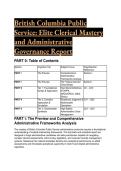
British Columbia Public
Service: Elite Clerical Mastery
and Administrative
Governance Report
PART 0: Table of Contents
Section Cognitive Tier Subject Focus Page/Section
Reference
PART I The Preview Comprehensive Section I
Administrative
Frameworks Analysis
PART I The Preview The "Critical Axioms" Section I
Cheat Sheet
PART II Tier 1: Foundational Hard Deck Definitions Q1 – Q10
Syntax & Application (FOIPPA,
ARCS/ORCS, eSkill,
Ethics)
PART II Tier 2: Complex Situational Judgment & Q11 – Q20
Application & Multivariable
Simulation Operations
PART II Tier 3: Grandmaster High-Stakes Q21 – Q30
Synthesis Administrative Crisis
Management
PART I: The Preview and Comprehensive
Administrative Frameworks Analysis
The mastery of British Columbia Public Service administrative protocols requires a foundational
understanding of multiple intersecting frameworks. This test bank and analytical report are
designed to forge administrative candidates into elite practitioners capable of navigating
complex clerical assessments, strict privacy legislation, and nuanced records management
systems. Mastering this material translates directly into exceptional performance on eSkill
assessments and immediate operational superiority in Clerk 9 and related administrative
capacities.
,Assessing Clerical Competency: The eSkill Framework
The recruitment architecture for administrative roles relies heavily on simulated competency
evaluations, frequently deployed via the eSkill platform or the standardized Tax Centre Clerical
Test (TCCT). These assessments are not merely tests of software knowledge; they are rigorous
evaluations of executive function, visual acuity, and sustained cognitive endurance under acute
time constraints. The TCCT Version C2 B202, for example, strictly measures the capacity to
perform clerical tasks with extreme speed and flawless accuracy.
The assessment algorithms penalize unforced errors heavily, reflecting the zero-tolerance reality
of public sector data management. Successful candidates must demonstrate high-level
proficiency in Microsoft Office applications (Excel, Word, Outlook), basic bookkeeping, and
document formatting. The testing format actively induces fatigue to measure cognitive stamina.
Sub-Test Designation Duration Volume Core Cognitive Metric
Number Checking 15 Minutes 48 Questions Rapid visual
discrimination of
seven-digit numeric
pairs.
Arithmetic 10 Minutes 15 Questions Foundational
mathematical
calculation under
pressure.
Coding and 5 Minutes 7 Questions Rapid synthesis of
Comprehension narrative text into
operational codes.
Name and Number 7 Minutes 19 Questions Advanced visual
Checking accuracy involving
alphanumeric variables.
Mass Number 10 Minutes 150 Questions Extreme cognitive
Checking stamina and fatigue
resistance.
Mathematical 13 Minutes 20 Questions Application of logic to
Reasoning complex numerical
scenarios.
These timed, browser-monitored environments simulate realistic administrative burdens. The
methodology evaluates a candidate's ability to prioritize flawless accuracy over reckless speed,
recognizing that a transposed digit in a citizen's social insurance file represents a critical
operational failure.
Information Governance: The FOIPPA Architecture
The Freedom of Information and Protection of Privacy Act (FOIPPA) is the legislative bedrock of
British Columbia's transparency and privacy mandates. The statute enforces a rigid
30-business-day time limit for public bodies to respond to formal access requests. This
calculation explicitly excludes Saturdays, Sundays, and statutory holidays, commencing the
calculation on the first business day following the receipt of the request.
The definition of a discoverable "record" is exhaustively broad, encompassing physical
documents, emails, instant messages, and photographs, provided they were created in the
, course of daily work. However, the legislation provides precise exceptions. For instance,
FOIPPA strictly excludes the personal notes and draft decisions of individuals acting in a judicial
or quasi-judicial capacity, protecting the absolute independence of the judiciary. Teaching
materials of faculty members at post-secondary institutions are similarly exempted.
Administrators possess distinct mechanisms to manage overwhelming requests. Under Section
10, the head of a public body may formally extend the time limit for up to an additional 30 days if
the request involves a massive volume of records that would unreasonably interfere with the
operations of the public body, or if extensive third-party consultation is required. Furthermore,
under Section 43, if a request is fundamentally frivolous, vexatious, or systematically
burdensome, the public body cannot unilaterally ignore it; they must petition the independent
Office of the Information and Privacy Commissioner (OIPC) for authorization to disregard the
request.
Cost recovery is also bifurcated by the nature of the request. While public bodies may issue
formal fee estimates to applicants requesting massive volumes of general information, FOIPPA
strictly prohibits charging any fee to an applicant seeking access to their own personal
information.
The Lifecycles of Data: ARCS, ORCS, and Transitory Records
Information within the BC government is strictly categorized by its operational utility and
historical value. The Administrative Records Classification System (ARCS) manages universal
administrative functions common to all ministries (e.g., human resources, facility management).
Conversely, the Operational Records Classification System (ORCS) is custom-engineered for
the specific, unique mandate of an individual agency or branch.
The architecture relies on primary and secondary block numbers. Two secondary numbers are
universally standardized across all primary subjects: -00 is strictly reserved for Policy and
Procedures records (documenting the rules of engagement for that function), and -01 is
reserved for General records that cannot be classified in specific case files.
The Office of Primary Responsibility (OPR) designates the specific desk or branch accountable
for maintaining the authoritative master copy of a record. Because ARCS applies across all of
government, the OPR designation in ARCS is left blank for the individual ministry to assign
based on its internal hierarchy. ORCS, being highly localized, explicitly names the OPR within
its schedules.
Records are governed by strict mathematical retention formulas dictating their Active (A),
Semi-Active (SA), and Final Disposition (FD) phases.
Retention Code Definition Operational Application
CY Calendar Year Calculation ends December 31.
FY Fiscal Year Calculation ends March 31.
SO Superseded or Obsolete Record remains active until a
specific real-world event
renders it obsolete.
DE Destruction Record has no enduring value
and is securely destroyed.
SR Selective Retention BC Archives evaluates and
retains a subset of the records.
FR Full Retention BC Archives permanently
retains the entire record series
Service: Elite Clerical Mastery
and Administrative
Governance Report
PART 0: Table of Contents
Section Cognitive Tier Subject Focus Page/Section
Reference
PART I The Preview Comprehensive Section I
Administrative
Frameworks Analysis
PART I The Preview The "Critical Axioms" Section I
Cheat Sheet
PART II Tier 1: Foundational Hard Deck Definitions Q1 – Q10
Syntax & Application (FOIPPA,
ARCS/ORCS, eSkill,
Ethics)
PART II Tier 2: Complex Situational Judgment & Q11 – Q20
Application & Multivariable
Simulation Operations
PART II Tier 3: Grandmaster High-Stakes Q21 – Q30
Synthesis Administrative Crisis
Management
PART I: The Preview and Comprehensive
Administrative Frameworks Analysis
The mastery of British Columbia Public Service administrative protocols requires a foundational
understanding of multiple intersecting frameworks. This test bank and analytical report are
designed to forge administrative candidates into elite practitioners capable of navigating
complex clerical assessments, strict privacy legislation, and nuanced records management
systems. Mastering this material translates directly into exceptional performance on eSkill
assessments and immediate operational superiority in Clerk 9 and related administrative
capacities.
,Assessing Clerical Competency: The eSkill Framework
The recruitment architecture for administrative roles relies heavily on simulated competency
evaluations, frequently deployed via the eSkill platform or the standardized Tax Centre Clerical
Test (TCCT). These assessments are not merely tests of software knowledge; they are rigorous
evaluations of executive function, visual acuity, and sustained cognitive endurance under acute
time constraints. The TCCT Version C2 B202, for example, strictly measures the capacity to
perform clerical tasks with extreme speed and flawless accuracy.
The assessment algorithms penalize unforced errors heavily, reflecting the zero-tolerance reality
of public sector data management. Successful candidates must demonstrate high-level
proficiency in Microsoft Office applications (Excel, Word, Outlook), basic bookkeeping, and
document formatting. The testing format actively induces fatigue to measure cognitive stamina.
Sub-Test Designation Duration Volume Core Cognitive Metric
Number Checking 15 Minutes 48 Questions Rapid visual
discrimination of
seven-digit numeric
pairs.
Arithmetic 10 Minutes 15 Questions Foundational
mathematical
calculation under
pressure.
Coding and 5 Minutes 7 Questions Rapid synthesis of
Comprehension narrative text into
operational codes.
Name and Number 7 Minutes 19 Questions Advanced visual
Checking accuracy involving
alphanumeric variables.
Mass Number 10 Minutes 150 Questions Extreme cognitive
Checking stamina and fatigue
resistance.
Mathematical 13 Minutes 20 Questions Application of logic to
Reasoning complex numerical
scenarios.
These timed, browser-monitored environments simulate realistic administrative burdens. The
methodology evaluates a candidate's ability to prioritize flawless accuracy over reckless speed,
recognizing that a transposed digit in a citizen's social insurance file represents a critical
operational failure.
Information Governance: The FOIPPA Architecture
The Freedom of Information and Protection of Privacy Act (FOIPPA) is the legislative bedrock of
British Columbia's transparency and privacy mandates. The statute enforces a rigid
30-business-day time limit for public bodies to respond to formal access requests. This
calculation explicitly excludes Saturdays, Sundays, and statutory holidays, commencing the
calculation on the first business day following the receipt of the request.
The definition of a discoverable "record" is exhaustively broad, encompassing physical
documents, emails, instant messages, and photographs, provided they were created in the
, course of daily work. However, the legislation provides precise exceptions. For instance,
FOIPPA strictly excludes the personal notes and draft decisions of individuals acting in a judicial
or quasi-judicial capacity, protecting the absolute independence of the judiciary. Teaching
materials of faculty members at post-secondary institutions are similarly exempted.
Administrators possess distinct mechanisms to manage overwhelming requests. Under Section
10, the head of a public body may formally extend the time limit for up to an additional 30 days if
the request involves a massive volume of records that would unreasonably interfere with the
operations of the public body, or if extensive third-party consultation is required. Furthermore,
under Section 43, if a request is fundamentally frivolous, vexatious, or systematically
burdensome, the public body cannot unilaterally ignore it; they must petition the independent
Office of the Information and Privacy Commissioner (OIPC) for authorization to disregard the
request.
Cost recovery is also bifurcated by the nature of the request. While public bodies may issue
formal fee estimates to applicants requesting massive volumes of general information, FOIPPA
strictly prohibits charging any fee to an applicant seeking access to their own personal
information.
The Lifecycles of Data: ARCS, ORCS, and Transitory Records
Information within the BC government is strictly categorized by its operational utility and
historical value. The Administrative Records Classification System (ARCS) manages universal
administrative functions common to all ministries (e.g., human resources, facility management).
Conversely, the Operational Records Classification System (ORCS) is custom-engineered for
the specific, unique mandate of an individual agency or branch.
The architecture relies on primary and secondary block numbers. Two secondary numbers are
universally standardized across all primary subjects: -00 is strictly reserved for Policy and
Procedures records (documenting the rules of engagement for that function), and -01 is
reserved for General records that cannot be classified in specific case files.
The Office of Primary Responsibility (OPR) designates the specific desk or branch accountable
for maintaining the authoritative master copy of a record. Because ARCS applies across all of
government, the OPR designation in ARCS is left blank for the individual ministry to assign
based on its internal hierarchy. ORCS, being highly localized, explicitly names the OPR within
its schedules.
Records are governed by strict mathematical retention formulas dictating their Active (A),
Semi-Active (SA), and Final Disposition (FD) phases.
Retention Code Definition Operational Application
CY Calendar Year Calculation ends December 31.
FY Fiscal Year Calculation ends March 31.
SO Superseded or Obsolete Record remains active until a
specific real-world event
renders it obsolete.
DE Destruction Record has no enduring value
and is securely destroyed.
SR Selective Retention BC Archives evaluates and
retains a subset of the records.
FR Full Retention BC Archives permanently
retains the entire record series


