

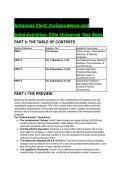
Arkansas Clerk Jurisprudence and
Administration: Elite Universal Test Bank
PART 0: THE TABLE OF CONTENTS
Section Reference Cognitive Tier Analytical Focus Area
PART I The Preview Critical Axioms, Administrative
Directives, & Statutory
Schedules
PART II Tier 1 (Questions 1–10) Foundational Syntax: Statutory
Deadlines, Fee Schedules, &
Court Structures
PART II Tier 2 (Questions 11–20) Complex Application:
Procedural Mandates,
Retention Laws, &
Jurisdictional Limits
PART II Tier 3 (Questions 21–30) Grandmaster Synthesis:
High-Stakes Multi-Variable
Conflicts & Record
Jurisprudence
PART I: THE PREVIEW
Mastering this specific test bank guarantees an elite understanding of Arkansas court and
county clerk jurisprudence, translating directly to impregnable administrative practices and
unassailable statutory compliance. This is the crucible where entry-level clerks evolve into
authoritative administrators of the judicial and legislative systems, capable of synthesizing
abstract rules of civil procedure with the rigid statutory mandates of the Arkansas General
Assembly.
The "Critical Axioms" Cheat Sheet:
● The Jurisdictional Ceilings: Small Claims dockets are capped strictly at $5,000 and
unequivocally bar attorney representation. State District Court civil dockets hold
concurrent jurisdiction with Circuit Courts up to $25,000.
● The Race-Notice Imperative: Arkansas is a "race-notice" state for deeds, but a "pure
race" state for mortgages. A deed must be recorded to be effective against third parties
without notice, and in dual-seat counties, it must be recorded in the exact correct judicial
district to provide constructive notice.
● The Destruction Mandate (ACA § 16-10-211): Financial records (bank reconciliations,
receipts) must be retained for a minimum of 3 years and audited before destruction. Case
files and dockets require a 7-year retention minimum.
● The Legislative Thresholds: Quorum Court ordinances require readings on three
separate days. Suspending this rule, or attaching an emergency clause, requires an
, absolute two-thirds (2/3) majority vote of the entire court.
● The E-Filing Standard: Electronic filing (eFlex) in Circuit Courts is mandatory for
attorneys. The uniform fee to initiate a civil/domestic action is $165 for paper and $185 for
electronic filing, exclusive of the $100 one-time eFlex registration fee.
Arkansas Uniform Filing Fee Matrix (Circuit Court)
Filing Type / Action Paper Filing Fee Electronic (eFlex) Fee Statutory Reference
Initiate Civil/Domestic $165.00 $185.00
Action
Notice of Default $140.00 N/A ACA § 21-6-403(b)(2)
(Mortgagee)
Reopen Cause of $50.00 $50.00 ACA § 21-6-403(b)(3)
Action
Transfer from District $50.00 $50.00 ACA § 21-6-403(b)(4)
Court
PART II: THE ELITE TEST BANK
Tier 1: Foundational Syntax & Application
Q1: A seventeen-year-old male and a seventeen-year-old female present themselves at the
County Clerk's office to apply for a marriage license. Both custodial parents are physically
present, provide proper identification, and offer notarized affidavits consenting to the union.
Based on the principles of Arkansas Marriage Licensure under Title 9, which administrative
action is the MOST ACCURATE? A) Issue the license immediately upon receipt of the $60
uniform fee and the notarized parental consent affidavits. B) Process the application, collect the
$60 uniform fee, and impose a mandatory five-business-day waiting period before issuing the
license. C) Deny the application entirely, as Arkansas law requires all applicants to be at least
eighteen years of age regardless of parental consent. D) Issue the license immediately, but
mandate that the completed license be returned to the clerk within thirty calendar days of the
ceremony.
● The Answer: B (Process the application, collect the $60 uniform fee, and impose a
mandatory five-business-day waiting period before issuing the license.)
● Distractor Analysis:
○ A is incorrect: This distractor preys upon the novice assumption that parental
consent universally overrides statutory cooling-off periods. While parental consent
cures the capacity deficit of a seventeen-year-old, it does not bypass the mandatory
five-business-day waiting period established by Arkansas law to prevent impulsive
juvenile marriages.
○ C is incorrect: Applicants who are seventeen years old may legally marry in
Arkansas, provided they secure the requisite parental consent or court orders if
custody is severed.
○ D is incorrect: There is a non-negotiable five-day waiting period for minors.
Furthermore, all completed licenses must be returned within sixty days of issuance,
not thirty days.
The Mentor's Analysis: Statutory waiting periods exist as an administrative buffer to prevent
impulsive legal bindings among minors. When facing underage applicants, the immediate
, priority is verifying custodial consent and enforcing the statutory delay. By utilizing the
five-business-day holding rule, the clerk bypasses the common trap of unlawfully expediting a
minor's marriage license based on the mere presence of a parent. Professional/Academic
Intuition: Minors wait five days; adults wed today, but all demographics possess exactly
sixty days to return the paperwork.
Q2: An attorney is initiating a new divorce proceeding in an Arkansas Circuit Court. The
attorney wishes to utilize the mandatory eFlex electronic filing system. Based on the principles
of Arkansas Uniform Filing Fees, which fee assessment by the Circuit Clerk is the MOST
ACCURATE? A) A $165 uniform filing fee, plus a $36 annual child support registry fee to be
paid upfront. B) A $150 uniform filing fee, plus a $100 eFlex registration fee assessed for every
new case. C) A $185 electronic filing fee to initiate the cause of action. D) A $165 uniform filing
fee, provided the attorney uses the electronic system rather than the conventional paper
method.
● The Answer: C (A $185 electronic filing fee to initiate the cause of action.)
● Distractor Analysis:
○ A is incorrect: The $165 fee represents the cost for conventional paper filing, not
electronic filing. Additionally, the $36 child support registry fee is billed annually to
the noncustodial parent, not collected as a prerequisite filing fee at case initiation.
○ B is incorrect: The $150 threshold is an outdated statutory base fee often cited in
legacy materials prior to administrative add-ons. Furthermore, the $100 eFlex
registration is a one-time account setup fee for the attorney, not a per-case
transactional charge.
○ D is incorrect: Electronic filing carries a specific $185 fee structure to subsidize
digital infrastructure, while conventional paper filing remains $165.
The Mentor's Analysis: Digital infrastructure costs are transferred to the filer at the initiation of
the judicial action. When intaking a new electronic filing, the immediate priority is assessing the
correct technology-inclusive fee. By utilizing the $185 eFlex initiation standard, the clerk
bypasses the common analytical trap of undercharging based on legacy paper fee structures.
Professional/Academic Intuition: Paper costs the court labor ($165); e-filing costs the
court bandwidth ($185).
Q3: A local entrepreneur wishes to register a sole proprietorship under an assumed name to
open a landscaping business. Based on the principles of Doing Business As (DBA) declarations
in Arkansas, which action is the MOST ACCURATE? A) The entrepreneur must file the DBA
with the Circuit Clerk and pay a $50 indexing and recording fee. B) The entrepreneur must file
the DBA with the Secretary of State exclusively and pay a $25 commercial fee. C) The
entrepreneur must file the DBA Certificate with the County Clerk and pay a $25 statutory filing
fee. D) The entrepreneur must file the DBA with the District Court Clerk and pay a $31 local
filing fee.
● The Answer: C (The entrepreneur must file the DBA Certificate with the County Clerk
and pay a $25 statutory filing fee.)
● Distractor Analysis:
○ A is incorrect: DBA certificates are historically and statutorily handled by the County
Clerk, not the Circuit Clerk, and the base statutory fee is $25, not $50.
○ B is incorrect: While LLCs and Corporations file with the Secretary of State, sole
proprietorship DBAs must be registered at the local county level via the County
Clerk.
○ D is incorrect: District Courts handle judicial matters, traffic fines, and small claims,
not assumed business name registries. The $31 figure represents a combination of
Administration: Elite Universal Test Bank
PART 0: THE TABLE OF CONTENTS
Section Reference Cognitive Tier Analytical Focus Area
PART I The Preview Critical Axioms, Administrative
Directives, & Statutory
Schedules
PART II Tier 1 (Questions 1–10) Foundational Syntax: Statutory
Deadlines, Fee Schedules, &
Court Structures
PART II Tier 2 (Questions 11–20) Complex Application:
Procedural Mandates,
Retention Laws, &
Jurisdictional Limits
PART II Tier 3 (Questions 21–30) Grandmaster Synthesis:
High-Stakes Multi-Variable
Conflicts & Record
Jurisprudence
PART I: THE PREVIEW
Mastering this specific test bank guarantees an elite understanding of Arkansas court and
county clerk jurisprudence, translating directly to impregnable administrative practices and
unassailable statutory compliance. This is the crucible where entry-level clerks evolve into
authoritative administrators of the judicial and legislative systems, capable of synthesizing
abstract rules of civil procedure with the rigid statutory mandates of the Arkansas General
Assembly.
The "Critical Axioms" Cheat Sheet:
● The Jurisdictional Ceilings: Small Claims dockets are capped strictly at $5,000 and
unequivocally bar attorney representation. State District Court civil dockets hold
concurrent jurisdiction with Circuit Courts up to $25,000.
● The Race-Notice Imperative: Arkansas is a "race-notice" state for deeds, but a "pure
race" state for mortgages. A deed must be recorded to be effective against third parties
without notice, and in dual-seat counties, it must be recorded in the exact correct judicial
district to provide constructive notice.
● The Destruction Mandate (ACA § 16-10-211): Financial records (bank reconciliations,
receipts) must be retained for a minimum of 3 years and audited before destruction. Case
files and dockets require a 7-year retention minimum.
● The Legislative Thresholds: Quorum Court ordinances require readings on three
separate days. Suspending this rule, or attaching an emergency clause, requires an
, absolute two-thirds (2/3) majority vote of the entire court.
● The E-Filing Standard: Electronic filing (eFlex) in Circuit Courts is mandatory for
attorneys. The uniform fee to initiate a civil/domestic action is $165 for paper and $185 for
electronic filing, exclusive of the $100 one-time eFlex registration fee.
Arkansas Uniform Filing Fee Matrix (Circuit Court)
Filing Type / Action Paper Filing Fee Electronic (eFlex) Fee Statutory Reference
Initiate Civil/Domestic $165.00 $185.00
Action
Notice of Default $140.00 N/A ACA § 21-6-403(b)(2)
(Mortgagee)
Reopen Cause of $50.00 $50.00 ACA § 21-6-403(b)(3)
Action
Transfer from District $50.00 $50.00 ACA § 21-6-403(b)(4)
Court
PART II: THE ELITE TEST BANK
Tier 1: Foundational Syntax & Application
Q1: A seventeen-year-old male and a seventeen-year-old female present themselves at the
County Clerk's office to apply for a marriage license. Both custodial parents are physically
present, provide proper identification, and offer notarized affidavits consenting to the union.
Based on the principles of Arkansas Marriage Licensure under Title 9, which administrative
action is the MOST ACCURATE? A) Issue the license immediately upon receipt of the $60
uniform fee and the notarized parental consent affidavits. B) Process the application, collect the
$60 uniform fee, and impose a mandatory five-business-day waiting period before issuing the
license. C) Deny the application entirely, as Arkansas law requires all applicants to be at least
eighteen years of age regardless of parental consent. D) Issue the license immediately, but
mandate that the completed license be returned to the clerk within thirty calendar days of the
ceremony.
● The Answer: B (Process the application, collect the $60 uniform fee, and impose a
mandatory five-business-day waiting period before issuing the license.)
● Distractor Analysis:
○ A is incorrect: This distractor preys upon the novice assumption that parental
consent universally overrides statutory cooling-off periods. While parental consent
cures the capacity deficit of a seventeen-year-old, it does not bypass the mandatory
five-business-day waiting period established by Arkansas law to prevent impulsive
juvenile marriages.
○ C is incorrect: Applicants who are seventeen years old may legally marry in
Arkansas, provided they secure the requisite parental consent or court orders if
custody is severed.
○ D is incorrect: There is a non-negotiable five-day waiting period for minors.
Furthermore, all completed licenses must be returned within sixty days of issuance,
not thirty days.
The Mentor's Analysis: Statutory waiting periods exist as an administrative buffer to prevent
impulsive legal bindings among minors. When facing underage applicants, the immediate
, priority is verifying custodial consent and enforcing the statutory delay. By utilizing the
five-business-day holding rule, the clerk bypasses the common trap of unlawfully expediting a
minor's marriage license based on the mere presence of a parent. Professional/Academic
Intuition: Minors wait five days; adults wed today, but all demographics possess exactly
sixty days to return the paperwork.
Q2: An attorney is initiating a new divorce proceeding in an Arkansas Circuit Court. The
attorney wishes to utilize the mandatory eFlex electronic filing system. Based on the principles
of Arkansas Uniform Filing Fees, which fee assessment by the Circuit Clerk is the MOST
ACCURATE? A) A $165 uniform filing fee, plus a $36 annual child support registry fee to be
paid upfront. B) A $150 uniform filing fee, plus a $100 eFlex registration fee assessed for every
new case. C) A $185 electronic filing fee to initiate the cause of action. D) A $165 uniform filing
fee, provided the attorney uses the electronic system rather than the conventional paper
method.
● The Answer: C (A $185 electronic filing fee to initiate the cause of action.)
● Distractor Analysis:
○ A is incorrect: The $165 fee represents the cost for conventional paper filing, not
electronic filing. Additionally, the $36 child support registry fee is billed annually to
the noncustodial parent, not collected as a prerequisite filing fee at case initiation.
○ B is incorrect: The $150 threshold is an outdated statutory base fee often cited in
legacy materials prior to administrative add-ons. Furthermore, the $100 eFlex
registration is a one-time account setup fee for the attorney, not a per-case
transactional charge.
○ D is incorrect: Electronic filing carries a specific $185 fee structure to subsidize
digital infrastructure, while conventional paper filing remains $165.
The Mentor's Analysis: Digital infrastructure costs are transferred to the filer at the initiation of
the judicial action. When intaking a new electronic filing, the immediate priority is assessing the
correct technology-inclusive fee. By utilizing the $185 eFlex initiation standard, the clerk
bypasses the common analytical trap of undercharging based on legacy paper fee structures.
Professional/Academic Intuition: Paper costs the court labor ($165); e-filing costs the
court bandwidth ($185).
Q3: A local entrepreneur wishes to register a sole proprietorship under an assumed name to
open a landscaping business. Based on the principles of Doing Business As (DBA) declarations
in Arkansas, which action is the MOST ACCURATE? A) The entrepreneur must file the DBA
with the Circuit Clerk and pay a $50 indexing and recording fee. B) The entrepreneur must file
the DBA with the Secretary of State exclusively and pay a $25 commercial fee. C) The
entrepreneur must file the DBA Certificate with the County Clerk and pay a $25 statutory filing
fee. D) The entrepreneur must file the DBA with the District Court Clerk and pay a $31 local
filing fee.
● The Answer: C (The entrepreneur must file the DBA Certificate with the County Clerk
and pay a $25 statutory filing fee.)
● Distractor Analysis:
○ A is incorrect: DBA certificates are historically and statutorily handled by the County
Clerk, not the Circuit Clerk, and the base statutory fee is $25, not $50.
○ B is incorrect: While LLCs and Corporations file with the Secretary of State, sole
proprietorship DBAs must be registered at the local county level via the County
Clerk.
○ D is incorrect: District Courts handle judicial matters, traffic fines, and small claims,
not assumed business name registries. The $31 figure represents a combination of


