

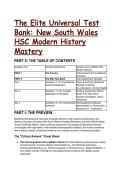
The Elite Universal Test
Bank: New South Wales
HSC Modern History
Mastery
PART 0: THE TABLE OF CONTENTS
Cognitive Tier Content Architecture Syllabus Focus (NESA HSC
Modern History)
PART I The Preview Critical Axioms & Foundational
Directives
PART II The Elite Test Bank Core Assessment Gauntlet
Tier 1 Questions 1–10: Foundational Power & Authority, Bolshevik
Syntax & Application Ideology, Indochina
De-colonisation, US Civil Rights
Tier 2 Questions 11–20: Complex Working Towards the Führer,
Application & Simulation Soviet Five-Year Plans,
Indochina Escalation, SNCC
Grassroots
Tier 3 Questions 21–30: Grandmaster Historiographical Debates
Synthesis (Intentionalist vs. Structuralist,
Revisionist vs. Totalitarian)
PART I: THE PREVIEW
Mastering this exhaustive test bank translates directly to elite cognitive performance and
flawless execution during the New South Wales Education Standards Authority (NESA) Higher
School Certificate Modern History external assessment. By bridging fundamental historical
chronologies with high-stakes, multi-variable historiographical analysis, the scholar transitions
from a passive reader of historical timelines into a forensic architect of historical causality.
The "Critical Axioms" Cheat Sheet
● The Historiographical Pivot (NESA Criterion 7): Elite historical synthesis never merely
recounts events. It actively deploys Structuralist (e.g., Ian Kershaw's polycracy),
Intentionalist/Orthodox (e.g., Robert Conquest), or Revisionist (e.g., Sheila Fitzpatrick, J.
Arch Getty) schools of thought to interrogate primary evidence and validate causal
arguments.
, ● The Power & Authority Paradigm (Core Study 1919-1946): The rise of totalitarianism is
not a monolith of absolute control. Elite analysis recognizes the interplay between
ideological intent and bureaucratic chaos, emphasizing how local agencies engaged in
cumulative radicalisation to fulfill perceived central directives.
● The Top-Down vs. Bottom-Up Dichotomy (Change in the Modern World): In
movements like US Civil Rights (1945–1968), novice narratives fixate exclusively on
charismatic, federal-level leadership (e.g., MLK, LBJ). Grandmaster analysis necessitates
the integration of grassroots mobilization and decentralized democratic leadership (e.g.,
Ella Baker, SNCC) as the primary engine for sustained social change.
● The Chronological Hard-Deck: Explanatory frameworks must remain strictly confined to
the syllabus date parameters (e.g., Russia 1917–1941, Indochina 1954–1979). Retelling
out-of-scope context invalidates the causal sequence and degrades the structural integrity
of the analysis.
PART II: THE ELITE TEST BANK
Tier 1: Foundational Syntax & Application
Q1: In the immediate aftermath of World War I, the creation of the League of Nations was
central to the peace treaties of 1919. Based on the syllabus framework of Power and Authority
in the Modern World 1919–1946, which structural flaw MOST ACCURATELY explains the
League's failure to prevent the rise of militarist dictatorships? A) The League's mandate actively
encouraged aggressive imperial expansion by granting Germany and Japan unrestrained veto
power over international border disputes. B) The League lacked an independent armed force
and relied on the unified diplomatic and economic cooperation of member states, which
fractured under the pressure of the Great Depression and competing nationalisms. C) The
United States utilized its permanent seat on the League Council to aggressively dismantle
European colonial empires, creating a power vacuum that fascists exploited. D) The League's
charter explicitly forbade the use of economic sanctions, leaving verbal condemnation as its
only authorized mechanism for international dispute resolution.
● The Answer: B (The League lacked an independent armed force and relied on the
unified diplomatic and economic cooperation of member states, which fractured under the
pressure of the Great Depression and competing nationalisms.)
● Distractor Analysis:
○ A is incorrect: Germany and Japan were not granted unrestrained veto power; both
eventually withdrew from the League when their imperial ambitions (e.g.,
Manchuria, rearmament) were challenged.
○ C is incorrect: The United States never joined the League of Nations, fundamentally
crippling its authority from inception, returning instead to isolationism.
○ D is incorrect: The League did possess the mechanism of economic sanctions
(Article 16), but member states routinely failed to enforce them effectively (e.g.,
during the Abyssinian Crisis) due to self-interest.
The Mentor's Analysis: Understanding the collapse of collective security requires recognizing
the structural impotence of internationalism when confronted with aggressive nationalism. The
immediate priority is identifying the gap between diplomatic intent and enforcement capability.
By utilizing structural geopolitical analysis, the scholar bypasses the common trap of attributing
the League's failure solely to appeasement policies. Professional/Academic Intuition:
, International diplomatic architecture without autonomous enforcement mechanisms
collapses rapidly under the strain of domestic economic crises and sovereign
self-interest.
Q2: During the Bolshevik consolidation of power in Russia (1917–1924), Vladimir Lenin
introduced the New Economic Policy (NEP) in 1921. Which statement MOST ACCURATELY
characterizes the ideological and practical function of the NEP? A) It was a permanent
abandonment of Marxist theory, transitioning the Soviet Union into a fully deregulated capitalist
democracy to secure Western financial loans. B) It was an emergency decree designed to
rapidly expand forced collectivisation and eliminate the Kulak class through state-sponsored
terror. C) It was a pragmatic, temporary retreat from War Communism that reintroduced limited
private trade and small-scale enterprise to stabilize the collapsing postwar economy, while the
state retained control of the "commanding heights." D) It was a foreign policy initiative designed
to export permanent revolution to industrialised Western European nations through the funding
of foreign communist parties.
● The Answer: C (It was a pragmatic, temporary retreat from War Communism that
reintroduced limited private trade and small-scale enterprise to stabilize the collapsing
postwar economy, while the state retained control of the "commanding heights.")
● Distractor Analysis:
○ A is incorrect: Lenin viewed the NEP as a tactical retreat ("one step back, two steps
forward"), not a permanent abandonment of socialism, maintaining strict political
control over heavy industry and banking.
○ B is incorrect: This describes Joseph Stalin's later policies of forced collectivisation
and dekulakization beginning in 1928, not Lenin's 1921 NEP.
○ D is incorrect: Exporting revolution was the domain of the Comintern; the NEP was
strictly a domestic economic stabilization policy designed to appease a rebellious
peasantry.
The Mentor's Analysis: When analyzing the Bolshevik consolidation, the immediate priority is
distinguishing between ideological purity and pragmatic statecraft. By utilizing Leninist
pragmatic doctrine, the scholar bypasses the novice error of viewing early Soviet economic
policy as an unbroken, linear progression toward absolute communism.
Professional/Academic Intuition: Regime survival supersedes ideological purity; early
dictatorships routinely implement tactical ideological retreats to avert total economic
collapse and prevent mass uprisings.
Q3: The 1954 Geneva Peace Agreement officially concluded the First Indochina War. Based on
the historical context of Conflict in Indochina 1954–1979, which outcome was the MOST
IMMEDIATE geopolitical result of these accords? A) The creation of a unified, communist
Vietnamese state under the exclusive leadership of Ho Chi Minh, officially recognized by the
United States. B) The permanent partition of Vietnam into two distinct sovereign nations, with a
mandate that neither side could ever pursue reunification. C) The temporary division of Vietnam
at the 17th parallel pending nationwide free elections scheduled for 1956, which were ultimately
thwarted by Southern and American resistance. D) The direct, immediate deployment of
500,000 United States combat troops to Saigon to establish a permanent colonial
administration.
● The Answer: C (The temporary division of Vietnam at the 17th parallel pending
nationwide free elections scheduled for 1956, which were ultimately thwarted by Southern
and American resistance.)
● Distractor Analysis:
○ A is incorrect: The United States refused to sign the accords and actively sought to
Bank: New South Wales
HSC Modern History
Mastery
PART 0: THE TABLE OF CONTENTS
Cognitive Tier Content Architecture Syllabus Focus (NESA HSC
Modern History)
PART I The Preview Critical Axioms & Foundational
Directives
PART II The Elite Test Bank Core Assessment Gauntlet
Tier 1 Questions 1–10: Foundational Power & Authority, Bolshevik
Syntax & Application Ideology, Indochina
De-colonisation, US Civil Rights
Tier 2 Questions 11–20: Complex Working Towards the Führer,
Application & Simulation Soviet Five-Year Plans,
Indochina Escalation, SNCC
Grassroots
Tier 3 Questions 21–30: Grandmaster Historiographical Debates
Synthesis (Intentionalist vs. Structuralist,
Revisionist vs. Totalitarian)
PART I: THE PREVIEW
Mastering this exhaustive test bank translates directly to elite cognitive performance and
flawless execution during the New South Wales Education Standards Authority (NESA) Higher
School Certificate Modern History external assessment. By bridging fundamental historical
chronologies with high-stakes, multi-variable historiographical analysis, the scholar transitions
from a passive reader of historical timelines into a forensic architect of historical causality.
The "Critical Axioms" Cheat Sheet
● The Historiographical Pivot (NESA Criterion 7): Elite historical synthesis never merely
recounts events. It actively deploys Structuralist (e.g., Ian Kershaw's polycracy),
Intentionalist/Orthodox (e.g., Robert Conquest), or Revisionist (e.g., Sheila Fitzpatrick, J.
Arch Getty) schools of thought to interrogate primary evidence and validate causal
arguments.
, ● The Power & Authority Paradigm (Core Study 1919-1946): The rise of totalitarianism is
not a monolith of absolute control. Elite analysis recognizes the interplay between
ideological intent and bureaucratic chaos, emphasizing how local agencies engaged in
cumulative radicalisation to fulfill perceived central directives.
● The Top-Down vs. Bottom-Up Dichotomy (Change in the Modern World): In
movements like US Civil Rights (1945–1968), novice narratives fixate exclusively on
charismatic, federal-level leadership (e.g., MLK, LBJ). Grandmaster analysis necessitates
the integration of grassroots mobilization and decentralized democratic leadership (e.g.,
Ella Baker, SNCC) as the primary engine for sustained social change.
● The Chronological Hard-Deck: Explanatory frameworks must remain strictly confined to
the syllabus date parameters (e.g., Russia 1917–1941, Indochina 1954–1979). Retelling
out-of-scope context invalidates the causal sequence and degrades the structural integrity
of the analysis.
PART II: THE ELITE TEST BANK
Tier 1: Foundational Syntax & Application
Q1: In the immediate aftermath of World War I, the creation of the League of Nations was
central to the peace treaties of 1919. Based on the syllabus framework of Power and Authority
in the Modern World 1919–1946, which structural flaw MOST ACCURATELY explains the
League's failure to prevent the rise of militarist dictatorships? A) The League's mandate actively
encouraged aggressive imperial expansion by granting Germany and Japan unrestrained veto
power over international border disputes. B) The League lacked an independent armed force
and relied on the unified diplomatic and economic cooperation of member states, which
fractured under the pressure of the Great Depression and competing nationalisms. C) The
United States utilized its permanent seat on the League Council to aggressively dismantle
European colonial empires, creating a power vacuum that fascists exploited. D) The League's
charter explicitly forbade the use of economic sanctions, leaving verbal condemnation as its
only authorized mechanism for international dispute resolution.
● The Answer: B (The League lacked an independent armed force and relied on the
unified diplomatic and economic cooperation of member states, which fractured under the
pressure of the Great Depression and competing nationalisms.)
● Distractor Analysis:
○ A is incorrect: Germany and Japan were not granted unrestrained veto power; both
eventually withdrew from the League when their imperial ambitions (e.g.,
Manchuria, rearmament) were challenged.
○ C is incorrect: The United States never joined the League of Nations, fundamentally
crippling its authority from inception, returning instead to isolationism.
○ D is incorrect: The League did possess the mechanism of economic sanctions
(Article 16), but member states routinely failed to enforce them effectively (e.g.,
during the Abyssinian Crisis) due to self-interest.
The Mentor's Analysis: Understanding the collapse of collective security requires recognizing
the structural impotence of internationalism when confronted with aggressive nationalism. The
immediate priority is identifying the gap between diplomatic intent and enforcement capability.
By utilizing structural geopolitical analysis, the scholar bypasses the common trap of attributing
the League's failure solely to appeasement policies. Professional/Academic Intuition:
, International diplomatic architecture without autonomous enforcement mechanisms
collapses rapidly under the strain of domestic economic crises and sovereign
self-interest.
Q2: During the Bolshevik consolidation of power in Russia (1917–1924), Vladimir Lenin
introduced the New Economic Policy (NEP) in 1921. Which statement MOST ACCURATELY
characterizes the ideological and practical function of the NEP? A) It was a permanent
abandonment of Marxist theory, transitioning the Soviet Union into a fully deregulated capitalist
democracy to secure Western financial loans. B) It was an emergency decree designed to
rapidly expand forced collectivisation and eliminate the Kulak class through state-sponsored
terror. C) It was a pragmatic, temporary retreat from War Communism that reintroduced limited
private trade and small-scale enterprise to stabilize the collapsing postwar economy, while the
state retained control of the "commanding heights." D) It was a foreign policy initiative designed
to export permanent revolution to industrialised Western European nations through the funding
of foreign communist parties.
● The Answer: C (It was a pragmatic, temporary retreat from War Communism that
reintroduced limited private trade and small-scale enterprise to stabilize the collapsing
postwar economy, while the state retained control of the "commanding heights.")
● Distractor Analysis:
○ A is incorrect: Lenin viewed the NEP as a tactical retreat ("one step back, two steps
forward"), not a permanent abandonment of socialism, maintaining strict political
control over heavy industry and banking.
○ B is incorrect: This describes Joseph Stalin's later policies of forced collectivisation
and dekulakization beginning in 1928, not Lenin's 1921 NEP.
○ D is incorrect: Exporting revolution was the domain of the Comintern; the NEP was
strictly a domestic economic stabilization policy designed to appease a rebellious
peasantry.
The Mentor's Analysis: When analyzing the Bolshevik consolidation, the immediate priority is
distinguishing between ideological purity and pragmatic statecraft. By utilizing Leninist
pragmatic doctrine, the scholar bypasses the novice error of viewing early Soviet economic
policy as an unbroken, linear progression toward absolute communism.
Professional/Academic Intuition: Regime survival supersedes ideological purity; early
dictatorships routinely implement tactical ideological retreats to avert total economic
collapse and prevent mass uprisings.
Q3: The 1954 Geneva Peace Agreement officially concluded the First Indochina War. Based on
the historical context of Conflict in Indochina 1954–1979, which outcome was the MOST
IMMEDIATE geopolitical result of these accords? A) The creation of a unified, communist
Vietnamese state under the exclusive leadership of Ho Chi Minh, officially recognized by the
United States. B) The permanent partition of Vietnam into two distinct sovereign nations, with a
mandate that neither side could ever pursue reunification. C) The temporary division of Vietnam
at the 17th parallel pending nationwide free elections scheduled for 1956, which were ultimately
thwarted by Southern and American resistance. D) The direct, immediate deployment of
500,000 United States combat troops to Saigon to establish a permanent colonial
administration.
● The Answer: C (The temporary division of Vietnam at the 17th parallel pending
nationwide free elections scheduled for 1956, which were ultimately thwarted by Southern
and American resistance.)
● Distractor Analysis:
○ A is incorrect: The United States refused to sign the accords and actively sought to


