

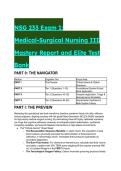
NSG 233 Exam 1:
Medical-Surgical Nursing III
Mastery Report and Elite Test
Bank
PART 0: THE NAVIGATOR
Section Cognitive Tier Focus Area
PART I The Preview Critical Axioms & Global
Directives
PART II Tier 1 (Questions 1–15) Foundational Syntax & Hard
Deck Application
PART II Tier 2 (Questions 16–35) Complex Application, Triage &
Hemodynamic Simulation
PART II Tier 3 (Questions 36–60) Grandmaster Synthesis &
Multi-System Failure
PART I: THE PREVIEW
Mastering this specialized test bank transforms baseline academic theory into elite, reflexive
clinical judgment, aligning precisely with the global Next-Generation NCLEX (NGN) standards
for high-acuity medical-surgical nursing. By internalizing these 60 highly calibrated scenarios,
you forge the cognitive pathways necessary to anticipate patient deterioration, synthesize
competing variables, and execute flawless interventions in high-stakes environments.
● The "Critical Axioms" Cheat Sheet:
○ The Resuscitation Sequence Mandate: In septic shock, the acquisition of dual
blood cultures universally precedes the administration of broad-spectrum
antibiotics; in hemorrhagic shock, immediate direct pressure supersedes all
secondary diagnostics.
○ The Burn Fluid Axiom: For chemical or thermal burns, calculate total fluid volume
accurately; a patient with 20% TBSA burns weighing 98 lbs requires precisely 890
mL of Lactated Ringer's in the FIRST 8 hours.
○ The Toxicological Oxygen Fallacy: Carbon monoxide poisoning produces falsely
, normal pulse oximetry (SpO2) readings due to the device's inability to differentiate
carboxyhemoglobin from oxyhemoglobin; rely exclusively on clinical presentation.
○ The Hypothermic Myocardium Rule: Profound accidental hypothermia induces
ventricular fibrillation that is highly refractory to standard electrical therapy; the
myocardium must be actively rewarmed to a core temperature exceeding 32.2°C
(90°F) before defibrillation attempts can achieve sustainable return of spontaneous
circulation.
○ The Ventilator High-Pressure Directive: When a mechanical ventilator indicates
progressively higher pressure alongside oxygen desaturation in a securely placed
endotracheal tube, immediately suspect secretion occlusion and execute targeted
airway suctioning.
PART II: THE ELITE TEST BANK
Tier 1: Foundational Syntax & Application
Q1: A triage nurse in the Emergency Department is sorting incoming patients using the
Emergency Severity Index (ESI) tool. The triage nurse's core responsibility is to assess,
reassess, and initiate treatment based on acuity. A patient presents with acute, crushing
substernal chest pain, diaphoresis, and left arm radiation. Based on ESI protocols, which
classification is the MOST APPROPRIATE? A) ESI Level 1 B) ESI Level 2 C) ESI Level 3 D)
ESI Level 4
● The Answer: B (ESI Level 2)
● Distractor Analysis:
○ A is incorrect: Level 1 requires the patient to be in active cardiac or respiratory
arrest requiring immediate, life-saving intervention.
○ C is incorrect: Level 3 implies the patient needs multiple resources but is
hemodynamically stable and can wait for treatment.
○ D is incorrect: Level 4 requires only one resource and implies a non-urgent
condition.
The Mentor's Analysis: High-risk situations, severe pain, or altered mental status automatically
trigger an ESI Level 2 designation. The patient is not dead or dying right this second (Level 1),
but waiting is clinically unacceptable because the myocardium is actively ischemic.
Professional/Academic Intuition: Chest pain with ischemic features is an automatic ESI
Level 2; do not wait for collapse to upgrade acuity.
Q2: A patient is admitted to the medical-surgical unit with suspected septic shock. The
physician orders a 30 mL/kg isotonic fluid bolus, blood cultures, intravenous vancomycin, and a
serum lactate level. According to evidence-based sepsis protocols, which action must the nurse
execute FIRST? A) Administer the 30 mL/kg fluid bolus B) Draw the serum lactate level C)
Obtain two sets of blood cultures D) Administer the intravenous vancomycin
● The Answer: C (Obtain two sets of blood cultures)
● Distractor Analysis:
○ A is incorrect: While fluid resuscitation is critical for hemodynamics, securing the
pathogenic source must occur before any pharmacological intervention that could
mask it.
○ B is incorrect: Lactate is a critical marker of tissue perfusion, but identifying the
pathogen dictates the definitive cure.
, ○ D is incorrect: Administering vancomycin before cultures will sterilize the sample,
rendering targeted antibiotic therapy impossible.
The Mentor's Analysis: Empirical antibiotics save lives, but blinding the infectious disease
team by administering them prior to cultures leads to systemic failure later. Blood cultures must
be drawn from two different sites to rule out skin contamination. Professional/Academic
Intuition: Cultures precede antibiotics without exception; preserve the diagnostic
integrity of the blood.
Q3: A patient involved in a high-speed motor vehicle collision is brought to the trauma bay. The
patient's heart rate is 115 bpm, respiratory rate is 24 breaths/min, and urine output has dropped
to 15 mL/hr. The patient is restless and confused but maintains a normal blood pressure. Which
stage of shock is MOST ACCURATE? A) Initial Stage B) Compensatory Stage C) Progressive
Stage D) Refractory Stage
● The Answer: B (Compensatory Stage)
● Distractor Analysis:
○ A is incorrect: The Initial Stage presents with cellular-level anaerobic metabolism
without obvious clinical manifestations.
○ C is incorrect: The Progressive Stage involves a failure of compensatory
mechanisms, resulting in profound hypotension and altered sensorium.
○ D is incorrect: The Refractory Stage is characterized by irreversible cellular death
and multi-organ dysfunction syndrome (MODS).
The Mentor's Analysis: Tachycardia, tachypnea, and oliguria in the presence of a normal blood
pressure are the hallmark physiological shifts of the body attempting to maintain central
perfusion. The drop in urine output is the kidneys retaining fluid to support the blood pressure.
Professional/Academic Intuition: Restlessness and oliguria with a normal MAP equal the
Compensatory Stage; the body is fighting back.
Q4: A patient who survived a residential fire presents with a completely normal SpO2 of 99% on
room air but exhibits profound confusion and a headache. Based on the pathophysiology of
carbon monoxide (CO) poisoning, which conclusion is the MOST ACCURATE? A) The patient is
adequately oxygenated; the confusion is likely from psychological trauma. B) The SpO2 is
falsely elevated because standard pulse oximetry cannot distinguish carboxyhemoglobin from
oxyhemoglobin. C) The patient requires immediate intubation due to impending alveolar
collapse. D) The SpO2 reading indicates the need for bronchodilators to clear smoke inhalation.
● The Answer: B (The SpO2 is falsely elevated because standard pulse oximetry cannot
distinguish carboxyhemoglobin from oxyhemoglobin.)
● Distractor Analysis:
○ A is incorrect: Dismissing altered mental status as psychological trauma in a fire
survivor is a lethal diagnostic error.
○ C is incorrect: Intubation is based on airway patency and ventilatory failure, not
solely on a CO exposure with a normal SpO2.
○ D is incorrect: Bronchodilators treat bronchospasm, not the hemoglobin-binding
affinity of carbon monoxide.
The Mentor's Analysis: Carbon monoxide has an affinity for hemoglobin 200 times greater
than oxygen. Standard pulse oximetry only reads the percentage of saturated hemoglobin,
blinding the clinician to the reality of cellular asphyxiation. The reading will look completely
normal. Professional/Academic Intuition: Never trust a normal pulse oximetry reading in a
carbon monoxide exposure.
Q5: An emergency nurse is managing a patient who has experienced a severe sexual assault.
The protocol requires administering prophylaxis for multiple sexually transmitted infections and
Medical-Surgical Nursing III
Mastery Report and Elite Test
Bank
PART 0: THE NAVIGATOR
Section Cognitive Tier Focus Area
PART I The Preview Critical Axioms & Global
Directives
PART II Tier 1 (Questions 1–15) Foundational Syntax & Hard
Deck Application
PART II Tier 2 (Questions 16–35) Complex Application, Triage &
Hemodynamic Simulation
PART II Tier 3 (Questions 36–60) Grandmaster Synthesis &
Multi-System Failure
PART I: THE PREVIEW
Mastering this specialized test bank transforms baseline academic theory into elite, reflexive
clinical judgment, aligning precisely with the global Next-Generation NCLEX (NGN) standards
for high-acuity medical-surgical nursing. By internalizing these 60 highly calibrated scenarios,
you forge the cognitive pathways necessary to anticipate patient deterioration, synthesize
competing variables, and execute flawless interventions in high-stakes environments.
● The "Critical Axioms" Cheat Sheet:
○ The Resuscitation Sequence Mandate: In septic shock, the acquisition of dual
blood cultures universally precedes the administration of broad-spectrum
antibiotics; in hemorrhagic shock, immediate direct pressure supersedes all
secondary diagnostics.
○ The Burn Fluid Axiom: For chemical or thermal burns, calculate total fluid volume
accurately; a patient with 20% TBSA burns weighing 98 lbs requires precisely 890
mL of Lactated Ringer's in the FIRST 8 hours.
○ The Toxicological Oxygen Fallacy: Carbon monoxide poisoning produces falsely
, normal pulse oximetry (SpO2) readings due to the device's inability to differentiate
carboxyhemoglobin from oxyhemoglobin; rely exclusively on clinical presentation.
○ The Hypothermic Myocardium Rule: Profound accidental hypothermia induces
ventricular fibrillation that is highly refractory to standard electrical therapy; the
myocardium must be actively rewarmed to a core temperature exceeding 32.2°C
(90°F) before defibrillation attempts can achieve sustainable return of spontaneous
circulation.
○ The Ventilator High-Pressure Directive: When a mechanical ventilator indicates
progressively higher pressure alongside oxygen desaturation in a securely placed
endotracheal tube, immediately suspect secretion occlusion and execute targeted
airway suctioning.
PART II: THE ELITE TEST BANK
Tier 1: Foundational Syntax & Application
Q1: A triage nurse in the Emergency Department is sorting incoming patients using the
Emergency Severity Index (ESI) tool. The triage nurse's core responsibility is to assess,
reassess, and initiate treatment based on acuity. A patient presents with acute, crushing
substernal chest pain, diaphoresis, and left arm radiation. Based on ESI protocols, which
classification is the MOST APPROPRIATE? A) ESI Level 1 B) ESI Level 2 C) ESI Level 3 D)
ESI Level 4
● The Answer: B (ESI Level 2)
● Distractor Analysis:
○ A is incorrect: Level 1 requires the patient to be in active cardiac or respiratory
arrest requiring immediate, life-saving intervention.
○ C is incorrect: Level 3 implies the patient needs multiple resources but is
hemodynamically stable and can wait for treatment.
○ D is incorrect: Level 4 requires only one resource and implies a non-urgent
condition.
The Mentor's Analysis: High-risk situations, severe pain, or altered mental status automatically
trigger an ESI Level 2 designation. The patient is not dead or dying right this second (Level 1),
but waiting is clinically unacceptable because the myocardium is actively ischemic.
Professional/Academic Intuition: Chest pain with ischemic features is an automatic ESI
Level 2; do not wait for collapse to upgrade acuity.
Q2: A patient is admitted to the medical-surgical unit with suspected septic shock. The
physician orders a 30 mL/kg isotonic fluid bolus, blood cultures, intravenous vancomycin, and a
serum lactate level. According to evidence-based sepsis protocols, which action must the nurse
execute FIRST? A) Administer the 30 mL/kg fluid bolus B) Draw the serum lactate level C)
Obtain two sets of blood cultures D) Administer the intravenous vancomycin
● The Answer: C (Obtain two sets of blood cultures)
● Distractor Analysis:
○ A is incorrect: While fluid resuscitation is critical for hemodynamics, securing the
pathogenic source must occur before any pharmacological intervention that could
mask it.
○ B is incorrect: Lactate is a critical marker of tissue perfusion, but identifying the
pathogen dictates the definitive cure.
, ○ D is incorrect: Administering vancomycin before cultures will sterilize the sample,
rendering targeted antibiotic therapy impossible.
The Mentor's Analysis: Empirical antibiotics save lives, but blinding the infectious disease
team by administering them prior to cultures leads to systemic failure later. Blood cultures must
be drawn from two different sites to rule out skin contamination. Professional/Academic
Intuition: Cultures precede antibiotics without exception; preserve the diagnostic
integrity of the blood.
Q3: A patient involved in a high-speed motor vehicle collision is brought to the trauma bay. The
patient's heart rate is 115 bpm, respiratory rate is 24 breaths/min, and urine output has dropped
to 15 mL/hr. The patient is restless and confused but maintains a normal blood pressure. Which
stage of shock is MOST ACCURATE? A) Initial Stage B) Compensatory Stage C) Progressive
Stage D) Refractory Stage
● The Answer: B (Compensatory Stage)
● Distractor Analysis:
○ A is incorrect: The Initial Stage presents with cellular-level anaerobic metabolism
without obvious clinical manifestations.
○ C is incorrect: The Progressive Stage involves a failure of compensatory
mechanisms, resulting in profound hypotension and altered sensorium.
○ D is incorrect: The Refractory Stage is characterized by irreversible cellular death
and multi-organ dysfunction syndrome (MODS).
The Mentor's Analysis: Tachycardia, tachypnea, and oliguria in the presence of a normal blood
pressure are the hallmark physiological shifts of the body attempting to maintain central
perfusion. The drop in urine output is the kidneys retaining fluid to support the blood pressure.
Professional/Academic Intuition: Restlessness and oliguria with a normal MAP equal the
Compensatory Stage; the body is fighting back.
Q4: A patient who survived a residential fire presents with a completely normal SpO2 of 99% on
room air but exhibits profound confusion and a headache. Based on the pathophysiology of
carbon monoxide (CO) poisoning, which conclusion is the MOST ACCURATE? A) The patient is
adequately oxygenated; the confusion is likely from psychological trauma. B) The SpO2 is
falsely elevated because standard pulse oximetry cannot distinguish carboxyhemoglobin from
oxyhemoglobin. C) The patient requires immediate intubation due to impending alveolar
collapse. D) The SpO2 reading indicates the need for bronchodilators to clear smoke inhalation.
● The Answer: B (The SpO2 is falsely elevated because standard pulse oximetry cannot
distinguish carboxyhemoglobin from oxyhemoglobin.)
● Distractor Analysis:
○ A is incorrect: Dismissing altered mental status as psychological trauma in a fire
survivor is a lethal diagnostic error.
○ C is incorrect: Intubation is based on airway patency and ventilatory failure, not
solely on a CO exposure with a normal SpO2.
○ D is incorrect: Bronchodilators treat bronchospasm, not the hemoglobin-binding
affinity of carbon monoxide.
The Mentor's Analysis: Carbon monoxide has an affinity for hemoglobin 200 times greater
than oxygen. Standard pulse oximetry only reads the percentage of saturated hemoglobin,
blinding the clinician to the reality of cellular asphyxiation. The reading will look completely
normal. Professional/Academic Intuition: Never trust a normal pulse oximetry reading in a
carbon monoxide exposure.
Q5: An emergency nurse is managing a patient who has experienced a severe sexual assault.
The protocol requires administering prophylaxis for multiple sexually transmitted infections and


