
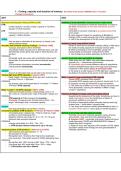
1 - Coding, capacity and duration of memory Be mindful of the question DEMAND (Aims / Procedure
/ Findings/ Conclusions)
AO1 AO3
Short term and long term memory (STM vs LTM) Baddeley’s study identified 2 memory stores / high control
STM: - Controlled procedures to isolate the mechanism of coding in
- Limited capacity / acoustic coding / capacity of 7±2 items, the STM, manipulation of word lists with specific acoustic
duration of 18-20 seconds / properties
LTM: - Controlled for semantic meaning to accurately pinpoint the
- Permanent memory store / semantic coding / unlimited errors made
capacity / lifetime duration - E: Later research showed no exceptions to Baddeley’s
findings (STM is mostly acoustic and LTM is mostly semantic)
Coding - L: Led to the development of the MS model (HIGH INT V)
- How we take in information & the format it is stored in the
various memory stores. Baddeley’s study used artificial stimuli
Acoustic and semantic memory (Coding)→ Baddeley (1966) - Words to recall had no semantic meaning, telling us little about
- 4 groups, each given a list to remember. the reality of coding capacity for everyday memory tasks
- Acoustically similar (cat,cap,can) or dissimilar (lorry, cow, pit). - E: When processing is more meaningful, people will
- Semantically similar (great, big, large) or dissimilar (tiny, car, predominantly use semantic coding even for STM
window) - L: The findings have limited application (LOW EXT V)
FINDINGS:
- Immediate recall was worse with acoustically similar words. Jacobs’ study has high replicability & reliability
- Recall after 20 mins was worse with semantically similar - Older study from the 1880s, may have lacked adequate
words. controls (cv’s → distractions, environment)
- STM processes information (encodes) acoustically. - E: Repeatedly tested across different cultures & populations
- LTM processes semantically. overtime (straightforward nature of the digit span technique)
- Confirmed in later studies (Boop & Verhaegan 2005)
Capacity - L: His study is a valid measure of STM digit span, replicable (a
- Amount of information that can be held in the memory store. key feature of science) & has proven to be highly reliable.
Testing digit span (STM capacity)→ Jacobs (1887)
- Read 4 digits / increase span till the ppt can’t recall the order Miller’s research may overestimate STM capacity
correctly. Final no. = digit span - Cowan (2001) reviewed other research
FINDINGS - Concluded STM capacity was only about 4 chunks (not 7 ± 2)
- On average, ppts could repeat back 9.3 numbers / 7.3 letters - E: Capacity can also be influenced by age and practice.
- STM has a finite capacity - L: The lower end of Miller’s estimate (5 items) may have been
more appropriate, reducing the reliability of Miller’s magic
Magic number 7 ±2 (STM capacity)→ Miller (1956) number 7 hypothesis.
- Observed everyday practice, noticing things come in 7’s
- EG: notes of a musical scale / days of the week / deadly sins Peterson & Peterson’s study used meaningless stimuli
FINDINGS - Questioning the relevance of the study. Sometimes we have to
- STM capacity is 7 ±2, increased by chunking recall meaningless stimuli but recalling as a trigram of
- Chunking: Grouping small, discrete pieces of info / into consonant syllables is not common
larger / meaningful units = increases capacity - E: It fails to meaningfully reflect everyday memory tasks (eg;
random facts / times tables / shopping lists)
Duration - L: The study lacks external validity, generalisability & has low
- How long information can be held in memory mundane realism (eco v) - fail to apply to real-life situations.
Consonant syllables (STM duration) → Peterson & Peterson (1959)
- 24 students given a trigram (eg - YCG) to recall & a 3 digit Bahrick et al’s study had high external validity
number to count backwards from. - Everyday meaningful memories (people’s names & faces)
- Retention interval was varied ( / / secs) were studied - they were from their graduating class
- Distractor task prevents rehearsal - E: Shepard (1967) - conducted a lab study, finding that found
FINDINGS recall rates were LOWER with MEANINGLESS images of
- Average recall (after 3s = 80% / 18s = 3%) people they didn’t recognise
- C: STM duration without rehearsal is up to 18 secs. - L: Reflect a more ‘real’ estimate of the duration of LTM, higher
population validity & the findings are more generalisable to
Yearbook photos (LTM duration) → Bahrick et al (1975) everyday experiences.
- 392 American ppts aged between 17 - 74
- Recall tested in 2 ways…
- Recognition test - 50 photos from high school yearbooks
- Free recall test - Ppts listed names of THEIR graduating class
FINDINGS
- Recognition test: 90% accuracy after 15yrs / 70% = 48yrs
- Free recall test: 60% recall after 15yrs / 30% = 48yrs
- C: LTM duration can last a lifetime
, 2 - The multi-store model of memory (MSM) Outline model structure + key processes
AO1 AO3
The Multi-Store Model of Memory Research support showing STM & LTM are different
- Atkinson & Shiffrin (1968) - Baddeley (1966) found we tend to mix up acoustically similar
- Describes how information flows through a memory system words when using our STMs - proving coding is acoustic.
- Memory = 3 stores, linked by processing. - E: We mix up semantically similar words when using our LTMs
- coding is semantic
1 - STORE: Sensory register (SR) - L: Supports the MSMs view that these 2 memory stores are
- All stimuli from the environment separate and independent.
- Raw sensory impressions
- 5 stores (one for each sense) Research support from any of the spread above
- Coding = modality-specific (iconic / echoic / etc) - Bahrick et al (1975) or Jacobs (1859)
- Duration = very brief, a fraction of a second
- Capacity = very high Real w practical application in education and memory
2 - Attention - MSM has influenced revision / memory strategies, studies can
- SR → STM transfer use maintenance rehearsal or elaborative rehearsal to
- If we pay attention to information, it transfers from the SR → strengthen LTM storage.
STM - E: Techniques like spaced repetition or active recall, keeping
3 - STORE: Short-term memory (STM) info active & rehearsed to be encoded into LTM
- Coding = acoustic - L: MSM is valuable both theoretically and practically, useful in
- Duration = 18-30s unless information is rehearsed schools and clinical settings - greater credibility.
- Capacity = 7±2 chunks before some forgetting occurs - (Belleville et al 2006 - intervention)
4 - Maintenance rehearsal
- Rehearsal of material, we can keep information in STM as Evidence suggesting there is more than 1 STM store
long as we rehearse it - Shallice & Warrington (1970) did a case study on KF
- Extensive rehearsal → LTM - KF = amnesia after a motorcycle accident
5 - STORE: Long-term memory (LTM) - E: STM recall for digits = severely impaired (verbal/auditory
- A permanent memory store info)
- Coding = mostly semantic - STM = largely unaffected for visual information when he read
- Duration = potentially up to a lifetime the digits.
- Capacity = theoretically unlimited - Other studies also confirm there may be separate STM stores
6 - Retrieval from LTM for non-verbal sounds (noises / visual information )
- To recall information in the LTM, it has to be retrieved - L: STM is not a unitary store, it is overly simplistic to claim that
(transferred back into the STM) there is just 1 store processing different types of information.
Decay STM may not exclusively code acoustically…WMM
- Information lost via displacement (new info enters) or decay
(lost over time) Prolonged rehearsal is not needed for STM-LTM transfer
- Memories can be forgotten (decay) if they are not recalled - Craik & Watkins (1973) argued there are 2 types of rehearsal.
after a long period of time - Maintenance: amount of rehearsal (MSM)
- The forgetting curve - E: ALSO elaborative rehearsal: linking information to your
existing knowledge or think about its semantic meaning,
building on your schema
- C & W argue this is needed for long-term storage.
- L: The MSM doesn’t fully explain how LT storage is achieved,
& elaborative rehearsal may be more effective.
/ Findings/ Conclusions)
AO1 AO3
Short term and long term memory (STM vs LTM) Baddeley’s study identified 2 memory stores / high control
STM: - Controlled procedures to isolate the mechanism of coding in
- Limited capacity / acoustic coding / capacity of 7±2 items, the STM, manipulation of word lists with specific acoustic
duration of 18-20 seconds / properties
LTM: - Controlled for semantic meaning to accurately pinpoint the
- Permanent memory store / semantic coding / unlimited errors made
capacity / lifetime duration - E: Later research showed no exceptions to Baddeley’s
findings (STM is mostly acoustic and LTM is mostly semantic)
Coding - L: Led to the development of the MS model (HIGH INT V)
- How we take in information & the format it is stored in the
various memory stores. Baddeley’s study used artificial stimuli
Acoustic and semantic memory (Coding)→ Baddeley (1966) - Words to recall had no semantic meaning, telling us little about
- 4 groups, each given a list to remember. the reality of coding capacity for everyday memory tasks
- Acoustically similar (cat,cap,can) or dissimilar (lorry, cow, pit). - E: When processing is more meaningful, people will
- Semantically similar (great, big, large) or dissimilar (tiny, car, predominantly use semantic coding even for STM
window) - L: The findings have limited application (LOW EXT V)
FINDINGS:
- Immediate recall was worse with acoustically similar words. Jacobs’ study has high replicability & reliability
- Recall after 20 mins was worse with semantically similar - Older study from the 1880s, may have lacked adequate
words. controls (cv’s → distractions, environment)
- STM processes information (encodes) acoustically. - E: Repeatedly tested across different cultures & populations
- LTM processes semantically. overtime (straightforward nature of the digit span technique)
- Confirmed in later studies (Boop & Verhaegan 2005)
Capacity - L: His study is a valid measure of STM digit span, replicable (a
- Amount of information that can be held in the memory store. key feature of science) & has proven to be highly reliable.
Testing digit span (STM capacity)→ Jacobs (1887)
- Read 4 digits / increase span till the ppt can’t recall the order Miller’s research may overestimate STM capacity
correctly. Final no. = digit span - Cowan (2001) reviewed other research
FINDINGS - Concluded STM capacity was only about 4 chunks (not 7 ± 2)
- On average, ppts could repeat back 9.3 numbers / 7.3 letters - E: Capacity can also be influenced by age and practice.
- STM has a finite capacity - L: The lower end of Miller’s estimate (5 items) may have been
more appropriate, reducing the reliability of Miller’s magic
Magic number 7 ±2 (STM capacity)→ Miller (1956) number 7 hypothesis.
- Observed everyday practice, noticing things come in 7’s
- EG: notes of a musical scale / days of the week / deadly sins Peterson & Peterson’s study used meaningless stimuli
FINDINGS - Questioning the relevance of the study. Sometimes we have to
- STM capacity is 7 ±2, increased by chunking recall meaningless stimuli but recalling as a trigram of
- Chunking: Grouping small, discrete pieces of info / into consonant syllables is not common
larger / meaningful units = increases capacity - E: It fails to meaningfully reflect everyday memory tasks (eg;
random facts / times tables / shopping lists)
Duration - L: The study lacks external validity, generalisability & has low
- How long information can be held in memory mundane realism (eco v) - fail to apply to real-life situations.
Consonant syllables (STM duration) → Peterson & Peterson (1959)
- 24 students given a trigram (eg - YCG) to recall & a 3 digit Bahrick et al’s study had high external validity
number to count backwards from. - Everyday meaningful memories (people’s names & faces)
- Retention interval was varied ( / / secs) were studied - they were from their graduating class
- Distractor task prevents rehearsal - E: Shepard (1967) - conducted a lab study, finding that found
FINDINGS recall rates were LOWER with MEANINGLESS images of
- Average recall (after 3s = 80% / 18s = 3%) people they didn’t recognise
- C: STM duration without rehearsal is up to 18 secs. - L: Reflect a more ‘real’ estimate of the duration of LTM, higher
population validity & the findings are more generalisable to
Yearbook photos (LTM duration) → Bahrick et al (1975) everyday experiences.
- 392 American ppts aged between 17 - 74
- Recall tested in 2 ways…
- Recognition test - 50 photos from high school yearbooks
- Free recall test - Ppts listed names of THEIR graduating class
FINDINGS
- Recognition test: 90% accuracy after 15yrs / 70% = 48yrs
- Free recall test: 60% recall after 15yrs / 30% = 48yrs
- C: LTM duration can last a lifetime
, 2 - The multi-store model of memory (MSM) Outline model structure + key processes
AO1 AO3
The Multi-Store Model of Memory Research support showing STM & LTM are different
- Atkinson & Shiffrin (1968) - Baddeley (1966) found we tend to mix up acoustically similar
- Describes how information flows through a memory system words when using our STMs - proving coding is acoustic.
- Memory = 3 stores, linked by processing. - E: We mix up semantically similar words when using our LTMs
- coding is semantic
1 - STORE: Sensory register (SR) - L: Supports the MSMs view that these 2 memory stores are
- All stimuli from the environment separate and independent.
- Raw sensory impressions
- 5 stores (one for each sense) Research support from any of the spread above
- Coding = modality-specific (iconic / echoic / etc) - Bahrick et al (1975) or Jacobs (1859)
- Duration = very brief, a fraction of a second
- Capacity = very high Real w practical application in education and memory
2 - Attention - MSM has influenced revision / memory strategies, studies can
- SR → STM transfer use maintenance rehearsal or elaborative rehearsal to
- If we pay attention to information, it transfers from the SR → strengthen LTM storage.
STM - E: Techniques like spaced repetition or active recall, keeping
3 - STORE: Short-term memory (STM) info active & rehearsed to be encoded into LTM
- Coding = acoustic - L: MSM is valuable both theoretically and practically, useful in
- Duration = 18-30s unless information is rehearsed schools and clinical settings - greater credibility.
- Capacity = 7±2 chunks before some forgetting occurs - (Belleville et al 2006 - intervention)
4 - Maintenance rehearsal
- Rehearsal of material, we can keep information in STM as Evidence suggesting there is more than 1 STM store
long as we rehearse it - Shallice & Warrington (1970) did a case study on KF
- Extensive rehearsal → LTM - KF = amnesia after a motorcycle accident
5 - STORE: Long-term memory (LTM) - E: STM recall for digits = severely impaired (verbal/auditory
- A permanent memory store info)
- Coding = mostly semantic - STM = largely unaffected for visual information when he read
- Duration = potentially up to a lifetime the digits.
- Capacity = theoretically unlimited - Other studies also confirm there may be separate STM stores
6 - Retrieval from LTM for non-verbal sounds (noises / visual information )
- To recall information in the LTM, it has to be retrieved - L: STM is not a unitary store, it is overly simplistic to claim that
(transferred back into the STM) there is just 1 store processing different types of information.
Decay STM may not exclusively code acoustically…WMM
- Information lost via displacement (new info enters) or decay
(lost over time) Prolonged rehearsal is not needed for STM-LTM transfer
- Memories can be forgotten (decay) if they are not recalled - Craik & Watkins (1973) argued there are 2 types of rehearsal.
after a long period of time - Maintenance: amount of rehearsal (MSM)
- The forgetting curve - E: ALSO elaborative rehearsal: linking information to your
existing knowledge or think about its semantic meaning,
building on your schema
- C & W argue this is needed for long-term storage.
- L: The MSM doesn’t fully explain how LT storage is achieved,
& elaborative rehearsal may be more effective.


