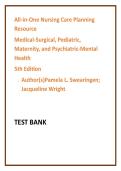
All-in-One Nursing Care Planning
Resource
Medical-Surgical, Pediatric,
Maternity, and Psychiatric-Mental
Health
5th Edition
• Author(s)Pamela L. Swearingen;
Jacqueline Wright
TEST BANK
,Question Bank: Cancer Care and Older Adult Care
1) MCQ — Cancer Care (Chemotherapy extravasation)
Clinical Scenario:
A 62-year-old patient receiving peripheral IV doxorubicin
reports burning pain at the IV site. The nurse notes swelling and
redness around the catheter.
Question Stem:
What is the nurse’s priority action?
Answer Options:
A. Increase the infusion rate to finish the dose quickly
B. Stop the infusion and remove the IV catheter immediately
C. Stop the infusion, leave the catheter in place, and aspirate as
directed by protocol
D. Apply a warm compress and continue to monitor the site
Correct Answer:
C
Detailed Rationale:
Doxorubicin is a vesicant. The priority is to stop the infusion
immediately and leave the catheter in place so the nurse can
aspirate residual drug and follow the extravasation protocol.
This reduces tissue injury and supports patient safety.
Incorrect Option Analysis:
, • A: Incorrect; increases tissue exposure and injury. Common
misconception: “finish the dose first.”
• B: Incorrect; removing the catheter too soon may prevent
aspiration of the vesicant.
• D: Incorrect; warm compresses may be inappropriate
depending on the drug and protocol, and the infusion
must be stopped first.
Nursing Process Linkage:
Implementation
Clinical Judgment Competencies:
Recognize Cues, Analyze Cues, Take Action
Difficulty Level:
Difficult
Bloom’s Cognitive Level:
Apply
NCLEX Client Needs Category:
Pharmacological and Parenteral Therapies
Nursing Diagnosis Integration:
Priority Nursing Diagnosis: Risk for tissue injury
Risk Factors: Vesicant infusion, peripheral IV access,
infiltration/extravasation signs
, Expected Outcome:
The infusion is stopped promptly and tissue injury is minimized.
Key Learning Objective:
Identify and respond safely to chemotherapy extravasation.
2) SATA — Cancer Care (Immunotherapy adverse effects)
Clinical Scenario:
A 54-year-old patient receiving pembrolizumab calls the clinic
reporting new symptoms after the second infusion.
Question Stem:
Which findings require the nurse to report immediately? Select
all that apply.
Answer Options:
A. New cough and shortness of breath
B. Watery diarrhea 6 times in 24 hours
C. Mild fatigue that improves with rest
D. Dark urine and yellowing of the eyes
E. Localized itching at the injection site only
Correct Answers:
A, B, D
Detailed Rationale:
Immune checkpoint inhibitors can cause immune-related
adverse events affecting the lungs, GI tract, and liver. New
Resource
Medical-Surgical, Pediatric,
Maternity, and Psychiatric-Mental
Health
5th Edition
• Author(s)Pamela L. Swearingen;
Jacqueline Wright
TEST BANK
,Question Bank: Cancer Care and Older Adult Care
1) MCQ — Cancer Care (Chemotherapy extravasation)
Clinical Scenario:
A 62-year-old patient receiving peripheral IV doxorubicin
reports burning pain at the IV site. The nurse notes swelling and
redness around the catheter.
Question Stem:
What is the nurse’s priority action?
Answer Options:
A. Increase the infusion rate to finish the dose quickly
B. Stop the infusion and remove the IV catheter immediately
C. Stop the infusion, leave the catheter in place, and aspirate as
directed by protocol
D. Apply a warm compress and continue to monitor the site
Correct Answer:
C
Detailed Rationale:
Doxorubicin is a vesicant. The priority is to stop the infusion
immediately and leave the catheter in place so the nurse can
aspirate residual drug and follow the extravasation protocol.
This reduces tissue injury and supports patient safety.
Incorrect Option Analysis:
, • A: Incorrect; increases tissue exposure and injury. Common
misconception: “finish the dose first.”
• B: Incorrect; removing the catheter too soon may prevent
aspiration of the vesicant.
• D: Incorrect; warm compresses may be inappropriate
depending on the drug and protocol, and the infusion
must be stopped first.
Nursing Process Linkage:
Implementation
Clinical Judgment Competencies:
Recognize Cues, Analyze Cues, Take Action
Difficulty Level:
Difficult
Bloom’s Cognitive Level:
Apply
NCLEX Client Needs Category:
Pharmacological and Parenteral Therapies
Nursing Diagnosis Integration:
Priority Nursing Diagnosis: Risk for tissue injury
Risk Factors: Vesicant infusion, peripheral IV access,
infiltration/extravasation signs
, Expected Outcome:
The infusion is stopped promptly and tissue injury is minimized.
Key Learning Objective:
Identify and respond safely to chemotherapy extravasation.
2) SATA — Cancer Care (Immunotherapy adverse effects)
Clinical Scenario:
A 54-year-old patient receiving pembrolizumab calls the clinic
reporting new symptoms after the second infusion.
Question Stem:
Which findings require the nurse to report immediately? Select
all that apply.
Answer Options:
A. New cough and shortness of breath
B. Watery diarrhea 6 times in 24 hours
C. Mild fatigue that improves with rest
D. Dark urine and yellowing of the eyes
E. Localized itching at the injection site only
Correct Answers:
A, B, D
Detailed Rationale:
Immune checkpoint inhibitors can cause immune-related
adverse events affecting the lungs, GI tract, and liver. New