

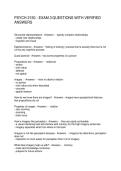
PSYCH 2150 - EXAM 3 QUESTIONS WITH VERIFIED
ANSWERS
Structured representations - Answers - - specify complex relationships
- create new relationships
- linguistic and visual
Epiphenomenon - Answers - "feeling of looking"; process that is actually there but is not
run by any cognitive process
Quasi pictorial - Answers - has some properties of a picture
Propositions are - Answers - - relational
- syntax
- truth value
- abstract
- not spatial
Images : - Answers - - have no distinct relation
- no syntax
- truth value only when described
- concrete
- spatial medium
How do we know there are images? - Answers - images have quasipictorial features
that propositions do not
Propeties of images - Answers - - rotation
- size zooming
- scanning
- brain locus
How is imagery like perception - Answers - - they are easily confusable
- a visual interfering task will interfere with memory for the high imagery sentences
- imagery separates what from where in the brain
Imagery is not like perception because - Answers - - imagery has distortions, perception
does not
- inspection is much easier for perception than it is for imagery
What does imagery help us with? - Answers - - memory
- make tacit knowledge conscious
- prepare for future actions
, Ambiguities associated with language - Answers - - how do we percieve sounds
- how do we perceive words
- how to we perceive sentences
- how do we percieve texts
Why is phoneme perception hard? - Answers - - produced fast
- different speakers produce them differently
- same speakers produce them differently based on context (coarticulation)
Coarticulation - Answers - overlap of phonemes; same speakers pronounce phonemes
differently based on context
Why is word perception hard? - Answers - - speech stream
Why are sentences hard? - Answers - - more than one meaning is possible (even w/o
change in word order)
Why are texts hard - Answers - - we make inferences about texts without realizing it
Text - Answers - a collection of sentences forming a paragraph or collection of related
paragraphs
Phoneme restoration effect - Answers - sounds actually missing from a speech signal
can be restored by the brain and may appear to be heard.
Mcgurk Effect - Answers - demonstrates an interaction between hearing and vision in
speech perception
Statistical learning helps with ____ - Answers - word segmentation
Are people good at perceiving slight differences in phonemes? - Answers - no
Sentence processing is aided by our understanding of ___ - Answers - grammar
Grammar - Answers - NOT what you find in a grammar book; grammar refers to the set
of rules people carry around in their heads to produce sentences.
Associations theory - Answers - - incorrect
- grammatical sentences are understood word by word based on the associations of the
rest of the words
Word chains - Answers - - incorrect
- based on dependencies
Phrase structure grammars - Answers - - solution to understanding sentences
ANSWERS
Structured representations - Answers - - specify complex relationships
- create new relationships
- linguistic and visual
Epiphenomenon - Answers - "feeling of looking"; process that is actually there but is not
run by any cognitive process
Quasi pictorial - Answers - has some properties of a picture
Propositions are - Answers - - relational
- syntax
- truth value
- abstract
- not spatial
Images : - Answers - - have no distinct relation
- no syntax
- truth value only when described
- concrete
- spatial medium
How do we know there are images? - Answers - images have quasipictorial features
that propositions do not
Propeties of images - Answers - - rotation
- size zooming
- scanning
- brain locus
How is imagery like perception - Answers - - they are easily confusable
- a visual interfering task will interfere with memory for the high imagery sentences
- imagery separates what from where in the brain
Imagery is not like perception because - Answers - - imagery has distortions, perception
does not
- inspection is much easier for perception than it is for imagery
What does imagery help us with? - Answers - - memory
- make tacit knowledge conscious
- prepare for future actions
, Ambiguities associated with language - Answers - - how do we percieve sounds
- how do we perceive words
- how to we perceive sentences
- how do we percieve texts
Why is phoneme perception hard? - Answers - - produced fast
- different speakers produce them differently
- same speakers produce them differently based on context (coarticulation)
Coarticulation - Answers - overlap of phonemes; same speakers pronounce phonemes
differently based on context
Why is word perception hard? - Answers - - speech stream
Why are sentences hard? - Answers - - more than one meaning is possible (even w/o
change in word order)
Why are texts hard - Answers - - we make inferences about texts without realizing it
Text - Answers - a collection of sentences forming a paragraph or collection of related
paragraphs
Phoneme restoration effect - Answers - sounds actually missing from a speech signal
can be restored by the brain and may appear to be heard.
Mcgurk Effect - Answers - demonstrates an interaction between hearing and vision in
speech perception
Statistical learning helps with ____ - Answers - word segmentation
Are people good at perceiving slight differences in phonemes? - Answers - no
Sentence processing is aided by our understanding of ___ - Answers - grammar
Grammar - Answers - NOT what you find in a grammar book; grammar refers to the set
of rules people carry around in their heads to produce sentences.
Associations theory - Answers - - incorrect
- grammatical sentences are understood word by word based on the associations of the
rest of the words
Word chains - Answers - - incorrect
- based on dependencies
Phrase structure grammars - Answers - - solution to understanding sentences


