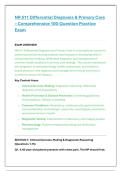
NR 511 Differential Diagnosis & Primary Care
– Comprehensive 100-Question Practice
Exam
EXAM OVERVIEW
NR 511 Differential Diagnosis and Primary Care is a foundational course for
advanced practice nursing students that focuses on developing skills in
clinical decision-making, differential diagnosis, and management of
common health problems in primary care settings . The course emphasizes
the integration of pathophysiology, health assessment, and evidence-
based practice in the diagnosis and management of acute and chronic
conditions across the lifespan .
Key Content Areas
• Clinical Decision-Making: Diagnostic reasoning, differential
diagnosis, clinical guidelines
• Health Promotion & Disease Prevention: Screening guidelines,
immunizations, lifestyle counseling
• Common Conditions: Respiratory, cardiovascular, gastrointestinal,
musculoskeletal, dermatologic, endocrine, neurological, psychiatric,
and women's/men's health
• Diagnostic Testing: Interpretation of laboratory and imaging studies
• Pharmacology: Evidence-based prescribing and medication
management
SECTION 1: Clinical Decision-Making & Diagnostic Reasoning
(Questions 1-15)
Q1. A 45-year-old patient presents with chest pain. The NP should first:
, • A) Prescribe nitroglycerin
• B) Assess the quality, location, and radiation of the pain
• C) Order an ECG
• D) Refer to cardiology
Answer: B – Assessment of the character, location, and radiation of chest
pain is the first step in determining the etiology. This information helps
differentiate cardiac from non-cardiac causes. ECG and treatment
decisions follow the initial assessment .
Q2. Which of the following is the most common cause of acute cough in
adults?
• A) Asthma
• B) Upper respiratory tract infection (URI)
• C) GERD
• D) COPD
Answer: B – Upper respiratory tract infections (viral) are the most common
cause of acute cough (<3 weeks). Other causes include acute bronchitis,
pneumonia, and allergic rhinitis .
Q3. A patient presents with a red, warm, tender area on the right lower
leg after a scratch while gardening. The NP should suspect:
• A) Contact dermatitis
• B) Cellulitis
• C) Venous stasis
• D) Deep vein thrombosis
Answer: B – Cellulitis presents with localized erythema, warmth,
tenderness, and edema. It typically occurs at a site of skin breakdown
(scratch). Antibiotic therapy is indicated .
,Q4. A 55-year-old patient with a 30-pack-year smoking history presents
with a new persistent cough. According to USPSTF guidelines, which is
the most appropriate next step?
• A) Chest x-ray
• B) Annual low-dose CT (LDCT)
• C) Sputum cytology
• D) Observation
Answer: B – USPSTF recommends annual low-dose CT (LDCT) for lung
cancer screening in adults aged 50-80 years with a 20-pack-year smoking
history who currently smoke or have quit within the past 15 years .
Q5. A patient is prescribed albuterol for asthma. Which statement
indicates understanding?
• A) "I will use this daily to prevent attacks."
• B) "I will use this when I have wheezing or shortness of breath."
• C) "I will take this before bedtime."
• D) "This medication will cure my asthma."
Answer: B – Albuterol is a rescue (short-acting beta-agonist) medication
used for acute symptoms. It is not a controller medication. Patients should
be educated on the difference between rescue and controller medications .
Q6. The NP is evaluating a patient with a chronic cough. The most
common causes are:
• A) Post-nasal drip, asthma, GERD
• B) COPD, pneumonia, lung cancer
• C) Heart failure, PE, aspiration
, • D) Allergic rhinitis, sinusitis, bronchitis
Answer: A – The three most common causes of chronic cough (>8 weeks)
are post-nasal drip (upper airway cough syndrome), asthma, and GERD .
Q7. A patient presents with headache, fever, and stiff neck. The NP
should:
• A) Prescribe analgesics
• B) Perform a neurological exam and consider meningitis
• C) Order a CT scan
• D) Reassure the patient
Answer: B – Fever, headache, and nuchal rigidity are classic signs of
meningitis. A complete neurological exam should be performed. If
suspicion is high, the patient should be referred to the ED for evaluation .
Q8. The clinical reasoning process in primary care includes all of the
following EXCEPT:
• A) Gathering data
• B) Generating hypotheses
• C) Diagnosing based on personal experience only
• D) Evaluating the diagnosis
Answer: C – Diagnosing based solely on personal experience is not
evidence-based. Clinical reasoning involves gathering data, generating
differential diagnoses, testing hypotheses, and evaluating the diagnosis .
Q9. A patient with diabetes and hypertension is at increased risk for:
• A) Cardiovascular disease and nephropathy
• B) Osteoarthritis
– Comprehensive 100-Question Practice
Exam
EXAM OVERVIEW
NR 511 Differential Diagnosis and Primary Care is a foundational course for
advanced practice nursing students that focuses on developing skills in
clinical decision-making, differential diagnosis, and management of
common health problems in primary care settings . The course emphasizes
the integration of pathophysiology, health assessment, and evidence-
based practice in the diagnosis and management of acute and chronic
conditions across the lifespan .
Key Content Areas
• Clinical Decision-Making: Diagnostic reasoning, differential
diagnosis, clinical guidelines
• Health Promotion & Disease Prevention: Screening guidelines,
immunizations, lifestyle counseling
• Common Conditions: Respiratory, cardiovascular, gastrointestinal,
musculoskeletal, dermatologic, endocrine, neurological, psychiatric,
and women's/men's health
• Diagnostic Testing: Interpretation of laboratory and imaging studies
• Pharmacology: Evidence-based prescribing and medication
management
SECTION 1: Clinical Decision-Making & Diagnostic Reasoning
(Questions 1-15)
Q1. A 45-year-old patient presents with chest pain. The NP should first:
, • A) Prescribe nitroglycerin
• B) Assess the quality, location, and radiation of the pain
• C) Order an ECG
• D) Refer to cardiology
Answer: B – Assessment of the character, location, and radiation of chest
pain is the first step in determining the etiology. This information helps
differentiate cardiac from non-cardiac causes. ECG and treatment
decisions follow the initial assessment .
Q2. Which of the following is the most common cause of acute cough in
adults?
• A) Asthma
• B) Upper respiratory tract infection (URI)
• C) GERD
• D) COPD
Answer: B – Upper respiratory tract infections (viral) are the most common
cause of acute cough (<3 weeks). Other causes include acute bronchitis,
pneumonia, and allergic rhinitis .
Q3. A patient presents with a red, warm, tender area on the right lower
leg after a scratch while gardening. The NP should suspect:
• A) Contact dermatitis
• B) Cellulitis
• C) Venous stasis
• D) Deep vein thrombosis
Answer: B – Cellulitis presents with localized erythema, warmth,
tenderness, and edema. It typically occurs at a site of skin breakdown
(scratch). Antibiotic therapy is indicated .
,Q4. A 55-year-old patient with a 30-pack-year smoking history presents
with a new persistent cough. According to USPSTF guidelines, which is
the most appropriate next step?
• A) Chest x-ray
• B) Annual low-dose CT (LDCT)
• C) Sputum cytology
• D) Observation
Answer: B – USPSTF recommends annual low-dose CT (LDCT) for lung
cancer screening in adults aged 50-80 years with a 20-pack-year smoking
history who currently smoke or have quit within the past 15 years .
Q5. A patient is prescribed albuterol for asthma. Which statement
indicates understanding?
• A) "I will use this daily to prevent attacks."
• B) "I will use this when I have wheezing or shortness of breath."
• C) "I will take this before bedtime."
• D) "This medication will cure my asthma."
Answer: B – Albuterol is a rescue (short-acting beta-agonist) medication
used for acute symptoms. It is not a controller medication. Patients should
be educated on the difference between rescue and controller medications .
Q6. The NP is evaluating a patient with a chronic cough. The most
common causes are:
• A) Post-nasal drip, asthma, GERD
• B) COPD, pneumonia, lung cancer
• C) Heart failure, PE, aspiration
, • D) Allergic rhinitis, sinusitis, bronchitis
Answer: A – The three most common causes of chronic cough (>8 weeks)
are post-nasal drip (upper airway cough syndrome), asthma, and GERD .
Q7. A patient presents with headache, fever, and stiff neck. The NP
should:
• A) Prescribe analgesics
• B) Perform a neurological exam and consider meningitis
• C) Order a CT scan
• D) Reassure the patient
Answer: B – Fever, headache, and nuchal rigidity are classic signs of
meningitis. A complete neurological exam should be performed. If
suspicion is high, the patient should be referred to the ED for evaluation .
Q8. The clinical reasoning process in primary care includes all of the
following EXCEPT:
• A) Gathering data
• B) Generating hypotheses
• C) Diagnosing based on personal experience only
• D) Evaluating the diagnosis
Answer: C – Diagnosing based solely on personal experience is not
evidence-based. Clinical reasoning involves gathering data, generating
differential diagnoses, testing hypotheses, and evaluating the diagnosis .
Q9. A patient with diabetes and hypertension is at increased risk for:
• A) Cardiovascular disease and nephropathy
• B) Osteoarthritis