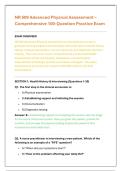
NR 509 Advanced Physical Assessment –
Comprehensive 100-Question Practice Exam
EXAM OVERVIEW
NR 509 Advanced Physical Assessment is a foundational course in
graduate nursing programs that develops advanced skills in health history
taking, physical examination, clinical reasoning, and diagnostic decision-
making . The curriculum covers comprehensive and focused health
assessments across the lifespan, therapeutic communication,
interpretation of findings, and documentation strategies . This exam
simulates the structure and content of NR 509 midterm and final
examinations .
SECTION 1: Health History & Interviewing (Questions 1-20)
Q1. The first step in the clinical encounter is:
• A) Physical examination
• B) Establishing rapport and initiating the session
• C) Documentation
• D) Diagnostic testing
Answer: B – Establishing rapport and initiating the session sets the stage
for the entire clinical encounter. How you greet the patient, provide for
comfort, and arrange the physical setting shapes the patient's first
impressions and builds trust .
Q2. A nurse practitioner is interviewing a new patient. Which of the
following is an example of a "FIFE" question?
• A) "When did your symptoms start?"
• B) "How is this problem affecting your daily life?"
, • C) "What medications are you currently taking?"
• D) "Have you had this problem before?"
Answer: B – FIFE stands for Feelings, Ideas, Effect on Function, and
Expectations. Questions about how symptoms affect daily life explore the
"Effect on Function" component. This patient-centered approach helps
understand the full impact of illness .
Q3. Which of the following is an open-ended question?
• A) "Are you having pain?"
• B) "Tell me about your symptoms."
• C) "Have you taken any medication for this?"
• D) "Did the pain start suddenly?"
Answer: B – Open-ended questions allow the patient to tell their story in
their own words. They begin with "Tell me..." or "Describe..." and are
essential for gathering the history of present illness .
Q4. The OLDCARTS mnemonic is used to gather information about:
• A) Past medical history
• B) History of present illness (HPI)
• C) Family history
• D) Social history
Answer: B – OLDCARTS (Onset, Location, Duration, Characteristics,
Aggravating factors, Relieving factors, Timing, Severity) is used to gather a
comprehensive description of the patient's present illness. It helps elicit
the seven features of every symptom .
,Q5. A patient reports "I've been having chest pain for three days."
Which of the following questions would help clarify the character of the
pain?
• A) "Can you describe the pain—is it sharp, dull, or pressure-like?"
• B) "Where exactly is the pain located?"
• C) "Does anything make the pain better?"
• D) "How severe is the pain on a scale of 0-10?"
Answer: A – Character is one of the seven features of every symptom.
Asking the patient to describe the pain's nature helps differentiate between
cardiac (pressure, heaviness), pleural (sharp, stabbing), and
musculoskeletal (tender to palpation) causes .
Q6. The "FIFE" mnemonic in patient-centered interviewing includes all
of the following EXCEPT:
• A) Feelings
• B) Ideas
• C) Function
• D) Focus
Answer: D – FIFE stands for Feelings (patient's fears and concerns), Ideas
(patient's understanding of the problem), Effect on Function (how the
problem affects daily life), and Expectations (patient's hopes and
expectations from care). "Focus" is not part of the mnemonic .
Q7. Active listening in the clinical interview involves:
• A) Focusing on what the patient is telling you, both verbally and
nonverbally
• B) Taking detailed notes while the patient speaks
• C) Preparing the next question while the patient is talking
, • D) Interrupting to clarify information
Answer: A – Active listening requires full attention to the patient's verbal
and nonverbal communication. It involves making eye contact, nodding,
and using gestures that show engagement while avoiding distractions .
Q8. Which of the following statements demonstrates empathy?
• A) "You shouldn't worry about that."
• B) "This must be very difficult for you."
• C) "I know exactly how you feel."
• D) "Let's focus on the facts."
Answer: B – Empathic responses validate the patient's feelings and show
understanding without judgment. They acknowledge the patient's
emotional experience and build trust. "I know how you feel" can be
dismissive as it assumes identical experience .
Q9. A patient with limited English proficiency is being interviewed.
Which of the following is the most appropriate action?
• A) Use a family member as an interpreter
• B) Use a qualified medical interpreter
• C) Speak loudly and slowly
• D) Conduct the interview without an interpreter
Answer: B – Qualified medical interpreters should be used when patients
have limited English proficiency. Family members should not be used as
interpreters due to privacy concerns and potential errors. Speaking loudly
does not improve comprehension .
Q10. A talkative patient is dominating the interview. Which technique is
most appropriate to redirect the conversation?
Comprehensive 100-Question Practice Exam
EXAM OVERVIEW
NR 509 Advanced Physical Assessment is a foundational course in
graduate nursing programs that develops advanced skills in health history
taking, physical examination, clinical reasoning, and diagnostic decision-
making . The curriculum covers comprehensive and focused health
assessments across the lifespan, therapeutic communication,
interpretation of findings, and documentation strategies . This exam
simulates the structure and content of NR 509 midterm and final
examinations .
SECTION 1: Health History & Interviewing (Questions 1-20)
Q1. The first step in the clinical encounter is:
• A) Physical examination
• B) Establishing rapport and initiating the session
• C) Documentation
• D) Diagnostic testing
Answer: B – Establishing rapport and initiating the session sets the stage
for the entire clinical encounter. How you greet the patient, provide for
comfort, and arrange the physical setting shapes the patient's first
impressions and builds trust .
Q2. A nurse practitioner is interviewing a new patient. Which of the
following is an example of a "FIFE" question?
• A) "When did your symptoms start?"
• B) "How is this problem affecting your daily life?"
, • C) "What medications are you currently taking?"
• D) "Have you had this problem before?"
Answer: B – FIFE stands for Feelings, Ideas, Effect on Function, and
Expectations. Questions about how symptoms affect daily life explore the
"Effect on Function" component. This patient-centered approach helps
understand the full impact of illness .
Q3. Which of the following is an open-ended question?
• A) "Are you having pain?"
• B) "Tell me about your symptoms."
• C) "Have you taken any medication for this?"
• D) "Did the pain start suddenly?"
Answer: B – Open-ended questions allow the patient to tell their story in
their own words. They begin with "Tell me..." or "Describe..." and are
essential for gathering the history of present illness .
Q4. The OLDCARTS mnemonic is used to gather information about:
• A) Past medical history
• B) History of present illness (HPI)
• C) Family history
• D) Social history
Answer: B – OLDCARTS (Onset, Location, Duration, Characteristics,
Aggravating factors, Relieving factors, Timing, Severity) is used to gather a
comprehensive description of the patient's present illness. It helps elicit
the seven features of every symptom .
,Q5. A patient reports "I've been having chest pain for three days."
Which of the following questions would help clarify the character of the
pain?
• A) "Can you describe the pain—is it sharp, dull, or pressure-like?"
• B) "Where exactly is the pain located?"
• C) "Does anything make the pain better?"
• D) "How severe is the pain on a scale of 0-10?"
Answer: A – Character is one of the seven features of every symptom.
Asking the patient to describe the pain's nature helps differentiate between
cardiac (pressure, heaviness), pleural (sharp, stabbing), and
musculoskeletal (tender to palpation) causes .
Q6. The "FIFE" mnemonic in patient-centered interviewing includes all
of the following EXCEPT:
• A) Feelings
• B) Ideas
• C) Function
• D) Focus
Answer: D – FIFE stands for Feelings (patient's fears and concerns), Ideas
(patient's understanding of the problem), Effect on Function (how the
problem affects daily life), and Expectations (patient's hopes and
expectations from care). "Focus" is not part of the mnemonic .
Q7. Active listening in the clinical interview involves:
• A) Focusing on what the patient is telling you, both verbally and
nonverbally
• B) Taking detailed notes while the patient speaks
• C) Preparing the next question while the patient is talking
, • D) Interrupting to clarify information
Answer: A – Active listening requires full attention to the patient's verbal
and nonverbal communication. It involves making eye contact, nodding,
and using gestures that show engagement while avoiding distractions .
Q8. Which of the following statements demonstrates empathy?
• A) "You shouldn't worry about that."
• B) "This must be very difficult for you."
• C) "I know exactly how you feel."
• D) "Let's focus on the facts."
Answer: B – Empathic responses validate the patient's feelings and show
understanding without judgment. They acknowledge the patient's
emotional experience and build trust. "I know how you feel" can be
dismissive as it assumes identical experience .
Q9. A patient with limited English proficiency is being interviewed.
Which of the following is the most appropriate action?
• A) Use a family member as an interpreter
• B) Use a qualified medical interpreter
• C) Speak loudly and slowly
• D) Conduct the interview without an interpreter
Answer: B – Qualified medical interpreters should be used when patients
have limited English proficiency. Family members should not be used as
interpreters due to privacy concerns and potential errors. Speaking loudly
does not improve comprehension .
Q10. A talkative patient is dominating the interview. Which technique is
most appropriate to redirect the conversation?