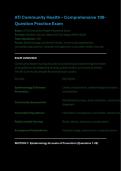
ATI Community Health – Comprehensive 100-
Question Practice Exam
Exam: ATI Community Health Proctored Exam
Format: Multiple Choice, Select All That Apply (NGN-Style)
Total Questions: 100
Focus: Epidemiology, prevention levels, community assessment,
vulnerable populations, disaster management, and public health nursing
EXAM OVERVIEW
Community health nursing focuses on promoting and preserving the health
of populations by integrating nursing, public health, and social sciences.
The ATI Community Health Proctored Exam covers:
Domain Key Topics
Epidemiology & Disease Levels of prevention, epidemiological models,
Prevention surveillance
Windshield surveys, data collection, community
Community Assessment
diagnosis
Vulnerable Populations Homeless, immigrants, rural health, mental heal
Public Health Nursing Roles, ethics, advocacy, collaboration
Emergency Preparedness Disaster triage, bioterrorism, response plans
SECTION 1: Epidemiology & Levels of Prevention (Questions 1-20)
,Q1. A community health nurse is teaching a client about the
importance of wearing a seatbelt. This is an example of which level of
prevention?
• A) Primary prevention
• B) Secondary prevention
• C) Tertiary prevention
• D) Health promotion
Correct Answer: A – Primary prevention aims to prevent disease or injury
before it occurs. Teaching clients to wear seatbelts is a primary prevention
strategy that reduces risk of injury. Vaccinations, health education, and
lifestyle modification are also primary prevention.
Q2. A nurse is conducting a cholesterol screening at a community
health fair. This is an example of which level of prevention?
• A) Primary prevention
• B) Secondary prevention
• C) Tertiary prevention
• D) Health promotion
Correct Answer: B – Secondary prevention involves early detection and
treatment of disease. Screening for high cholesterol identifies risk factors
early, allowing for intervention before disease progression. Mammograms,
blood pressure screenings, and Pap smears are also secondary prevention.
Q3. A nurse is providing cardiac rehabilitation to a client who had a
myocardial infarction. This is an example of which level of prevention?
• A) Primary prevention
• B) Secondary prevention
• C) Tertiary prevention
, • D) Health promotion
Correct Answer: C – Tertiary prevention aims to reduce disability and
restore function after disease has occurred. Cardiac rehabilitation, stroke
rehabilitation, and support groups for chronic illness are examples of
tertiary prevention.
Q4. A community health nurse is planning a vaccination clinic for
influenza. This is an example of which level of prevention?
• A) Primary prevention
• B) Secondary prevention
• C) Tertiary prevention
• D) Health promotion
Correct Answer: A – Vaccination prevents disease from occurring and is
therefore primary prevention. The goal is to protect the population from
illness before exposure occurs.
Q5. A nurse is providing teaching to a client with diabetes about proper
foot care to prevent amputation. This is an example of which level of
prevention?
• A) Primary prevention
• B) Secondary prevention
• C) Tertiary prevention
• D) Health promotion
Correct Answer: C – This is tertiary prevention because it aims to prevent
complications (amputation) in a client who already has a chronic disease.
The focus is on reducing disability and maintaining function.
, Q6. A nurse is screening clients for tuberculosis at a homeless shelter.
This is an example of which level of prevention?
• A) Primary prevention
• B) Secondary prevention
• C) Tertiary prevention
• D) Health promotion
Correct Answer: B – Screening for disease in an at-risk population is
secondary prevention. Early detection allows for prompt treatment and
reduces transmission to others.
Q7. A nurse is teaching a community group about healthy eating and
exercise to prevent heart disease. This is an example of which level of
prevention?
• A) Primary prevention
• B) Secondary prevention
• C) Tertiary prevention
• D) Health promotion
Correct Answer: A – Health education aimed at preventing disease is
primary prevention. The goal is to modify risk factors before disease
develops.
Q8. A community health nurse is conducting a survey to identify the
incidence of hypertension in a community. This activity is part of which
public health function?
• A) Assessment
• B) Policy development
• C) Assurance
• D) Quality improvement
Question Practice Exam
Exam: ATI Community Health Proctored Exam
Format: Multiple Choice, Select All That Apply (NGN-Style)
Total Questions: 100
Focus: Epidemiology, prevention levels, community assessment,
vulnerable populations, disaster management, and public health nursing
EXAM OVERVIEW
Community health nursing focuses on promoting and preserving the health
of populations by integrating nursing, public health, and social sciences.
The ATI Community Health Proctored Exam covers:
Domain Key Topics
Epidemiology & Disease Levels of prevention, epidemiological models,
Prevention surveillance
Windshield surveys, data collection, community
Community Assessment
diagnosis
Vulnerable Populations Homeless, immigrants, rural health, mental heal
Public Health Nursing Roles, ethics, advocacy, collaboration
Emergency Preparedness Disaster triage, bioterrorism, response plans
SECTION 1: Epidemiology & Levels of Prevention (Questions 1-20)
,Q1. A community health nurse is teaching a client about the
importance of wearing a seatbelt. This is an example of which level of
prevention?
• A) Primary prevention
• B) Secondary prevention
• C) Tertiary prevention
• D) Health promotion
Correct Answer: A – Primary prevention aims to prevent disease or injury
before it occurs. Teaching clients to wear seatbelts is a primary prevention
strategy that reduces risk of injury. Vaccinations, health education, and
lifestyle modification are also primary prevention.
Q2. A nurse is conducting a cholesterol screening at a community
health fair. This is an example of which level of prevention?
• A) Primary prevention
• B) Secondary prevention
• C) Tertiary prevention
• D) Health promotion
Correct Answer: B – Secondary prevention involves early detection and
treatment of disease. Screening for high cholesterol identifies risk factors
early, allowing for intervention before disease progression. Mammograms,
blood pressure screenings, and Pap smears are also secondary prevention.
Q3. A nurse is providing cardiac rehabilitation to a client who had a
myocardial infarction. This is an example of which level of prevention?
• A) Primary prevention
• B) Secondary prevention
• C) Tertiary prevention
, • D) Health promotion
Correct Answer: C – Tertiary prevention aims to reduce disability and
restore function after disease has occurred. Cardiac rehabilitation, stroke
rehabilitation, and support groups for chronic illness are examples of
tertiary prevention.
Q4. A community health nurse is planning a vaccination clinic for
influenza. This is an example of which level of prevention?
• A) Primary prevention
• B) Secondary prevention
• C) Tertiary prevention
• D) Health promotion
Correct Answer: A – Vaccination prevents disease from occurring and is
therefore primary prevention. The goal is to protect the population from
illness before exposure occurs.
Q5. A nurse is providing teaching to a client with diabetes about proper
foot care to prevent amputation. This is an example of which level of
prevention?
• A) Primary prevention
• B) Secondary prevention
• C) Tertiary prevention
• D) Health promotion
Correct Answer: C – This is tertiary prevention because it aims to prevent
complications (amputation) in a client who already has a chronic disease.
The focus is on reducing disability and maintaining function.
, Q6. A nurse is screening clients for tuberculosis at a homeless shelter.
This is an example of which level of prevention?
• A) Primary prevention
• B) Secondary prevention
• C) Tertiary prevention
• D) Health promotion
Correct Answer: B – Screening for disease in an at-risk population is
secondary prevention. Early detection allows for prompt treatment and
reduces transmission to others.
Q7. A nurse is teaching a community group about healthy eating and
exercise to prevent heart disease. This is an example of which level of
prevention?
• A) Primary prevention
• B) Secondary prevention
• C) Tertiary prevention
• D) Health promotion
Correct Answer: A – Health education aimed at preventing disease is
primary prevention. The goal is to modify risk factors before disease
develops.
Q8. A community health nurse is conducting a survey to identify the
incidence of hypertension in a community. This activity is part of which
public health function?
• A) Assessment
• B) Policy development
• C) Assurance
• D) Quality improvement