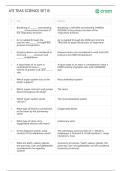
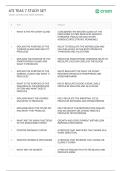
ATI TEAS STUDY GUIDE. (SCIENCE)
# Term Definition
1 What is the Cardiovascular 1. Heart 2. Blood Vessels 3. Blood
system (Circulatory) made up of?
2 What are the functions of the 1. Transportation: - oxygen from the lungs to
Cardiovascular system? the body. - carbon dioxide from the body to the
lungs. - nutrients, enzymes, and hormones to
cells. - waste products from cellular metabolism.
2. Regulation: - Acid-base balance with buffer
system. - pH balance of blood (7.35-7.45) - Body
temperature. (Thermoregulation) - Osmotic
pressure. 3. Protection. - Immune response &
Inflammatory response.
3 What are the components of 1. Plasma (55%) 2. Formed elements: blood cells
blood? - Red blood cells. - White blood cells. - Platelets
(thrombocytes.)
4 What are the components of 1. H2O (90%) 2. Proteins (7%) 3. Elecrolytes,
plasma? glucose, enzymes, amino acids etc. (3%)
5 What are the plasma proteins 1. Albumin: (60%) *the most abundant -
and their functions? Promotes water retention which maintains
normal osmotic pressure and blood volume. -
Hormone transportation. 2. Globulins (36%): -
Transportation of lipids and fat-soluble vitamins
(A, D, E, K.) - LDL (Low-Density Lipoproteins):
transport cholesterol from it's site of synthesis
to various sites in the body. - HDL (High-Density
Lipoproteins): remove cholesterol and
triglycerides from arteries. 3. Fibrinogen (4%):
Blood clotting.
6 What is the difference between Serum is lacking fibrinogen (blood clotting
serum and plasma? plasma protein)
7 What are the differences in 1. Alpha & Beta: - Produced by the liver. -
Alpha, Beta, and Gamma Transportation of lipids and fat-soluble
Globulins? vitamins. 2. Gamma Globulins:
(immunoglobulins) - Produced by
Lymphocyte-B. - Prevent diseases. - Antibodies
are proteins that inactive bacteria, viruses, and
other foreign antigens.
,ATI TEAS STUDY GUIDE. (SCIENCE)
# Term Definition
8 What are the characteristics and *Also called Erythrocytes. - 120-day lifespan. -
composition of a red blood cell? Lack of a nucleus so unable to multiply. (mitosis)
- No Mitochondria. - Die in the spleen.
Composition: 1. Plasma membrane. 2.
Hemoglobin - makes up most of the weight. -
full of iron.
9 What are Erythropoietin and 1. Erythropoietin: - A hormone produced by the
Erythropoiesis? kidneys. - Stimulates RBC production. *People
with kidney failure are often anemic because of
this. 2. Erythropoiesis: RBC Production - Before
birth, RBC's are formed in the yolk sac & liver
and spleen. - After birth, RBC's are formed in the
red bone marrow (epiphysis of long bones.)
10 What are the different types of Anemia is when a person has fewer RBC's/low
anemia? hemoglobin. 1. Hemorrhagic anemia: blood loss
through wounding. 2. Aplastic anemia: failure to
produce RBC's. 3. Hemolytic anemia: RBC's
burst. 4. Pernicious anemia: - Lack of vitamin
B12 in the diet. - Lack of intrinsic factor
production by the stomach.
11 What happens when a red blood It goes to the spleen (sometimes liver) to die.
cell dies? Phagocytosis occurs by Spleen or Liver
macrophages. - they eat the outer covering of
RBC's. - Hemoglobin is released and the iron is
recycled.
12 What are the different white *Also called Leukocytes. 1. Granulocytes: have a
blood cells and their segmented nucleus + granules in the cytoplasm
characteristics? - Neutrophils. - Eosinophils. - Basophils. 2.
Agranulocytes: have no granules + a whole
nucleus. - Monocytes. - Lymphocytes.
13 What are the functions of 1. Neutrophils: most abundant 60% - Destroys
Neutrophils, Eosinophils, and microorganisms and foreign particles by
Basophils? (Granulocytes) phagocytosis. 2. Eosinophils: 1-4% - Fights
against allergic reactions - Modulates
inflammation reactions. 3. Basophils Less than
1% - Produce Histamines (along with Mastall)
14 What are the functions of 1. Monocyte: 2-8% - Under stress, they become
Monocytes and Lymphocytes? macrophages and ingest and destroy harmful
(Agranulocytes) particles. - Phagocytes. 2. Lymphocytes: 20-40%
- Involved in immune response + synthesizes
antibodies. -T-Lymphocyte & B-Lymphocyte.
,ATI TEAS STUDY GUIDE. (SCIENCE)
# Term Definition
15 What are the different functions 1. T-Lymphocyte: Cellular Immune Response. -
of T-Lymphocyte and Mediator between bacteria/virus and our body. -
B-Lymphocytes? Matures in the Thymus gland. 2. B-Lymphocyte:
Humoral Immune Response. - Produce
antibodies. - Involved in immune response.
16 What are Thrombocytes? They are platelets. - Involved blood clotting. -
Releases serotonin.
17 What is Hemostasis? A homeostatic mechanism which prevents
blood loss. - Constriction of blood vessels. -
Aggregation of platelets (platelet plug) - Blood
coagulation.
18 What are Antigens and Antigens are found on the outside of the red
Antibodies on a different type of blood cell (except type O). Red blood cells
red blood cells? naturally create antibodies to fight off other
blood types. Ex.) Type B Blood types have "B"
Antigen and create "A" Antibodies. - This means
they can receive B and O blood types but not A
or AB blood types.
19 What are Aggultuinogen, Agglutinogen: Antigen specific to blood.
Agglutinin, and Agglutination? Agglutinin: Antibody specific to blood.
Agglutination: Clumping of RBC's.
20 What is the Immune system and The immune system is the bodies defense
its components? against infectious organisms and other
invaders. - Its main functional unit is
Lymphocytes.
21 What are Antigens and Antigens: any substance that induces an
Antibodies in the immune immune response. Antibodies: Proteins
system? produced by B-Lymphocytes in response to
foreign antigens.
22 What is a Primary immune 1. Primary immune response: the first time a
response and a Secondary B-Lymphocyte is exposed to an antigen and
immune response? produces antibodies. 2. Secondary immune
response: the next time a B-Lymphocyte is
exposed to a specific antigen, “memory”
B-Lymphocytes multiply and produce
antibodies. *Secondary immune response is
more effective at ridding the body of infection.
, ATI TEAS STUDY GUIDE. (SCIENCE)
# Term Definition
23 What are the different 1. IgA: Protect against microbes entering the
immunoglobulins and their body. - Found in the respiratory tract, intestinal
function + location? tract, saliva, tears, and breast milk. 2. IgE:
Mediates allergic reactions, asthma,
inflammation etc. - Found on the surface of
mast cells and basophils. 3. IgG: Fights infection
and bacteria. - only antibodies that cross the
barrier which gives the baby passive immunity.
*most abundant. - Found in blood and
extracellular space. 4. IgM: Stimulates the action
of macrophages. - First at the site of infection. -
Largest one. - Found in blood-lymph.
24 What are Memory T-Cells and 1. Memory T-Cells: Cells that remain potentially
Helper T-Cells? active for years after an invading antigen has
been inactivated. - Vaccines. 2. Helper T-Cells:
Influences or controls the differentiation or
activity of other cells of the immune system.
25 What are Cytoxic T-Cells and 1. Cytoxic T-Cells: Kills invading microorganisms
Suppressor T-Cells? or infected cells. 2. Suppressor T-Cells:
Suppresses autoimmune responses and
excessive antibody production.
26 What are the different types of 1. Innative "native" resistance: Born with
immunity? immunity. Acquired Immunity: 1.
Naturally-acquired active immunity: Formed
during the disease process. 2.
Artificially-acquired active immunity: Vaccines.
Dead or weakened antigens. 3.
Naturally-acquired passive immunity: Transfer
of IgG's from mother to fetus. 4.
Artificially-acquired passive immunity: Injection
of immune serum. Ex.) a snake bite injected with
anti-venom.
27 What are Auto-immune diseases 1. Auto-immune diseases: the formation of
and immunodeficiencies? antibodies against own body. 2.
Immunodeficiencies: conditions which destroy
the ability to respond antigens.
28 Where is the heart located and The center of the thorax. - The apex is the tip of
what is the apex + base? the heart. - The base is the back of the heart
where the large blood vessels are (Aorta,
Superior/Inferior Vena Cava, & Pulmonary
Trunk.)
# Term Definition
1 What is the Cardiovascular 1. Heart 2. Blood Vessels 3. Blood
system (Circulatory) made up of?
2 What are the functions of the 1. Transportation: - oxygen from the lungs to
Cardiovascular system? the body. - carbon dioxide from the body to the
lungs. - nutrients, enzymes, and hormones to
cells. - waste products from cellular metabolism.
2. Regulation: - Acid-base balance with buffer
system. - pH balance of blood (7.35-7.45) - Body
temperature. (Thermoregulation) - Osmotic
pressure. 3. Protection. - Immune response &
Inflammatory response.
3 What are the components of 1. Plasma (55%) 2. Formed elements: blood cells
blood? - Red blood cells. - White blood cells. - Platelets
(thrombocytes.)
4 What are the components of 1. H2O (90%) 2. Proteins (7%) 3. Elecrolytes,
plasma? glucose, enzymes, amino acids etc. (3%)
5 What are the plasma proteins 1. Albumin: (60%) *the most abundant -
and their functions? Promotes water retention which maintains
normal osmotic pressure and blood volume. -
Hormone transportation. 2. Globulins (36%): -
Transportation of lipids and fat-soluble vitamins
(A, D, E, K.) - LDL (Low-Density Lipoproteins):
transport cholesterol from it's site of synthesis
to various sites in the body. - HDL (High-Density
Lipoproteins): remove cholesterol and
triglycerides from arteries. 3. Fibrinogen (4%):
Blood clotting.
6 What is the difference between Serum is lacking fibrinogen (blood clotting
serum and plasma? plasma protein)
7 What are the differences in 1. Alpha & Beta: - Produced by the liver. -
Alpha, Beta, and Gamma Transportation of lipids and fat-soluble
Globulins? vitamins. 2. Gamma Globulins:
(immunoglobulins) - Produced by
Lymphocyte-B. - Prevent diseases. - Antibodies
are proteins that inactive bacteria, viruses, and
other foreign antigens.
,ATI TEAS STUDY GUIDE. (SCIENCE)
# Term Definition
8 What are the characteristics and *Also called Erythrocytes. - 120-day lifespan. -
composition of a red blood cell? Lack of a nucleus so unable to multiply. (mitosis)
- No Mitochondria. - Die in the spleen.
Composition: 1. Plasma membrane. 2.
Hemoglobin - makes up most of the weight. -
full of iron.
9 What are Erythropoietin and 1. Erythropoietin: - A hormone produced by the
Erythropoiesis? kidneys. - Stimulates RBC production. *People
with kidney failure are often anemic because of
this. 2. Erythropoiesis: RBC Production - Before
birth, RBC's are formed in the yolk sac & liver
and spleen. - After birth, RBC's are formed in the
red bone marrow (epiphysis of long bones.)
10 What are the different types of Anemia is when a person has fewer RBC's/low
anemia? hemoglobin. 1. Hemorrhagic anemia: blood loss
through wounding. 2. Aplastic anemia: failure to
produce RBC's. 3. Hemolytic anemia: RBC's
burst. 4. Pernicious anemia: - Lack of vitamin
B12 in the diet. - Lack of intrinsic factor
production by the stomach.
11 What happens when a red blood It goes to the spleen (sometimes liver) to die.
cell dies? Phagocytosis occurs by Spleen or Liver
macrophages. - they eat the outer covering of
RBC's. - Hemoglobin is released and the iron is
recycled.
12 What are the different white *Also called Leukocytes. 1. Granulocytes: have a
blood cells and their segmented nucleus + granules in the cytoplasm
characteristics? - Neutrophils. - Eosinophils. - Basophils. 2.
Agranulocytes: have no granules + a whole
nucleus. - Monocytes. - Lymphocytes.
13 What are the functions of 1. Neutrophils: most abundant 60% - Destroys
Neutrophils, Eosinophils, and microorganisms and foreign particles by
Basophils? (Granulocytes) phagocytosis. 2. Eosinophils: 1-4% - Fights
against allergic reactions - Modulates
inflammation reactions. 3. Basophils Less than
1% - Produce Histamines (along with Mastall)
14 What are the functions of 1. Monocyte: 2-8% - Under stress, they become
Monocytes and Lymphocytes? macrophages and ingest and destroy harmful
(Agranulocytes) particles. - Phagocytes. 2. Lymphocytes: 20-40%
- Involved in immune response + synthesizes
antibodies. -T-Lymphocyte & B-Lymphocyte.
,ATI TEAS STUDY GUIDE. (SCIENCE)
# Term Definition
15 What are the different functions 1. T-Lymphocyte: Cellular Immune Response. -
of T-Lymphocyte and Mediator between bacteria/virus and our body. -
B-Lymphocytes? Matures in the Thymus gland. 2. B-Lymphocyte:
Humoral Immune Response. - Produce
antibodies. - Involved in immune response.
16 What are Thrombocytes? They are platelets. - Involved blood clotting. -
Releases serotonin.
17 What is Hemostasis? A homeostatic mechanism which prevents
blood loss. - Constriction of blood vessels. -
Aggregation of platelets (platelet plug) - Blood
coagulation.
18 What are Antigens and Antigens are found on the outside of the red
Antibodies on a different type of blood cell (except type O). Red blood cells
red blood cells? naturally create antibodies to fight off other
blood types. Ex.) Type B Blood types have "B"
Antigen and create "A" Antibodies. - This means
they can receive B and O blood types but not A
or AB blood types.
19 What are Aggultuinogen, Agglutinogen: Antigen specific to blood.
Agglutinin, and Agglutination? Agglutinin: Antibody specific to blood.
Agglutination: Clumping of RBC's.
20 What is the Immune system and The immune system is the bodies defense
its components? against infectious organisms and other
invaders. - Its main functional unit is
Lymphocytes.
21 What are Antigens and Antigens: any substance that induces an
Antibodies in the immune immune response. Antibodies: Proteins
system? produced by B-Lymphocytes in response to
foreign antigens.
22 What is a Primary immune 1. Primary immune response: the first time a
response and a Secondary B-Lymphocyte is exposed to an antigen and
immune response? produces antibodies. 2. Secondary immune
response: the next time a B-Lymphocyte is
exposed to a specific antigen, “memory”
B-Lymphocytes multiply and produce
antibodies. *Secondary immune response is
more effective at ridding the body of infection.
, ATI TEAS STUDY GUIDE. (SCIENCE)
# Term Definition
23 What are the different 1. IgA: Protect against microbes entering the
immunoglobulins and their body. - Found in the respiratory tract, intestinal
function + location? tract, saliva, tears, and breast milk. 2. IgE:
Mediates allergic reactions, asthma,
inflammation etc. - Found on the surface of
mast cells and basophils. 3. IgG: Fights infection
and bacteria. - only antibodies that cross the
barrier which gives the baby passive immunity.
*most abundant. - Found in blood and
extracellular space. 4. IgM: Stimulates the action
of macrophages. - First at the site of infection. -
Largest one. - Found in blood-lymph.
24 What are Memory T-Cells and 1. Memory T-Cells: Cells that remain potentially
Helper T-Cells? active for years after an invading antigen has
been inactivated. - Vaccines. 2. Helper T-Cells:
Influences or controls the differentiation or
activity of other cells of the immune system.
25 What are Cytoxic T-Cells and 1. Cytoxic T-Cells: Kills invading microorganisms
Suppressor T-Cells? or infected cells. 2. Suppressor T-Cells:
Suppresses autoimmune responses and
excessive antibody production.
26 What are the different types of 1. Innative "native" resistance: Born with
immunity? immunity. Acquired Immunity: 1.
Naturally-acquired active immunity: Formed
during the disease process. 2.
Artificially-acquired active immunity: Vaccines.
Dead or weakened antigens. 3.
Naturally-acquired passive immunity: Transfer
of IgG's from mother to fetus. 4.
Artificially-acquired passive immunity: Injection
of immune serum. Ex.) a snake bite injected with
anti-venom.
27 What are Auto-immune diseases 1. Auto-immune diseases: the formation of
and immunodeficiencies? antibodies against own body. 2.
Immunodeficiencies: conditions which destroy
the ability to respond antigens.
28 Where is the heart located and The center of the thorax. - The apex is the tip of
what is the apex + base? the heart. - The base is the back of the heart
where the large blood vessels are (Aorta,
Superior/Inferior Vena Cava, & Pulmonary
Trunk.)