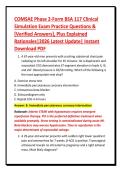
COMSAE Phase 2-Form BSA 106 Clinical
Simulation Exam Practice Questions &
[Verified Answers], Plus Explained
Rationales|2026 Latest Update| Instant
Download PDF
1. A 67-year-old man presents with progressive fatigue, early satiety,
and a 10-lb weight loss over 6 months. Examination reveals
splenomegaly. CBC shows WBC 115,000/μL with numerous
mature granulocytes and basophils. Leukocyte alkaline
phosphatase score is low. Which is the most likely diagnosis?
A. Chronic lymphocytic leukemia
B. Acute myeloid leukemia
C. Chronic myelogenous leukemia
D. Polycythemia vera
Answer: C. Chronic myelogenous leukemia
Rationale: CML is characterized by marked leukocytosis with mature
granulocytes at different stages of maturation, basophilia,
splenomegaly, and low LAP score. The disease results from the BCR-
ABL fusion gene created by t(9;22), the Philadelphia chromosome.
2. A 28-year-old woman develops fever, pleuritic chest pain, malar
rash, and proteinuria. Which antibody is most strongly associated
with active renal disease?
,A. Anti-Smith
B. ANA
C. Anti-dsDNA
D. Anti-RNP
Answer: C. Anti-dsDNA
Rationale: Anti-dsDNA is highly specific for SLE and correlates strongly
with lupus nephritis activity. Anti-Smith is highly specific but does not
correlate with disease severity.
3. A 58-year-old smoker presents with sudden tearing chest pain
radiating to the back. Blood pressure is 180/100 mmHg in the
right arm and 145/80 mmHg in the left arm. Diagnosis?
A. STEMI
B. Pericarditis
C. Pulmonary embolism
D. Aortic dissection
Answer: D. Aortic dissection
Rationale: Severe tearing chest pain radiating to the back with pulse
or blood pressure asymmetry is classic for aortic dissection.
Hypertension is the most important risk factor.
4. A patient with alcoholism presents with confusion,
ophthalmoplegia, and ataxia. Which treatment should be
administered first?
A. Dextrose infusion
B. Folic acid
,C. Thiamine
D. Vitamin B12
Answer: C. Thiamine
Rationale: The triad represents Wernicke encephalopathy. Thiamine
must be administered before glucose because glucose can worsen
neurologic injury in thiamine-deficient patients.
5. A 35-year-old woman has episodic palpitations, sweating, and
headaches. Blood pressure is 200/110 mmHg during attacks.
Urinary metanephrines are elevated. Diagnosis?
A. Hyperthyroidism
B. Essential hypertension
C. Pheochromocytoma
D. Cushing syndrome
Answer: C. Pheochromocytoma
Rationale: Catecholamine-secreting tumors produce episodic
headaches, sweating, palpitations, and severe hypertension. Elevated
plasma or urinary metanephrines confirm the diagnosis.
6. A 6-year-old boy develops hematuria and edema 10 days after
streptococcal pharyngitis. Complement C3 is decreased.
Diagnosis?
A. IgA nephropathy
B. Minimal change disease
C. Poststreptococcal glomerulonephritis
D. Goodpasture syndrome
, Answer: C. Poststreptococcal glomerulonephritis
Rationale: PSGN follows streptococcal infection by 1–3 weeks and
presents with hematuria, edema, hypertension, and low complement
levels.
7. A patient has recurrent kidney stones. Stone analysis
demonstrates hexagonal crystals. Diagnosis?
A. Uric acid stones
B. Cystinuria
C. Calcium oxalate stones
D. Struvite stones
Answer: B. Cystinuria
Rationale: Hexagonal crystals are pathognomonic for cystine stones
due to defective renal tubular reabsorption of cystine and dibasic
amino acids.
8. A 24-year-old IV drug user presents with fever and a holosystolic
murmur at the left lower sternal border. Which valve is involved?
A. Mitral
B. Aortic
C. Pulmonic
D. Tricuspid
Answer: D. Tricuspid
Rationale: Right-sided infective endocarditis in IV drug users most
commonly affects the tricuspid valve, producing septic pulmonary
emboli and regurgitant murmurs.
Simulation Exam Practice Questions &
[Verified Answers], Plus Explained
Rationales|2026 Latest Update| Instant
Download PDF
1. A 67-year-old man presents with progressive fatigue, early satiety,
and a 10-lb weight loss over 6 months. Examination reveals
splenomegaly. CBC shows WBC 115,000/μL with numerous
mature granulocytes and basophils. Leukocyte alkaline
phosphatase score is low. Which is the most likely diagnosis?
A. Chronic lymphocytic leukemia
B. Acute myeloid leukemia
C. Chronic myelogenous leukemia
D. Polycythemia vera
Answer: C. Chronic myelogenous leukemia
Rationale: CML is characterized by marked leukocytosis with mature
granulocytes at different stages of maturation, basophilia,
splenomegaly, and low LAP score. The disease results from the BCR-
ABL fusion gene created by t(9;22), the Philadelphia chromosome.
2. A 28-year-old woman develops fever, pleuritic chest pain, malar
rash, and proteinuria. Which antibody is most strongly associated
with active renal disease?
,A. Anti-Smith
B. ANA
C. Anti-dsDNA
D. Anti-RNP
Answer: C. Anti-dsDNA
Rationale: Anti-dsDNA is highly specific for SLE and correlates strongly
with lupus nephritis activity. Anti-Smith is highly specific but does not
correlate with disease severity.
3. A 58-year-old smoker presents with sudden tearing chest pain
radiating to the back. Blood pressure is 180/100 mmHg in the
right arm and 145/80 mmHg in the left arm. Diagnosis?
A. STEMI
B. Pericarditis
C. Pulmonary embolism
D. Aortic dissection
Answer: D. Aortic dissection
Rationale: Severe tearing chest pain radiating to the back with pulse
or blood pressure asymmetry is classic for aortic dissection.
Hypertension is the most important risk factor.
4. A patient with alcoholism presents with confusion,
ophthalmoplegia, and ataxia. Which treatment should be
administered first?
A. Dextrose infusion
B. Folic acid
,C. Thiamine
D. Vitamin B12
Answer: C. Thiamine
Rationale: The triad represents Wernicke encephalopathy. Thiamine
must be administered before glucose because glucose can worsen
neurologic injury in thiamine-deficient patients.
5. A 35-year-old woman has episodic palpitations, sweating, and
headaches. Blood pressure is 200/110 mmHg during attacks.
Urinary metanephrines are elevated. Diagnosis?
A. Hyperthyroidism
B. Essential hypertension
C. Pheochromocytoma
D. Cushing syndrome
Answer: C. Pheochromocytoma
Rationale: Catecholamine-secreting tumors produce episodic
headaches, sweating, palpitations, and severe hypertension. Elevated
plasma or urinary metanephrines confirm the diagnosis.
6. A 6-year-old boy develops hematuria and edema 10 days after
streptococcal pharyngitis. Complement C3 is decreased.
Diagnosis?
A. IgA nephropathy
B. Minimal change disease
C. Poststreptococcal glomerulonephritis
D. Goodpasture syndrome
, Answer: C. Poststreptococcal glomerulonephritis
Rationale: PSGN follows streptococcal infection by 1–3 weeks and
presents with hematuria, edema, hypertension, and low complement
levels.
7. A patient has recurrent kidney stones. Stone analysis
demonstrates hexagonal crystals. Diagnosis?
A. Uric acid stones
B. Cystinuria
C. Calcium oxalate stones
D. Struvite stones
Answer: B. Cystinuria
Rationale: Hexagonal crystals are pathognomonic for cystine stones
due to defective renal tubular reabsorption of cystine and dibasic
amino acids.
8. A 24-year-old IV drug user presents with fever and a holosystolic
murmur at the left lower sternal border. Which valve is involved?
A. Mitral
B. Aortic
C. Pulmonic
D. Tricuspid
Answer: D. Tricuspid
Rationale: Right-sided infective endocarditis in IV drug users most
commonly affects the tricuspid valve, producing septic pulmonary
emboli and regurgitant murmurs.