

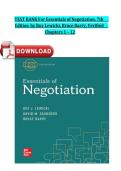
TEST BANK For Essentials of Negotiation, 7th
Edition by Roy Lewicki, Bruce Barry, Verified
Chapters 1 – 12
, Table of Contents
1. The Natureof Negotiation
2. Strategy and Tactics of DistributiveBargaining
3. Strategy and Tactics of IntegrativeNegotiation
4. Negotiation:Strategy and Planning
5. Ethics in Negotiation
6. Perception,Cognition,and Emotion
7. Communication
8. Finding and Using NegotiationPower
9. Relationshipsin Negotiation
10. MultipleParties, Groups,and Teams in Negotiation
11. Internationaland Cross- Cultural Negotiation
12. Best Practices in Negotiations
,Chapter1
Fill intheBlankQuestions
1. People all the time.
2. The term is used to describe the competitive,win- lose situationssuch as haggling
over price that happensat yard sale, flea market, or used car lot.
3. Negotiatingparties always negotiateby _.
4. Thereare times whenyou should negotiate.
5. Successful negotiation involvesthe managementof _ (e.g.,the price or the terms ofagreement)and
also the resolutionof .
, 6. Independentparties are able to meet their own withoutthe help and assistance of
others.
7. The mix of convergentand conflicting goals characterizes many relationships.
8. The of people'sgoals, and the of the situationin which they are
going to negotiate,strongly shapes negotiationprocesses and outcomes.
9. Whetheryou shouldor should not agree on somethingin a negotiationdependsentirely uponthe
attractivenessto you of the best available .
10. Whenparties are interdependent,they have to find a way to their differences.
11. Negotiationis a that transforms over time.
12. Negotiationsoftenbegin with statementsof opening .
Edition by Roy Lewicki, Bruce Barry, Verified
Chapters 1 – 12
, Table of Contents
1. The Natureof Negotiation
2. Strategy and Tactics of DistributiveBargaining
3. Strategy and Tactics of IntegrativeNegotiation
4. Negotiation:Strategy and Planning
5. Ethics in Negotiation
6. Perception,Cognition,and Emotion
7. Communication
8. Finding and Using NegotiationPower
9. Relationshipsin Negotiation
10. MultipleParties, Groups,and Teams in Negotiation
11. Internationaland Cross- Cultural Negotiation
12. Best Practices in Negotiations
,Chapter1
Fill intheBlankQuestions
1. People all the time.
2. The term is used to describe the competitive,win- lose situationssuch as haggling
over price that happensat yard sale, flea market, or used car lot.
3. Negotiatingparties always negotiateby _.
4. Thereare times whenyou should negotiate.
5. Successful negotiation involvesthe managementof _ (e.g.,the price or the terms ofagreement)and
also the resolutionof .
, 6. Independentparties are able to meet their own withoutthe help and assistance of
others.
7. The mix of convergentand conflicting goals characterizes many relationships.
8. The of people'sgoals, and the of the situationin which they are
going to negotiate,strongly shapes negotiationprocesses and outcomes.
9. Whetheryou shouldor should not agree on somethingin a negotiationdependsentirely uponthe
attractivenessto you of the best available .
10. Whenparties are interdependent,they have to find a way to their differences.
11. Negotiationis a that transforms over time.
12. Negotiationsoftenbegin with statementsof opening .


