

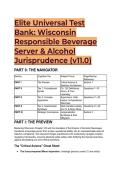
Elite Universal Test
Bank: Wisconsin
Responsible Beverage
Server & Alcohol
Jurisprudence (v11.0)
PART 0: THE NAVIGATOR
Section Cognitive Tier Subject Focus Page/Section
Reference
PART I The Preview Critical Axioms & Section 1
Statutory Architecture
PART II Tier 1: Foundational Ch. 125 Definitions, Questions 1–10
Syntax Hours, & Core
Licensing
PART II Tier 2: Complex Supervision, Safe Questions 11–20
Application Harbor, & Operational
Dilemmas
PART II Tier 3: Grandmaster Multi-Variable Liability, Questions 21–30
Synthesis Act 73, & Dram Shop
PART III Strategic Conclusions Jurisprudential Section 3
Synthesis & Risk
Mitigation
PART I: THE PREVIEW
Mastering Wisconsin Chapter 125 and the mandates of the Division of Alcoholic Beverages
transitions a beverage server from a basic operational liability into an unimpeachable asset of
statutory compliance. This document forges practitioners who instinctively navigate complex
regulatory frameworks, ensuring absolute public safety while fortifying the licensed premises
against devastating civil and criminal sanctions.
The "Critical Axioms" Cheat Sheet
● The Unaccompanied Minor Imperative: Underage persons (under 21) are strictly
, prohibited from possessing or consuming alcohol on licensed premises, unless
accompanied by a parent, legal guardian, or spouse of legal drinking age.
● The Act 73 Labor Framework: Only personnel 18 years or older may dispense, sell, or
pour alcohol. Personnel aged 14 to 17 may only carry alcohol to seated patrons, and
strictly under the continuous, immediate supervision of a licensed operator.
● The Corkage Prohibition (Closed-Loop System): "Corkage fees" are illegal; patrons
may never bring outside alcohol into a licensed premises. All alcohol must be sourced
from a permitted Wisconsin wholesaler.
● The 125.035 Dram Shop Shield: Wisconsin grants broad civil liability immunity to
providers of alcohol to adults. This shield evaporates immediately if alcohol is forced,
misrepresented as non-alcoholic, or provided to an unaccompanied underage person who
subsequently causes third-party injury.
● The 15/30 Credit Mandate: Retailers cannot sustain rolling debt. Wholesaler invoices
must be satisfied within 15 days for fermented malt beverages (beer) and 30 days for
intoxicating liquor.
Comprehensive Statutory Architecture
To facilitate elite-level retention, the following operational limits strictly define Wisconsin retail
environments :
License Classification Permitted Beverages Off-Premises Closing On-Premises Closing
Hour Hour
Class "A" Fermented Malt 12:00 Midnight to 6:00 Not Permitted
Beverages (Beer) a.m.
"Class A" Intoxicating Liquor 9:00 p.m. to 6:00 a.m. Not Permitted
(including Wine)
Class "B" Fermented Malt 12:00 Midnight to 6:00 2:00 a.m. (2:30 a.m.
Beverages (Beer) a.m. Weekends)
"Class B" Intoxicating Liquor 12:00 Midnight to 6:00 2:00 a.m. (2:30 a.m.
(including Wine) a.m. Weekends)
PART II: THE ELITE TEST BANK
Q1: A patron enters a Wisconsin retail establishment operating strictly under a "Class A"
(Intoxicating Liquor) license at 9:30 p.m. on a Tuesday. The patron attempts to purchase a
750ml bottle of vodka for off-premises consumption. Based on the principles of Wisconsin
statutory closing hours, which action/conclusion is the MOST ACCURATE? A) The sale is
permitted because "Class A" establishments may sell intoxicating liquor until midnight. B) The
sale is prohibited because the statutory cutoff for off-premises intoxicating liquor sales is 9:00
p.m. C) The sale is permitted provided the patron signs the ID register book to verify the time of
purchase. D) The sale is prohibited because "Class A" licenses only authorize the sale of
fermented malt beverages.
● The Answer: B (The sale is prohibited because the statutory cutoff for off-premises
intoxicating liquor sales is 9:00 p.m.)
● Distractor Analysis:
○ A is incorrect: This conflates the midnight cutoff for Class "A" (Beer) with the stricter
9:00 p.m. cutoff for "Class A" (Intoxicating Liquor).
○ C is incorrect: The ID register book is used to document age verification for
, questionable patrons, not to override statutory limits on operational hours.
○ D is incorrect: A "Class A" license (using quotation marks in Wisconsin syntax)
strictly refers to intoxicating liquor and wine, whereas a Class "A" (no quotes) refers
to fermented malt beverages.
The Mentor's Analysis: Wisconsin enforces a rigid legislative demarcation between the sale of
beer and the sale of intoxicating liquor for off-premises consumption. When managing a "Class
A" inventory, the immediate priority is locking out the point-of-sale system at exactly 21:00
hours. By utilizing an automated POS register lockout, you bypass the common trap of an
employee making an illegal late-night sale during shift fatigue. Professional/Academic
Intuition: Liquor stops at 9; Beer stops at Midnight. Automate your compliance.
Q2: An establishment holds a Class "B" retail license. It is the Sunday morning immediately
following the transition into Daylight Saving Time (spring forward). The bartender is determining
the legally mandated closing time to clear the floor. Based on Wis. Stat. § 125.32(3), which
action/conclusion is the MOST ACCURATE? A) The establishment must close at 2:00 a.m.,
ignoring the time change to prevent patron confusion. B) The establishment must close at 2:30
a.m. Central Standard Time. C) The establishment must close at 3:30 a.m. Central Daylight
Time. D) The establishment is exempt from closing hours due to the administrative burden of
the time change.
● The Answer: C (The establishment must close at 3:30 a.m. Central Daylight Time.)
● Distractor Analysis:
○ A is incorrect: Ignoring the statutory time change creates a direct conflict with state
law, which specifically addresses and accommodates the spring forward event.
○ B is incorrect: While 2:30 a.m. is the standard weekend closing time, the statute
provides a specific one-hour extension during the spring time change to prevent
losing an hour of legal economic operation.
○ D is incorrect: Establishments are never exempt from closing hours, with the sole
exception being January 1 (New Year's Day).
The Mentor's Analysis: Time is a rigid statutory construct, but the legislature recognized the
economic impact of losing a weekend operational hour in the spring. When Daylight Saving
Time begins, the immediate priority is adjusting the operational clock to 3:30 a.m.. By utilizing
this exact statutory allowance, you bypass the common trap of prematurely forcing patrons out
or accidentally serving past a perceived deadline. Professional/Academic Intuition: Spring
forward to 3:30 a.m.; Fall back to 2:30 a.m. Control the clock.
Q3: A 20-year-old patron approaches a bar inside a Class "B" licensed restaurant, accompanied
by his 22-year-old legally married wife. The wife orders two beers and hands one to her
20-year-old husband. Based on the principles of the Wisconsin Underage Exception under Wis.
Stat. § 125.07, which action/conclusion is the MOST ACCURATE? A) The bartender must
confiscate the beer, as the legal drinking age in Wisconsin is 21 without exception. B) The
bartender may allow the consumption, but only if the wife physically holds the beverage for the
husband. C) The bartender may legally allow the consumption, provided the establishment's
internal policies do not prohibit it. D) The bartender must demand the husband's parent arrive on
the premises to validate the marital status.
● The Answer: C (The bartender may legally allow the consumption, provided the
establishment's internal policies do not prohibit it.)
● Distractor Analysis:
○ A is incorrect: Wisconsin specifically grants an underage consumption exception
when the minor is accompanied by a parent, legal guardian, or spouse of legal
drinking age.
Bank: Wisconsin
Responsible Beverage
Server & Alcohol
Jurisprudence (v11.0)
PART 0: THE NAVIGATOR
Section Cognitive Tier Subject Focus Page/Section
Reference
PART I The Preview Critical Axioms & Section 1
Statutory Architecture
PART II Tier 1: Foundational Ch. 125 Definitions, Questions 1–10
Syntax Hours, & Core
Licensing
PART II Tier 2: Complex Supervision, Safe Questions 11–20
Application Harbor, & Operational
Dilemmas
PART II Tier 3: Grandmaster Multi-Variable Liability, Questions 21–30
Synthesis Act 73, & Dram Shop
PART III Strategic Conclusions Jurisprudential Section 3
Synthesis & Risk
Mitigation
PART I: THE PREVIEW
Mastering Wisconsin Chapter 125 and the mandates of the Division of Alcoholic Beverages
transitions a beverage server from a basic operational liability into an unimpeachable asset of
statutory compliance. This document forges practitioners who instinctively navigate complex
regulatory frameworks, ensuring absolute public safety while fortifying the licensed premises
against devastating civil and criminal sanctions.
The "Critical Axioms" Cheat Sheet
● The Unaccompanied Minor Imperative: Underage persons (under 21) are strictly
, prohibited from possessing or consuming alcohol on licensed premises, unless
accompanied by a parent, legal guardian, or spouse of legal drinking age.
● The Act 73 Labor Framework: Only personnel 18 years or older may dispense, sell, or
pour alcohol. Personnel aged 14 to 17 may only carry alcohol to seated patrons, and
strictly under the continuous, immediate supervision of a licensed operator.
● The Corkage Prohibition (Closed-Loop System): "Corkage fees" are illegal; patrons
may never bring outside alcohol into a licensed premises. All alcohol must be sourced
from a permitted Wisconsin wholesaler.
● The 125.035 Dram Shop Shield: Wisconsin grants broad civil liability immunity to
providers of alcohol to adults. This shield evaporates immediately if alcohol is forced,
misrepresented as non-alcoholic, or provided to an unaccompanied underage person who
subsequently causes third-party injury.
● The 15/30 Credit Mandate: Retailers cannot sustain rolling debt. Wholesaler invoices
must be satisfied within 15 days for fermented malt beverages (beer) and 30 days for
intoxicating liquor.
Comprehensive Statutory Architecture
To facilitate elite-level retention, the following operational limits strictly define Wisconsin retail
environments :
License Classification Permitted Beverages Off-Premises Closing On-Premises Closing
Hour Hour
Class "A" Fermented Malt 12:00 Midnight to 6:00 Not Permitted
Beverages (Beer) a.m.
"Class A" Intoxicating Liquor 9:00 p.m. to 6:00 a.m. Not Permitted
(including Wine)
Class "B" Fermented Malt 12:00 Midnight to 6:00 2:00 a.m. (2:30 a.m.
Beverages (Beer) a.m. Weekends)
"Class B" Intoxicating Liquor 12:00 Midnight to 6:00 2:00 a.m. (2:30 a.m.
(including Wine) a.m. Weekends)
PART II: THE ELITE TEST BANK
Q1: A patron enters a Wisconsin retail establishment operating strictly under a "Class A"
(Intoxicating Liquor) license at 9:30 p.m. on a Tuesday. The patron attempts to purchase a
750ml bottle of vodka for off-premises consumption. Based on the principles of Wisconsin
statutory closing hours, which action/conclusion is the MOST ACCURATE? A) The sale is
permitted because "Class A" establishments may sell intoxicating liquor until midnight. B) The
sale is prohibited because the statutory cutoff for off-premises intoxicating liquor sales is 9:00
p.m. C) The sale is permitted provided the patron signs the ID register book to verify the time of
purchase. D) The sale is prohibited because "Class A" licenses only authorize the sale of
fermented malt beverages.
● The Answer: B (The sale is prohibited because the statutory cutoff for off-premises
intoxicating liquor sales is 9:00 p.m.)
● Distractor Analysis:
○ A is incorrect: This conflates the midnight cutoff for Class "A" (Beer) with the stricter
9:00 p.m. cutoff for "Class A" (Intoxicating Liquor).
○ C is incorrect: The ID register book is used to document age verification for
, questionable patrons, not to override statutory limits on operational hours.
○ D is incorrect: A "Class A" license (using quotation marks in Wisconsin syntax)
strictly refers to intoxicating liquor and wine, whereas a Class "A" (no quotes) refers
to fermented malt beverages.
The Mentor's Analysis: Wisconsin enforces a rigid legislative demarcation between the sale of
beer and the sale of intoxicating liquor for off-premises consumption. When managing a "Class
A" inventory, the immediate priority is locking out the point-of-sale system at exactly 21:00
hours. By utilizing an automated POS register lockout, you bypass the common trap of an
employee making an illegal late-night sale during shift fatigue. Professional/Academic
Intuition: Liquor stops at 9; Beer stops at Midnight. Automate your compliance.
Q2: An establishment holds a Class "B" retail license. It is the Sunday morning immediately
following the transition into Daylight Saving Time (spring forward). The bartender is determining
the legally mandated closing time to clear the floor. Based on Wis. Stat. § 125.32(3), which
action/conclusion is the MOST ACCURATE? A) The establishment must close at 2:00 a.m.,
ignoring the time change to prevent patron confusion. B) The establishment must close at 2:30
a.m. Central Standard Time. C) The establishment must close at 3:30 a.m. Central Daylight
Time. D) The establishment is exempt from closing hours due to the administrative burden of
the time change.
● The Answer: C (The establishment must close at 3:30 a.m. Central Daylight Time.)
● Distractor Analysis:
○ A is incorrect: Ignoring the statutory time change creates a direct conflict with state
law, which specifically addresses and accommodates the spring forward event.
○ B is incorrect: While 2:30 a.m. is the standard weekend closing time, the statute
provides a specific one-hour extension during the spring time change to prevent
losing an hour of legal economic operation.
○ D is incorrect: Establishments are never exempt from closing hours, with the sole
exception being January 1 (New Year's Day).
The Mentor's Analysis: Time is a rigid statutory construct, but the legislature recognized the
economic impact of losing a weekend operational hour in the spring. When Daylight Saving
Time begins, the immediate priority is adjusting the operational clock to 3:30 a.m.. By utilizing
this exact statutory allowance, you bypass the common trap of prematurely forcing patrons out
or accidentally serving past a perceived deadline. Professional/Academic Intuition: Spring
forward to 3:30 a.m.; Fall back to 2:30 a.m. Control the clock.
Q3: A 20-year-old patron approaches a bar inside a Class "B" licensed restaurant, accompanied
by his 22-year-old legally married wife. The wife orders two beers and hands one to her
20-year-old husband. Based on the principles of the Wisconsin Underage Exception under Wis.
Stat. § 125.07, which action/conclusion is the MOST ACCURATE? A) The bartender must
confiscate the beer, as the legal drinking age in Wisconsin is 21 without exception. B) The
bartender may allow the consumption, but only if the wife physically holds the beverage for the
husband. C) The bartender may legally allow the consumption, provided the establishment's
internal policies do not prohibit it. D) The bartender must demand the husband's parent arrive on
the premises to validate the marital status.
● The Answer: C (The bartender may legally allow the consumption, provided the
establishment's internal policies do not prohibit it.)
● Distractor Analysis:
○ A is incorrect: Wisconsin specifically grants an underage consumption exception
when the minor is accompanied by a parent, legal guardian, or spouse of legal
drinking age.


