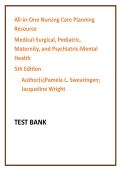
All-in-One Nursing Care Planning
Resource
Medical-Surgical, Pediatric,
Maternity, and Psychiatric-Mental
Health
5th Edition
• Author(s)Pamela L. Swearingen;
Jacqueline Wright
TEST BANK
,1) MCQ — Cancer Care
Clinical scenario:
A 56-year-old client received chemotherapy 7 days ago and now
has a temperature of 38.2°C (100.8°F), chills, and an absolute
neutrophil count of 400/mm³.
Stem:
What should the nurse do first?
Answer options:
A. Encourage oral fluids and reassess in 2 hours
B. Administer acetaminophen and document the temperature
C. Initiate protective precautions and notify the provider
immediately
D. Place a warm blanket over the client and leave the room to
reduce stimulation
Correct answer:
C
Detailed rationale:
This client has febrile neutropenia, a medical emergency
because the immune system may not be able to contain an
infection. The nurse should act immediately to reduce exposure
risk and alert the provider so cultures, antibiotics, and further
treatment can begin.
,Incorrect option analysis:
• A: Delays urgent care and does not address infection risk.
Common misconception: thinking hydration alone is
enough.
• B: May mask the fever and delay recognition of sepsis.
• D: Warmth does not treat the cause; leaving the client
alone is unsafe.
Nursing process linkage: Implementation
NCJMM competencies: Recognize Cues, Prioritize Hypotheses,
Take Action
Difficulty: Difficult
Bloom’s level: Analyze
NCLEX client needs: Reduction of Risk Potential / Physiological
Adaptation
Nursing diagnosis integration:
• Priority diagnosis: Risk for infection
• Risk factors: Chemotherapy-related neutropenia
Expected outcome: The client will remain free from sepsis,
have blood cultures obtained, and begin prescribed
antimicrobial therapy promptly.
Key learning objective: Prioritize emergency infection-
control actions in chemotherapy-related neutropenia.
, 2) SATA — Cancer Care
Clinical scenario:
A client receiving chemotherapy reports a sore mouth, pain
when swallowing, and a burning sensation in the cheeks and
tongue.
Stem:
Which nursing interventions are appropriate? Select all that
apply.
Answer options:
A. Use a soft-bristle toothbrush or gentle oral swab if tolerated
B. Rinse the mouth with saline or sodium bicarbonate solution
C. Offer spicy, acidic, or rough-textured foods to stimulate
appetite
D. Give prescribed pain medication before meals
E. Use alcohol-based mouthwash after each meal
F. Offer cool, soft, bland foods
Correct answers:
A, B, D, F
Detailed rationale:
These findings suggest oral mucositis, a common
chemotherapy effect. Gentle oral care, rinses that do not
irritate tissue, pre-meal analgesia, and nonirritating foods
reduce pain and support nutrition.
Resource
Medical-Surgical, Pediatric,
Maternity, and Psychiatric-Mental
Health
5th Edition
• Author(s)Pamela L. Swearingen;
Jacqueline Wright
TEST BANK
,1) MCQ — Cancer Care
Clinical scenario:
A 56-year-old client received chemotherapy 7 days ago and now
has a temperature of 38.2°C (100.8°F), chills, and an absolute
neutrophil count of 400/mm³.
Stem:
What should the nurse do first?
Answer options:
A. Encourage oral fluids and reassess in 2 hours
B. Administer acetaminophen and document the temperature
C. Initiate protective precautions and notify the provider
immediately
D. Place a warm blanket over the client and leave the room to
reduce stimulation
Correct answer:
C
Detailed rationale:
This client has febrile neutropenia, a medical emergency
because the immune system may not be able to contain an
infection. The nurse should act immediately to reduce exposure
risk and alert the provider so cultures, antibiotics, and further
treatment can begin.
,Incorrect option analysis:
• A: Delays urgent care and does not address infection risk.
Common misconception: thinking hydration alone is
enough.
• B: May mask the fever and delay recognition of sepsis.
• D: Warmth does not treat the cause; leaving the client
alone is unsafe.
Nursing process linkage: Implementation
NCJMM competencies: Recognize Cues, Prioritize Hypotheses,
Take Action
Difficulty: Difficult
Bloom’s level: Analyze
NCLEX client needs: Reduction of Risk Potential / Physiological
Adaptation
Nursing diagnosis integration:
• Priority diagnosis: Risk for infection
• Risk factors: Chemotherapy-related neutropenia
Expected outcome: The client will remain free from sepsis,
have blood cultures obtained, and begin prescribed
antimicrobial therapy promptly.
Key learning objective: Prioritize emergency infection-
control actions in chemotherapy-related neutropenia.
, 2) SATA — Cancer Care
Clinical scenario:
A client receiving chemotherapy reports a sore mouth, pain
when swallowing, and a burning sensation in the cheeks and
tongue.
Stem:
Which nursing interventions are appropriate? Select all that
apply.
Answer options:
A. Use a soft-bristle toothbrush or gentle oral swab if tolerated
B. Rinse the mouth with saline or sodium bicarbonate solution
C. Offer spicy, acidic, or rough-textured foods to stimulate
appetite
D. Give prescribed pain medication before meals
E. Use alcohol-based mouthwash after each meal
F. Offer cool, soft, bland foods
Correct answers:
A, B, D, F
Detailed rationale:
These findings suggest oral mucositis, a common
chemotherapy effect. Gentle oral care, rinses that do not
irritate tissue, pre-meal analgesia, and nonirritating foods
reduce pain and support nutrition.