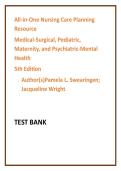
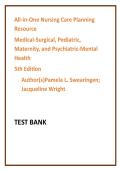
All-in-One Nursing Care Planning
Resource
Medical-Surgical, Pediatric,
Maternity, and Psychiatric-Mental
Health
5th Edition
• Author(s)Pamela L. Swearingen;
Jacqueline Wright
TEST BANK
,1) MCQ — Cancer Care: Febrile Neutropenia
Clinical scenario: A 67-year-old receiving cycle 2 of
chemotherapy reports chills. The nurse notes a temperature of
38.4°C (101.1°F), ANC 620/mm³, and mild confusion.
Question stem: What is the nurse’s priority action?
Answer options:
A. Give acetaminophen and reassess in 4 hours
B. Notify the provider, initiate infection precautions, and
prepare for cultures and IV antibiotics
C. Encourage fresh fruits and raw vegetables
D. Delay action until the next CBC result is available
Correct answer: B
Rationale: Fever with neutropenia is an oncologic emergency.
The nurse should act immediately to reduce sepsis risk, obtain
ordered cultures, and prepare for prompt broad-spectrum
antibiotics.
Incorrect option analysis:
A. Incorrect — masks a potentially life-threatening infection;
common misconception is treating fever as a comfort issue only.
C. Incorrect — raw foods increase infection risk during
neutropenia.
D. Incorrect — delays urgent treatment and increases risk of
shock.
,Nursing process link: Implementation
NCJMM: Recognize Cues; Analyze Cues; Prioritize Hypotheses;
Take Action
Difficulty: Difficult
Bloom’s level: Analyze
NCLEX client needs: Physiological Adaptation
Nursing diagnosis integration: Risk for infection related to
chemotherapy-induced neutropenia
Expected outcome: Patient receives timely cultures and
antibiotics, and temperature/hemodynamics stabilize
Key learning objective: Prioritize emergency interventions for
neutropenic fever
2) SATA — Cancer Care: Radiation Skin Teaching
Clinical scenario: A patient starting external beam radiation to
the neck asks how to care for the treatment area.
Question stem: Which statements indicate correct
understanding? Select all that apply.
Answer options:
A. “I will wash the area gently with lukewarm water and mild
soap.”
B. “I will place an ice pack on the treated skin if it feels hot.”
C. “I will wear soft, loose clothing over the site.”
D. “I will scrub off the treatment markings after each session.”
, E. “I will avoid heating pads and adhesive tape on the area.”
F. “I will use only skin products approved by the radiation
team.”
Correct answers: A, C, E, F
Rationale: Radiation skin is fragile and must be protected from
friction, heat, and irritants. Gentle cleansing and approved
products support skin integrity.
Incorrect option analysis:
B. Incorrect — ice can injure irradiated skin.
D. Incorrect — markings should be preserved unless the team
instructs otherwise; scrubbing can damage skin.
Nursing process link: Planning / Implementation
NCJMM: Recognize Cues; Generate Solutions; Take Action
Difficulty: Moderate
Bloom’s level: Apply
NCLEX client needs: Basic Care and Comfort; Safety and
Infection Control
Nursing diagnosis integration: Risk for impaired skin integrity
related to radiation therapy
Expected outcome: Skin remains intact without breakdown or
infection
Key learning objective: Teach evidence-informed skin care
during radiation therapy
Resource
Medical-Surgical, Pediatric,
Maternity, and Psychiatric-Mental
Health
5th Edition
• Author(s)Pamela L. Swearingen;
Jacqueline Wright
TEST BANK
,1) MCQ — Cancer Care: Febrile Neutropenia
Clinical scenario: A 67-year-old receiving cycle 2 of
chemotherapy reports chills. The nurse notes a temperature of
38.4°C (101.1°F), ANC 620/mm³, and mild confusion.
Question stem: What is the nurse’s priority action?
Answer options:
A. Give acetaminophen and reassess in 4 hours
B. Notify the provider, initiate infection precautions, and
prepare for cultures and IV antibiotics
C. Encourage fresh fruits and raw vegetables
D. Delay action until the next CBC result is available
Correct answer: B
Rationale: Fever with neutropenia is an oncologic emergency.
The nurse should act immediately to reduce sepsis risk, obtain
ordered cultures, and prepare for prompt broad-spectrum
antibiotics.
Incorrect option analysis:
A. Incorrect — masks a potentially life-threatening infection;
common misconception is treating fever as a comfort issue only.
C. Incorrect — raw foods increase infection risk during
neutropenia.
D. Incorrect — delays urgent treatment and increases risk of
shock.
,Nursing process link: Implementation
NCJMM: Recognize Cues; Analyze Cues; Prioritize Hypotheses;
Take Action
Difficulty: Difficult
Bloom’s level: Analyze
NCLEX client needs: Physiological Adaptation
Nursing diagnosis integration: Risk for infection related to
chemotherapy-induced neutropenia
Expected outcome: Patient receives timely cultures and
antibiotics, and temperature/hemodynamics stabilize
Key learning objective: Prioritize emergency interventions for
neutropenic fever
2) SATA — Cancer Care: Radiation Skin Teaching
Clinical scenario: A patient starting external beam radiation to
the neck asks how to care for the treatment area.
Question stem: Which statements indicate correct
understanding? Select all that apply.
Answer options:
A. “I will wash the area gently with lukewarm water and mild
soap.”
B. “I will place an ice pack on the treated skin if it feels hot.”
C. “I will wear soft, loose clothing over the site.”
D. “I will scrub off the treatment markings after each session.”
, E. “I will avoid heating pads and adhesive tape on the area.”
F. “I will use only skin products approved by the radiation
team.”
Correct answers: A, C, E, F
Rationale: Radiation skin is fragile and must be protected from
friction, heat, and irritants. Gentle cleansing and approved
products support skin integrity.
Incorrect option analysis:
B. Incorrect — ice can injure irradiated skin.
D. Incorrect — markings should be preserved unless the team
instructs otherwise; scrubbing can damage skin.
Nursing process link: Planning / Implementation
NCJMM: Recognize Cues; Generate Solutions; Take Action
Difficulty: Moderate
Bloom’s level: Apply
NCLEX client needs: Basic Care and Comfort; Safety and
Infection Control
Nursing diagnosis integration: Risk for impaired skin integrity
related to radiation therapy
Expected outcome: Skin remains intact without breakdown or
infection
Key learning objective: Teach evidence-informed skin care
during radiation therapy