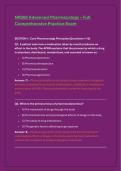
NR565 Advanced Pharmacology – Full
Comprehensive Practice Exam
SECTION 1: Core Pharmacology Principles (Questions 1-15)
Q1. A patient asks how a medication taken by mouth produces an
effect in the body. The APRN explains that the process by which a drug
is absorbed, distributed, metabolized, and excreted is known as:
• A) Pharmacodynamics
• B) Pharmacotherapeutics
• C) Pharmacokinetics
• D) Pharmacogenomics
Answer: C – Pharmacokinetics is the study of drug movement throughout
the body, including the processes of absorption, distribution, metabolism,
and excretion (ADME). Pharmacodynamics is what the drug does to the
body .
Q2. What is the primary focus of pharmacodynamics?
• A) The movement of drugs through the body
• B) The biochemical and physiological effects of drugs on the body
• C) The study of drug interactions
• D) The genetic factors affecting drug response
Answer: B – Pharmacodynamics is the study of the biochemical and
physiological effects of drugs on the body, exploring how medications
interact with receptors to produce biological responses .
,Q3. A drug that binds to a receptor and produces a response that is less
than that of a full agonist, even at maximal concentrations, is known as
a:
• A) Partial agonist
• B) Inverse agonist
• C) Competitive antagonist
• D) Non-competitive antagonist
Answer: A – A partial agonist has lower efficacy than a full agonist. It binds
to and activates a receptor but cannot produce a maximal response, even
when all receptors are occupied .
Q4. An APRN is prescribing a medication that is known to be a CYP450
enzyme inducer. What effect will this have on other medications
metabolized by that enzyme pathway?
• A) Increased serum levels of the other medications, potentially
leading to toxicity
• B) Decreased serum levels of the other medications, potentially
leading to therapeutic failure
• C) No effect on serum levels of the other medications
• D) Prolonged half-life of the other medications
Answer: B – CYP450 inducers increase the metabolic activity of liver
enzymes, leading to faster breakdown of medications metabolized through
that pathway. This results in decreased serum concentrations, which can
lead to therapeutic failure. Mnemonic: CRAPGPS - Carbamazepine,
Rifampin, Alcohol, Phenytoin, Griseofulvin, Phenobarbital, Sulfonylureas .
Q5. Which of the following is a CYP450 enzyme inhibitor?
• A) Rifampin
, • B) Phenytoin
• C) Ketoconazole
• D) Carbamazepine
Answer: C – Ketoconazole is a CYP450 inhibitor that slows the metabolic
activity of liver enzymes, increasing serum levels of medications
metabolized through that pathway. Inhibitors can be remembered using the
mnemonic "RIPE" (Ritonavir, Isoniazid, Protease inhibitors, Erythromycin)
and others like cimetidine, amiodarone, and grapefruit juice .
Q6. Which factor influences the rate of drug absorption? (Select all that
apply)
• A) Dissolution rate
• B) Surface area for absorption
• C) Vascularity at the absorption site
• D) Lipid solubility
Answer: A, B, C, D – Key physiological and chemical factors influencing
drug absorption include dissolution rate, surface area, vascularity, lipid
solubility, and pH partitioning .
Q7. The "first-pass effect" refers to:
• A) Drug distribution into body tissues
• B) The initial metabolism of an oral drug by the liver before it reaches
systemic circulation
• C) The binding of a drug to plasma proteins
• D) The excretion of a drug by the kidneys
Answer: B – The first-pass effect refers to the metabolism of an oral drug by
the liver before it reaches systemic circulation, reducing the amount of
active drug available .
, Q8. Which of the following is the most common cause of drug-drug
interactions?
• A) Altered absorption
• B) Competition for protein binding sites
• C) Inhibition or induction of CYP450 enzymes
• D) Altered renal excretion
Answer: C – The cytochrome P450 (CYP450) system is responsible for
phase 1 metabolism of many drugs. Inhibition or induction of CYP450
enzymes is the most common mechanism of drug-drug interactions .
Q9. What factor should be considered before prescribing any
medication?
• A) Age
• B) Race
• C) Weight
• D) All of the above
Answer: D – Factors such as age, race, weight, and diagnoses must be
considered before prescribing any medication .
Q10. The concept of Pharmacokinetics describes:
• A) What the drug does to the body
• B) The study of drug-receptor interactions
• C) The movement of a drug through the body over time
• D) The genetic variability in drug response
Comprehensive Practice Exam
SECTION 1: Core Pharmacology Principles (Questions 1-15)
Q1. A patient asks how a medication taken by mouth produces an
effect in the body. The APRN explains that the process by which a drug
is absorbed, distributed, metabolized, and excreted is known as:
• A) Pharmacodynamics
• B) Pharmacotherapeutics
• C) Pharmacokinetics
• D) Pharmacogenomics
Answer: C – Pharmacokinetics is the study of drug movement throughout
the body, including the processes of absorption, distribution, metabolism,
and excretion (ADME). Pharmacodynamics is what the drug does to the
body .
Q2. What is the primary focus of pharmacodynamics?
• A) The movement of drugs through the body
• B) The biochemical and physiological effects of drugs on the body
• C) The study of drug interactions
• D) The genetic factors affecting drug response
Answer: B – Pharmacodynamics is the study of the biochemical and
physiological effects of drugs on the body, exploring how medications
interact with receptors to produce biological responses .
,Q3. A drug that binds to a receptor and produces a response that is less
than that of a full agonist, even at maximal concentrations, is known as
a:
• A) Partial agonist
• B) Inverse agonist
• C) Competitive antagonist
• D) Non-competitive antagonist
Answer: A – A partial agonist has lower efficacy than a full agonist. It binds
to and activates a receptor but cannot produce a maximal response, even
when all receptors are occupied .
Q4. An APRN is prescribing a medication that is known to be a CYP450
enzyme inducer. What effect will this have on other medications
metabolized by that enzyme pathway?
• A) Increased serum levels of the other medications, potentially
leading to toxicity
• B) Decreased serum levels of the other medications, potentially
leading to therapeutic failure
• C) No effect on serum levels of the other medications
• D) Prolonged half-life of the other medications
Answer: B – CYP450 inducers increase the metabolic activity of liver
enzymes, leading to faster breakdown of medications metabolized through
that pathway. This results in decreased serum concentrations, which can
lead to therapeutic failure. Mnemonic: CRAPGPS - Carbamazepine,
Rifampin, Alcohol, Phenytoin, Griseofulvin, Phenobarbital, Sulfonylureas .
Q5. Which of the following is a CYP450 enzyme inhibitor?
• A) Rifampin
, • B) Phenytoin
• C) Ketoconazole
• D) Carbamazepine
Answer: C – Ketoconazole is a CYP450 inhibitor that slows the metabolic
activity of liver enzymes, increasing serum levels of medications
metabolized through that pathway. Inhibitors can be remembered using the
mnemonic "RIPE" (Ritonavir, Isoniazid, Protease inhibitors, Erythromycin)
and others like cimetidine, amiodarone, and grapefruit juice .
Q6. Which factor influences the rate of drug absorption? (Select all that
apply)
• A) Dissolution rate
• B) Surface area for absorption
• C) Vascularity at the absorption site
• D) Lipid solubility
Answer: A, B, C, D – Key physiological and chemical factors influencing
drug absorption include dissolution rate, surface area, vascularity, lipid
solubility, and pH partitioning .
Q7. The "first-pass effect" refers to:
• A) Drug distribution into body tissues
• B) The initial metabolism of an oral drug by the liver before it reaches
systemic circulation
• C) The binding of a drug to plasma proteins
• D) The excretion of a drug by the kidneys
Answer: B – The first-pass effect refers to the metabolism of an oral drug by
the liver before it reaches systemic circulation, reducing the amount of
active drug available .
, Q8. Which of the following is the most common cause of drug-drug
interactions?
• A) Altered absorption
• B) Competition for protein binding sites
• C) Inhibition or induction of CYP450 enzymes
• D) Altered renal excretion
Answer: C – The cytochrome P450 (CYP450) system is responsible for
phase 1 metabolism of many drugs. Inhibition or induction of CYP450
enzymes is the most common mechanism of drug-drug interactions .
Q9. What factor should be considered before prescribing any
medication?
• A) Age
• B) Race
• C) Weight
• D) All of the above
Answer: D – Factors such as age, race, weight, and diagnoses must be
considered before prescribing any medication .
Q10. The concept of Pharmacokinetics describes:
• A) What the drug does to the body
• B) The study of drug-receptor interactions
• C) The movement of a drug through the body over time
• D) The genetic variability in drug response