

Economics of Money and Finance
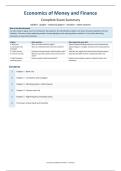
Complete Exam Summary
Models - graphs - empirical papers - intuition - exam answers
How to use this document
For each model or paper, learn the mechanism, the prediction, the identification problem, the result, the policy implication and one
limitation. The exam is about explaining models, interpreting figures and reasoning about causality; it is not mainly about long
derivations or exact point estimates.
Chapter Main question Most important exam skill
1. Bank runs Why can useful banks be fragile? Explain Diamond-Dybvig and panic versus fundamentals.
2. Correlation and Why can individual distress become systemic? Explain Wagner, contagion channels and macroprudential
contagion logic.
3. Credit channel How does monetary policy work through credit? Separate loan supply from demand and interpret papers.
4. Interest-rate risk Why do rates affect bank income and economic Separate flow NIM risk from valuation/duration risk.
value?
5. High-frequency How can policy shocks be identified? Explain event-window surprises, Swanson factors and
monetary policy limitations.
Contents
1 Chapter 1 - Bank runs
2 Chapter 2 - Correlation and contagion
3 Chapter 3 - Monetary policy: credit channel
4 Chapter 4 - Interest-rate risk
5 Chapter 5 - High-frequency monetary policy
6 Final exam answer bank and checklists
Economics of Money & Finance - Summary
,Paper map: exact contribution and conclusion
Paper What it studies Exam conclusion
Diamond & Dybvig (1983) Why banks exist and why they are fragile Demand deposits provide liquidity insurance but create two
equilibria: no-run and run.
Richardson & Troost (2009) Does liquidity intervention mitigate panics? Mississippi Fed-district design suggests discount-window
liquidity support increased bank survival.
Calomiris & Mason (2003) Panic versus fundamentals in the Depression Fundamentals explain much bank distress; panic dummies
add limited explanatory power before 1933.
De Graeve & Karas How to identify bank runs empirically Uninsured deposit outflows with higher rates indicate runs;
both panic and fundamentals matter, panic dominates
aggregate outflows.
Wagner (2010) Can diversification increase systemic risk? Private diversification can reduce individual risk but raise
joint failure risk through correlation.
Brunnermeier & Pedersen (2009) Funding liquidity and market liquidity Haircuts, leverage and asset prices reinforce each other in
liquidity spirals.
Bernanke & Blinder Timing of loans after policy tightening Delayed loan response does not refute the credit view
because loans are sticky.
Peek & Rosengren External bank-capital shock Bank balance-sheet weakness can reduce credit supply and
transmit internationally.
Khwaja & Mian Clean loan-supply identification Same-firm, different-bank comparisons control for
borrower demand.
Ciccarelli, Maddaloni & Peydro Bank Lending Survey evidence Monetary tightening affects credit standards; useful but
survey-based and qualitative.
De Graeve (2020) Credit anatomy of the housing boom Early boom mainly sound mortgage demand; bad/loose
supply becomes more important later.
Swanson (2021) Multidimensional policy surprises Separates policy-rate, forward-guidance and LSAP/QE
shocks using yield-curve movements.
Nakamura & Steinsson / Jarocinski-Karadi Information effects Policy announcements may reveal central-bank
information, complicating pure policy-shock interpretation.
Economics of Money & Finance - Summary
, Chapter 1 - Bank runs
Exam target
Explain why banks are useful and fragile, derive the two Diamond-Dybvig equilibria in words, distinguish panic from fundamentals, and
interpret the empirical papers on liquidity support and bank-run identification.
1.1 Why banks exist and why they are fragile
Banks exist because they transform illiquid long-term investments into liquid short-term claims. They pool idiosyncratic liquidity needs: not
everyone needs cash at the same time, so a bank can promise liquidity to depositors while investing in productive long-term projects. The
fragility is created by the same contract that provides liquidity: demand deposits are withdrawable early and paid sequentially.
Function Benefit Fragility created
Maturity transformation Long-term projects can be financed. Assets cannot be liquidated instantly without loss.
Liquidity insurance Impatient depositors can consume early. Patient depositors can mimic impatience and withdraw.
Demand deposits Depositors receive a liquid claim. First-come-first-served payment creates run incentives.
Pooling Idiosyncratic liquidity needs are shared. Aggregate panic can exhaust the pool.
Figure 1. Diamond-Dybvig timeline: the strategic problem appears at T=1.
High-yield sentence
A bank run is not simply a bank being risky; it is the possibility that a socially useful liquidity-insurance contract creates a bad self-
fulfilling equilibrium.
1.2 Diamond-Dybvig setup and two equilibria
• Three dates: T=0 investment; T=1 early consumption and withdrawal decision; T=2 long-term payoff.
• Two depositor types: impatient consumers need T=1 consumption; patient consumers prefer T=2 consumption.
• Long asset: if held to maturity, it pays R > 1; if liquidated early, it pays less.
• Private information: the bank cannot perfectly observe who is impatient.
Figure 2. Observable types give first-best contracts; unobservable types force demand deposits.
Equilibrium Depositor behavior Outcome Welfare
Good/no-run Only impatient types withdraw early; Long asset is preserved; patient types Efficient relative to autarky.
patient types wait. receive high return.
Bad/run Patient types also withdraw early. Long assets are liquidated early; solvent Inefficient; risk sharing
bank may fail. collapses.
Economics of Money & Finance - Summary
Complete Exam Summary
Models - graphs - empirical papers - intuition - exam answers
How to use this document
For each model or paper, learn the mechanism, the prediction, the identification problem, the result, the policy implication and one
limitation. The exam is about explaining models, interpreting figures and reasoning about causality; it is not mainly about long
derivations or exact point estimates.
Chapter Main question Most important exam skill
1. Bank runs Why can useful banks be fragile? Explain Diamond-Dybvig and panic versus fundamentals.
2. Correlation and Why can individual distress become systemic? Explain Wagner, contagion channels and macroprudential
contagion logic.
3. Credit channel How does monetary policy work through credit? Separate loan supply from demand and interpret papers.
4. Interest-rate risk Why do rates affect bank income and economic Separate flow NIM risk from valuation/duration risk.
value?
5. High-frequency How can policy shocks be identified? Explain event-window surprises, Swanson factors and
monetary policy limitations.
Contents
1 Chapter 1 - Bank runs
2 Chapter 2 - Correlation and contagion
3 Chapter 3 - Monetary policy: credit channel
4 Chapter 4 - Interest-rate risk
5 Chapter 5 - High-frequency monetary policy
6 Final exam answer bank and checklists
Economics of Money & Finance - Summary
,Paper map: exact contribution and conclusion
Paper What it studies Exam conclusion
Diamond & Dybvig (1983) Why banks exist and why they are fragile Demand deposits provide liquidity insurance but create two
equilibria: no-run and run.
Richardson & Troost (2009) Does liquidity intervention mitigate panics? Mississippi Fed-district design suggests discount-window
liquidity support increased bank survival.
Calomiris & Mason (2003) Panic versus fundamentals in the Depression Fundamentals explain much bank distress; panic dummies
add limited explanatory power before 1933.
De Graeve & Karas How to identify bank runs empirically Uninsured deposit outflows with higher rates indicate runs;
both panic and fundamentals matter, panic dominates
aggregate outflows.
Wagner (2010) Can diversification increase systemic risk? Private diversification can reduce individual risk but raise
joint failure risk through correlation.
Brunnermeier & Pedersen (2009) Funding liquidity and market liquidity Haircuts, leverage and asset prices reinforce each other in
liquidity spirals.
Bernanke & Blinder Timing of loans after policy tightening Delayed loan response does not refute the credit view
because loans are sticky.
Peek & Rosengren External bank-capital shock Bank balance-sheet weakness can reduce credit supply and
transmit internationally.
Khwaja & Mian Clean loan-supply identification Same-firm, different-bank comparisons control for
borrower demand.
Ciccarelli, Maddaloni & Peydro Bank Lending Survey evidence Monetary tightening affects credit standards; useful but
survey-based and qualitative.
De Graeve (2020) Credit anatomy of the housing boom Early boom mainly sound mortgage demand; bad/loose
supply becomes more important later.
Swanson (2021) Multidimensional policy surprises Separates policy-rate, forward-guidance and LSAP/QE
shocks using yield-curve movements.
Nakamura & Steinsson / Jarocinski-Karadi Information effects Policy announcements may reveal central-bank
information, complicating pure policy-shock interpretation.
Economics of Money & Finance - Summary
, Chapter 1 - Bank runs
Exam target
Explain why banks are useful and fragile, derive the two Diamond-Dybvig equilibria in words, distinguish panic from fundamentals, and
interpret the empirical papers on liquidity support and bank-run identification.
1.1 Why banks exist and why they are fragile
Banks exist because they transform illiquid long-term investments into liquid short-term claims. They pool idiosyncratic liquidity needs: not
everyone needs cash at the same time, so a bank can promise liquidity to depositors while investing in productive long-term projects. The
fragility is created by the same contract that provides liquidity: demand deposits are withdrawable early and paid sequentially.
Function Benefit Fragility created
Maturity transformation Long-term projects can be financed. Assets cannot be liquidated instantly without loss.
Liquidity insurance Impatient depositors can consume early. Patient depositors can mimic impatience and withdraw.
Demand deposits Depositors receive a liquid claim. First-come-first-served payment creates run incentives.
Pooling Idiosyncratic liquidity needs are shared. Aggregate panic can exhaust the pool.
Figure 1. Diamond-Dybvig timeline: the strategic problem appears at T=1.
High-yield sentence
A bank run is not simply a bank being risky; it is the possibility that a socially useful liquidity-insurance contract creates a bad self-
fulfilling equilibrium.
1.2 Diamond-Dybvig setup and two equilibria
• Three dates: T=0 investment; T=1 early consumption and withdrawal decision; T=2 long-term payoff.
• Two depositor types: impatient consumers need T=1 consumption; patient consumers prefer T=2 consumption.
• Long asset: if held to maturity, it pays R > 1; if liquidated early, it pays less.
• Private information: the bank cannot perfectly observe who is impatient.
Figure 2. Observable types give first-best contracts; unobservable types force demand deposits.
Equilibrium Depositor behavior Outcome Welfare
Good/no-run Only impatient types withdraw early; Long asset is preserved; patient types Efficient relative to autarky.
patient types wait. receive high return.
Bad/run Patient types also withdraw early. Long assets are liquidated early; solvent Inefficient; risk sharing
bank may fail. collapses.
Economics of Money & Finance - Summary


