

CSET ENGLISH SUBTEST I
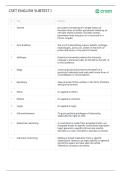
# Term Definition
1 Sonnet lyric poem consisting of a single stanza of
fourteen lines of iambic parameter linked by an
intricate rhyme scheme. fourteen iambic
parameter lines long just as it must end in a
heroic couplet.
2 Oral tradition the art of transmitting culture, beliefs, heritage,
mythologies, and so on, either in the form of
prose and verse, or by word of mouth.
3 Soliloquy theatrical convention where the character
onstage is alone but talks to himself or herself, or
to the audience.
4 Elegy a formal poem that laments the death of a
particular individual and ends with some form of
consolidation or reconciliation.
5 Epistolary style of prose fiction written in the form of letters
and journal entries.
6 Ethos An appeal to ethics
7 Pathos An appeal to emotion
8 Logos An appeal to logic
9 Enfranchisement To grant political privileges of citizenship,
especially the right to vote.
10 Deductive reasoning A conclusion is made from accepted truths. ex)
Accepted truths to specific conclusions (top-down
logic) general to specific All men are mortal.
Socrates is a man. Therefore, Socrates is mortal.
11 Inductive reasoning Making a broad realization from a specific
observation. (bottom up logic) Specific to general
ex) All the swans we have seen are white.
Therefore, all swans are white.
# Term Definition
1 Sonnet lyric poem consisting of a single stanza of
fourteen lines of iambic parameter linked by an
intricate rhyme scheme. fourteen iambic
parameter lines long just as it must end in a
heroic couplet.
2 Oral tradition the art of transmitting culture, beliefs, heritage,
mythologies, and so on, either in the form of
prose and verse, or by word of mouth.
3 Soliloquy theatrical convention where the character
onstage is alone but talks to himself or herself, or
to the audience.
4 Elegy a formal poem that laments the death of a
particular individual and ends with some form of
consolidation or reconciliation.
5 Epistolary style of prose fiction written in the form of letters
and journal entries.
6 Ethos An appeal to ethics
7 Pathos An appeal to emotion
8 Logos An appeal to logic
9 Enfranchisement To grant political privileges of citizenship,
especially the right to vote.
10 Deductive reasoning A conclusion is made from accepted truths. ex)
Accepted truths to specific conclusions (top-down
logic) general to specific All men are mortal.
Socrates is a man. Therefore, Socrates is mortal.
11 Inductive reasoning Making a broad realization from a specific
observation. (bottom up logic) Specific to general
ex) All the swans we have seen are white.
Therefore, all swans are white.


