

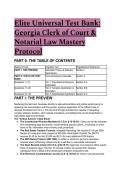
Elite Universal Test Bank:
Georgia Clerk of Court &
Notarial Law Mastery
Protocol
PART 0: THE TABLE OF CONTENTS
Section Focus Cognitive Tier Page/Section Reference
PART I: THE PREVIEW Axiomatic Theory & Statutory Section I
Hard-Decks
PART II: THE ELITE TEST Core Assessment Gauntlet Section II
BANK
Questions 1–10 Tier 1: Foundational Syntax & Section II.A
Application
Questions 11–20 Tier 2: Complex Application & Section II.B
Simulation
Questions 21–30 Tier 3: Grandmaster Synthesis Section II.C
PART I: THE PREVIEW
Mastering this test bank translates directly to elite administrative and judicial performance by
replacing rote memorization with the precise, systemic application of the Official Code of
Georgia Annotated (O.C.G.A.). This document forges practitioners capable of navigating
complex statutory taxation, strict notarial compliance, and liability-free record stewardship in
high-stakes legal environments.
The "Critical Axioms" Cheat Sheet:
● The Unauthorized Practice Mandate (O.C.G.A. § 15-19-51): Clerks are strictly forbidden
from interpreting legal documents, recommending specific actions, or advising on which
forms to file. Information must remain purely procedural.
● The Real Estate Taxation Formula: Intangible Recording Tax requires $1.50 per $500
fraction of a long-term note (capped at $25,000). Real Estate Transfer Tax (RETT)
requires $1.00 for the first $1,000 and $0.10 for each additional $100 fraction.
● The 2025 Notary Protocol (HB 1292): A written or electronic journal is absolutely
required when performing notarial acts for a self-filer on real estate instruments.
● The Open Records Axiom (O.C.G.A. § 50-18-71): Agencies must respond within exactly
three (3) business days. The first 15 minutes of labor are exempt from charges;
subsequent time is billed at the lowest-paid competent employee's rate.
● The Electronic Custodianship Law (O.C.G.A. § 15-6-62.1): Clerks must electronically
, back up digital records to the Georgia Superior Court Clerks' Cooperative Authority
(GSCCCA) portal no later than the 15th day of the following month.
PART II: THE ELITE TEST BANK
Tier 1: Foundational Syntax & Application
Q1: A customer presents a long-term promissory note secured by real estate in Georgia with a
face value of $350,250. Based on the principles of the Georgia Intangible Recording Tax
(O.C.G.A. § 48-6-61), which calculation represents the MOST ACCURATE tax liability? A)
$1,050.00 B) $1,050.75 C) $1,051.50 D) $25,000.00
● The Answer: C ($1,051.50)
● Distractor Analysis:
○ A is incorrect: This calculation fails to account for the statutory rounding rule. It
divides exactly and ignores the fraction over $500.
○ B is incorrect: This represents a mathematical percentage (0.3%) applied exactly,
which violates the statutory step-function increment of $1.50 per $500 or fraction
thereof.
○ D is incorrect: This is the statutory maximum cap for the tax, which only applies to
commercial loans exceeding approximately $8.33 million.
The Mentor's Analysis: Intangible tax operates as an escalating step-function, not a flat
percentage. When facing fractional increments in secured long-term notes, the immediate
priority is to divide the principal by 500 and round up to the next whole integer before multiplying
by $1.50. By utilizing the fractional rounding rule, the practitioner bypasses the common trap of
under-collecting state revenue. The Department of Revenue explicitly relies on this algorithmic
step to fund local jurisdictions accurately. Professional/Academic Intuition: Always round
fractional quotients up to the nearest whole number before applying the $1.50 multiplier.
Q2: A pro se litigant approaches the counter of the Superior Court Clerk's office and asks, "My
ex-husband hasn't paid child support in three months; which specific form should I file to hold
him in contempt?" Based on the principles of Unauthorized Practice of Law (O.C.G.A. §
15-19-51), which action is the MOST APPROPRIATE? A) Provide the litigant with the standard
Contempt of Court packet and instruct her on how to fill out the affidavit based on recent case
law. B) Direct the litigant to the court's public law library or online portal while explicitly refusing
to recommend a specific form. C) Inform the litigant that Contempt of Court is the correct action,
but she must locate the form herself. D) Accept the litigant's verbal complaint and draft a basic
motion on her behalf as an officer of the court.
● The Answer: B (Direct the litigant to the court's public law library or online portal while
explicitly refusing to recommend a specific form.)
● Distractor Analysis:
○ A is incorrect: Instructing a litigant on how to complete a specific legal affidavit
constitutes providing legal advice, violating the statute.
○ C is incorrect: Confirming that "Contempt of Court is the correct action" is a
definitive legal conclusion and an unauthorized application of law to specific facts.
○ D is incorrect: Drafting a motion for a citizen is a blatant violation of the prohibition
against practicing law without a license, exposing the clerk to civil and criminal
liability.
The Mentor's Analysis: A clerk's duty is access, not advocacy. When facing inquiries from
, unrepresented citizens, the immediate priority is protecting the court's impartiality. By utilizing
directional assistance rather than instructional advice, the practitioner bypasses the common
trap of accidental legal counsel. The judiciary's integrity relies on the clerk remaining an entirely
neutral custodian of the record. Professional/Academic Intuition: Clerks provide procedural
information and access to resources; they never apply the law to a citizen's specific facts.
Q3: Effective January 1, 2025, under the revised Georgia Notary Law (HB 1292), a notary public
is asked to attest a signature on a warranty deed. The signer is an unrepresented individual
completing a "For Sale By Owner" transaction. Based on the principles of Notarial
Recordkeeping (O.C.G.A. § 45-17-8), which conclusion is the MOST ACCURATE? A) The
notary is encouraged, but not statutorily required, to record the transaction in a journal. B) The
notary must record the transaction in a written or electronic journal because the signer qualifies
as a self-filer. C) The notary must refuse the transaction because warranty deeds can only be
notarized by licensed attorneys. D) The notary must record the transaction only if the property's
declared fair market value exceeds $100,000.
● The Answer: B (The notary must record the transaction in a written or electronic journal
because the signer qualifies as a self-filer.)
● Distractor Analysis:
○ A is incorrect: Prior to 2025, journals were merely "highly recommended." HB 1292
made them strictly mandatory for self-filer real estate transactions to combat
property fraud.
○ C is incorrect: Non-attorney notaries in Georgia are fully authorized to attest
signatures on deeds, provided they do not cross into providing closing advice.
○ D is incorrect: There is no monetary threshold governing notarial journal
requirements under the revised statute.
The Mentor's Analysis: The state now strictly monitors undocumented property transfers to
eliminate fraudulent conveyances. When facing unrepresented real estate signers, the
immediate priority is comprehensive recordkeeping. By utilizing a compliant notarial journal, the
practitioner bypasses the common trap of statutory negligence. A "self-filer" is explicitly defined
as any party not represented by an attorney, title agent, or licensed broker.
Professional/Academic Intuition: If a party to a real estate instrument lacks professional
representation, they are a self-filer, triggering a mandatory journal entry.
Q4: A citizen submits a formal Open Records Act (ORA) request for 500 pages of email
correspondence. The extraction and redaction process takes a deputy clerk exactly 1 hour and
15 minutes. The deputy clerk's hourly wage is $20.00. Based on the principles of O.C.G.A. §
50-18-71, which calculation represents the MOST ACCURATE labor charge allowable? A)
$25.00 B) $20.00 C) $0.00 D) $5.00
● The Answer: B ($20.00)
● Distractor Analysis:
○ A is incorrect: This calculation charges the requester for the full 1 hour and 15
minutes, failing to deduct the statutorily mandated free time.
○ C is incorrect: Only the first 15 minutes of agency labor are free; subsequent time
must be billed.
○ D is incorrect: This represents a mathematical inversion error, billing only for the
free time rather than the compensable hour.
The Mentor's Analysis: Public transparency must not financially penalize the agency, but the
public is granted a specific grace period to prevent prohibitive access costs. When facing ORA
labor calculations, the immediate priority is deducting the initial quarter-hour. By utilizing the
lowest-paid competent employee rate minus 15 minutes, the practitioner bypasses the common
Georgia Clerk of Court &
Notarial Law Mastery
Protocol
PART 0: THE TABLE OF CONTENTS
Section Focus Cognitive Tier Page/Section Reference
PART I: THE PREVIEW Axiomatic Theory & Statutory Section I
Hard-Decks
PART II: THE ELITE TEST Core Assessment Gauntlet Section II
BANK
Questions 1–10 Tier 1: Foundational Syntax & Section II.A
Application
Questions 11–20 Tier 2: Complex Application & Section II.B
Simulation
Questions 21–30 Tier 3: Grandmaster Synthesis Section II.C
PART I: THE PREVIEW
Mastering this test bank translates directly to elite administrative and judicial performance by
replacing rote memorization with the precise, systemic application of the Official Code of
Georgia Annotated (O.C.G.A.). This document forges practitioners capable of navigating
complex statutory taxation, strict notarial compliance, and liability-free record stewardship in
high-stakes legal environments.
The "Critical Axioms" Cheat Sheet:
● The Unauthorized Practice Mandate (O.C.G.A. § 15-19-51): Clerks are strictly forbidden
from interpreting legal documents, recommending specific actions, or advising on which
forms to file. Information must remain purely procedural.
● The Real Estate Taxation Formula: Intangible Recording Tax requires $1.50 per $500
fraction of a long-term note (capped at $25,000). Real Estate Transfer Tax (RETT)
requires $1.00 for the first $1,000 and $0.10 for each additional $100 fraction.
● The 2025 Notary Protocol (HB 1292): A written or electronic journal is absolutely
required when performing notarial acts for a self-filer on real estate instruments.
● The Open Records Axiom (O.C.G.A. § 50-18-71): Agencies must respond within exactly
three (3) business days. The first 15 minutes of labor are exempt from charges;
subsequent time is billed at the lowest-paid competent employee's rate.
● The Electronic Custodianship Law (O.C.G.A. § 15-6-62.1): Clerks must electronically
, back up digital records to the Georgia Superior Court Clerks' Cooperative Authority
(GSCCCA) portal no later than the 15th day of the following month.
PART II: THE ELITE TEST BANK
Tier 1: Foundational Syntax & Application
Q1: A customer presents a long-term promissory note secured by real estate in Georgia with a
face value of $350,250. Based on the principles of the Georgia Intangible Recording Tax
(O.C.G.A. § 48-6-61), which calculation represents the MOST ACCURATE tax liability? A)
$1,050.00 B) $1,050.75 C) $1,051.50 D) $25,000.00
● The Answer: C ($1,051.50)
● Distractor Analysis:
○ A is incorrect: This calculation fails to account for the statutory rounding rule. It
divides exactly and ignores the fraction over $500.
○ B is incorrect: This represents a mathematical percentage (0.3%) applied exactly,
which violates the statutory step-function increment of $1.50 per $500 or fraction
thereof.
○ D is incorrect: This is the statutory maximum cap for the tax, which only applies to
commercial loans exceeding approximately $8.33 million.
The Mentor's Analysis: Intangible tax operates as an escalating step-function, not a flat
percentage. When facing fractional increments in secured long-term notes, the immediate
priority is to divide the principal by 500 and round up to the next whole integer before multiplying
by $1.50. By utilizing the fractional rounding rule, the practitioner bypasses the common trap of
under-collecting state revenue. The Department of Revenue explicitly relies on this algorithmic
step to fund local jurisdictions accurately. Professional/Academic Intuition: Always round
fractional quotients up to the nearest whole number before applying the $1.50 multiplier.
Q2: A pro se litigant approaches the counter of the Superior Court Clerk's office and asks, "My
ex-husband hasn't paid child support in three months; which specific form should I file to hold
him in contempt?" Based on the principles of Unauthorized Practice of Law (O.C.G.A. §
15-19-51), which action is the MOST APPROPRIATE? A) Provide the litigant with the standard
Contempt of Court packet and instruct her on how to fill out the affidavit based on recent case
law. B) Direct the litigant to the court's public law library or online portal while explicitly refusing
to recommend a specific form. C) Inform the litigant that Contempt of Court is the correct action,
but she must locate the form herself. D) Accept the litigant's verbal complaint and draft a basic
motion on her behalf as an officer of the court.
● The Answer: B (Direct the litigant to the court's public law library or online portal while
explicitly refusing to recommend a specific form.)
● Distractor Analysis:
○ A is incorrect: Instructing a litigant on how to complete a specific legal affidavit
constitutes providing legal advice, violating the statute.
○ C is incorrect: Confirming that "Contempt of Court is the correct action" is a
definitive legal conclusion and an unauthorized application of law to specific facts.
○ D is incorrect: Drafting a motion for a citizen is a blatant violation of the prohibition
against practicing law without a license, exposing the clerk to civil and criminal
liability.
The Mentor's Analysis: A clerk's duty is access, not advocacy. When facing inquiries from
, unrepresented citizens, the immediate priority is protecting the court's impartiality. By utilizing
directional assistance rather than instructional advice, the practitioner bypasses the common
trap of accidental legal counsel. The judiciary's integrity relies on the clerk remaining an entirely
neutral custodian of the record. Professional/Academic Intuition: Clerks provide procedural
information and access to resources; they never apply the law to a citizen's specific facts.
Q3: Effective January 1, 2025, under the revised Georgia Notary Law (HB 1292), a notary public
is asked to attest a signature on a warranty deed. The signer is an unrepresented individual
completing a "For Sale By Owner" transaction. Based on the principles of Notarial
Recordkeeping (O.C.G.A. § 45-17-8), which conclusion is the MOST ACCURATE? A) The
notary is encouraged, but not statutorily required, to record the transaction in a journal. B) The
notary must record the transaction in a written or electronic journal because the signer qualifies
as a self-filer. C) The notary must refuse the transaction because warranty deeds can only be
notarized by licensed attorneys. D) The notary must record the transaction only if the property's
declared fair market value exceeds $100,000.
● The Answer: B (The notary must record the transaction in a written or electronic journal
because the signer qualifies as a self-filer.)
● Distractor Analysis:
○ A is incorrect: Prior to 2025, journals were merely "highly recommended." HB 1292
made them strictly mandatory for self-filer real estate transactions to combat
property fraud.
○ C is incorrect: Non-attorney notaries in Georgia are fully authorized to attest
signatures on deeds, provided they do not cross into providing closing advice.
○ D is incorrect: There is no monetary threshold governing notarial journal
requirements under the revised statute.
The Mentor's Analysis: The state now strictly monitors undocumented property transfers to
eliminate fraudulent conveyances. When facing unrepresented real estate signers, the
immediate priority is comprehensive recordkeeping. By utilizing a compliant notarial journal, the
practitioner bypasses the common trap of statutory negligence. A "self-filer" is explicitly defined
as any party not represented by an attorney, title agent, or licensed broker.
Professional/Academic Intuition: If a party to a real estate instrument lacks professional
representation, they are a self-filer, triggering a mandatory journal entry.
Q4: A citizen submits a formal Open Records Act (ORA) request for 500 pages of email
correspondence. The extraction and redaction process takes a deputy clerk exactly 1 hour and
15 minutes. The deputy clerk's hourly wage is $20.00. Based on the principles of O.C.G.A. §
50-18-71, which calculation represents the MOST ACCURATE labor charge allowable? A)
$25.00 B) $20.00 C) $0.00 D) $5.00
● The Answer: B ($20.00)
● Distractor Analysis:
○ A is incorrect: This calculation charges the requester for the full 1 hour and 15
minutes, failing to deduct the statutorily mandated free time.
○ C is incorrect: Only the first 15 minutes of agency labor are free; subsequent time
must be billed.
○ D is incorrect: This represents a mathematical inversion error, billing only for the
free time rather than the compensable hour.
The Mentor's Analysis: Public transparency must not financially penalize the agency, but the
public is granted a specific grace period to prevent prohibitive access costs. When facing ORA
labor calculations, the immediate priority is deducting the initial quarter-hour. By utilizing the
lowest-paid competent employee rate minus 15 minutes, the practitioner bypasses the common


