

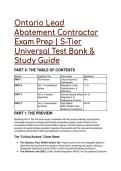
Ontario Lead
Abatement Contractor
Exam Prep | S-Tier
Universal Test Bank &
Study Guide
PART 0: THE TABLE OF CONTENTS
Section Cognitive Tier Focus Area Questions
PART I The Preview Critical Axioms & N/A
Frameworks
PART II Tier 1: Foundational Regulatory Limits, 1–15
Syntax Classifications, &
Definitions
PART II Tier 2: Complex Scenario-Based Safety, 16–35
Application Diagnostics, &
Engineering Controls
PART II Tier 3: Grandmaster High-Stakes 36–60
Synthesis Multi-Variable Case
Studies & Compliance
PART I: THE PREVIEW
Mastering this S-Tier test bank equips candidates with the precise statutory and practical
knowledge required to manage lead hazard remediation projects under Ontario's strict
occupational health and environmental safety regimes. Through rigorous scenario-based
analysis, this guide bridges academic regulatory frameworks with the real-world operational
competence demanded of elite lead abatement contractors in the province.
The "Critical Axioms" Cheat Sheet
● The Statutory Floor (OHSA Section 30): Project owners hold non-delegable liability to
determine and document the presence of lead before tendering any project, utilizing a
Designated Substance Survey (DSS) to inform all potential bidding contractors.
● The Airborne Limit (OEL): Under Ontario Regulation 490/09, the Occupational Exposure
, Limit (OEL) for inorganic lead is established at a strict time-weighted average (TWA) of
0.05\text{ mg/m}^3 over an 8-hour workday or 40-hour workweek.
● The Lead Material Classifications: According to the Environmental Abatement Council
of Ontario (EACO) Lead Guideline, surface coatings are classified as lead-based if they
contain lead concentrations > 0.5\% by weight, lead-containing between 0.1\% and 0.5\%,
and low-level lead if \le 0.1\%.
● Biological Monitoring Action Thresholds: General worker population medical removal
is mandated when a Blood Lead Level (BLL) reaches > 1.0\ \mu\text{mol/L} across two
tests taken one month apart, or immediately if a single measure exceeds > 1.4\
\mu\text{mol/L}. For pregnant workers or women of childbearing potential, the hard
removal ceiling is lowered to > 0.5\ \mu\text{mol/L}.
● Waste Characterization Boundaries: Under O. Reg. 347, any waste material generating
a leachate lead concentration \ge 5.0\text{ mg/L} via the Toxicity Characteristic Leaching
Procedure (TCLP) Method 1311 is designated as a leachate toxic hazardous waste.
PART II: THE ELITE TEST BANK
Tier 1: Foundational Syntax & Application (Questions 1–15)
Q1: According to the Environmental Abatement Council of Ontario (EACO) Lead Guideline,
what is the correct classification for a surface coating containing a total lead concentration of
0.35\% by weight? A) Lead-based paint B) Lead-containing paint C) Low-level lead paint D) De
minimis lead paint
● The Answer: B (Lead-containing paint)
● Distractor Analysis:
○ A is incorrect: EACO classifies paints with lead concentrations greater than 0.5\%
by weight as lead-based.
○ C is incorrect: Low-level lead paints are defined as those containing less than or
equal to 0.1\% lead by weight.
○ D is incorrect: "De minimis" is a conceptual term used in general industrial hygiene
for low-risk scenarios, not a formalized EACO classification category for 0.35\%
concentrations.
The Mentor's Analysis: Precise classification of surface coatings dictates the downstream
selection of engineering controls and respiratory protection. When evaluating laboratory bulk
analysis reports, contractors must strictly map weight percentages to EACO categories.
Professional/Academic Intuition: Any paint with lead concentrations between 0.1% and
0.5% by weight is classified as "lead-containing" and requires active dust suppression
and worker protection protocols during disturbance.
Q2: Under Ontario Regulation 490/09, what is the statutory Occupational Exposure Limit (OEL)
for airborne exposure to inorganic lead as a time-weighted average? A) 0.05\text{ mg/m}^3
calculated over an 8-hour workday B) 0.15\text{ mg/m}^3 calculated over an 8-hour workday C)
0.01\text{ mg/m}^3 calculated over a 40-hour workweek D) 0.50\text{ mg/m}^3 calculated over a
15-minute exposure window
● The Answer: A (0.05\text{ mg/m}^3 calculated over an 8-hour workday)
● Distractor Analysis:
○ B is incorrect: 0.15\text{ mg/m}^3 is an outdated standard and exceeds Ontario's
current regulatory limits.
, ○ C is incorrect: 0.01\text{ mg/m}^3 represents an ultra-low threshold used in specific
cleanrooms or specialized hazardous substance limits, not the default OEL for lead.
○ D is incorrect: 0.50\text{ mg/m}^3 refers to the upper limit of airborne lead
concentration defining a Type 2a operation, not the occupational exposure limit.
The Mentor's Analysis: The occupational exposure limit is a non-negotiable legal ceiling for
un-respirated worker environments. All engineering controls must be engineered to maintain
ambient concentrations below this threshold. Professional/Academic Intuition: The legal
exposure boundary for inorganic lead in Ontario is 0.05 milligrams per cubic metre of air
as an 8-hour daily or 40-hour weekly time-weighted average.
Q3: Under Section 30 of the Ontario Occupational Health and Safety Act (OHSA), what primary
duty is imposed on the owner of a construction project regarding designated substances? A)
The owner must personally perform air monitoring during all demolition phases. B) The owner
must identify if lead is present and notify potential contractors as part of the bidding process. C)
The owner must pay for the physical decontamination of all subcontracted workers. D) The
owner must obtain a hazardous waste generator registration prior to bidding.
● The Answer: B (The owner must identify if lead is present and notify potential contractors
as part of the bidding process)
● Distractor Analysis:
○ A is incorrect: The duty to perform tests and observations belongs to a competent
person hired during the project, not necessarily the owner personally.
○ C is incorrect: Decontamination is an operational duty managed by the constructor
or direct employer, not a direct statutory bidding-phase cost requirement of the
owner under Section 30.
○ D is incorrect: Hazardous waste registration is an operational requirement during
actual waste generation, not a pre-bid requirement under Section 30.
The Mentor's Analysis: Project liability begins at the pre-tender phase. Failure by a property
owner to provide a complete Designated Substance Survey (DSS) before bidding makes them
legally liable for any financial losses or damages incurred due to subsequent discovery of lead.
Professional/Academic Intuition: Section 30 of the OHSA mandates that project owners
must identify lead presence prior to tendering and formally transmit this list to all
prospective bidders.
Q4: According to the Ministry of Labour (MLITSD) Lead on Construction Projects Guideline,
which of the following operations is classified as a Type 1 operation? A) Manual demolition of
lead-painted plaster walls using a sledgehammer B) Removing lead-containing mortar using an
electric cutting device C) Application of lead-containing coatings with a brush or roller D) Spray
application of lead-containing coatings
● The Answer: C (Application of lead-containing coatings with a brush or roller)
● Distractor Analysis:
○ A is incorrect: Sledgehammer demolition of painted plaster is a high-dust, manual
impact activity classified as a Type 2a operation.
○ B is incorrect: Using an electric cutting device without HEPA dust collection to
remove lead mortar is classified as a Type 3a operation due to high mechanical
kinetic energy.
○ D is incorrect: Spray application of lead-containing coatings creates an inhalation
mist hazard and is classified as a Type 2b operation.
The Mentor's Analysis: Type 1 operations are low-risk activities where the expected airborne
lead concentration is at or below the OEL of 0.05\text{ mg/m}^3. These tasks generate minimal
mechanical dust or fumes. Professional/Academic Intuition: Applying lead coatings
, manually with brushes or rollers produces no dust or mist and is strictly classified as a
Type 1 operation.
Q5: What is the respirator requirement for workers performing a Type 1 lead operation under
Ontario regulations? A) A full-facepiece supplied-air respirator operated in pressure-demand
mode is mandatory. B) No respirator is required, but a half-mask particulate respirator with N-,
R- or P-series filter must be provided if requested by the worker. C) A powered air-purifying
respirator (PAPR) equipped with a HEPA filter is strictly mandatory. D) Dust masks are
prohibited, and workers must wear a full-facepiece air-purifying respirator with an APF of 50.
● The Answer: B (No respirator is required, but a half-mask particulate respirator with N-,
R- or P-series filter must be provided if requested by the worker)
● Distractor Analysis:
○ A is incorrect: This high-protection equipment is reserved for Type 3 high-hazard
indoor environments.
○ C is incorrect: PAPRs are mandatory for Type 2b spray operations and some Type
3 applications, not Type 1.
○ D is incorrect: Air-purifying respirators with an APF of 50 are too restrictive for
low-risk Type 1 work, and voluntary respiratory use is allowed if requested.
The Mentor's Analysis: While airborne concentrations in Type 1 tasks are expected to remain
below the OEL, worker comfort and voluntary safety are protected. Employers must
accommodate any worker request for basic respiratory protection. Professional/Academic
Intuition: Respirators are optional for Type 1 operations, but if requested, the employer
must provide a NIOSH-approved half-mask particulate respirator with at least 95%
efficiency.
Q6: Under the MLITSD Guideline, which task is categorized as a Type 2a operation? A)
Abrasive blasting of a structural steel bridge coated with lead paint B) Removal of
lead-containing coatings using non-powered hand tools by manual scraping or sanding C)
Removal of lead-containing dust using an air mist extraction system D) Applying chemical gel to
peel lead-paint with a fibrous laminated cloth wrap
● The Answer: B (Removal of lead-containing coatings using non-powered hand tools by
manual scraping or sanding)
● Distractor Analysis:
○ A is incorrect: Abrasive blasting creates massive dust loads and is classified as a
Type 3b operation.
○ C is incorrect: Using an air mist extraction system for dust cleanup is a high-hazard
task classified under Type 3b.
○ D is incorrect: Chemical gel stripping with laminated wraps contains the dust and is
classified as a low-risk Type 1 operation.
The Mentor's Analysis: Type 2a operations represent moderate-risk tasks that physically
disturb lead coatings manually, leading to anticipated exposure levels between 0.05\text{
mg/m}^3 and 0.50\text{ mg/m}^3. Professional/Academic Intuition: Manual scraping and
sanding without power assistance generates localized dust and is categorized as a Type
2a operation.
Q7: What is the statutory minimum Assigned Protection Factor (APF) and respirator type
required for workers conducting a Type 2b operation (spray application of lead coatings)? A)
APF of 10; half-mask air-purifying respirator B) APF of 25; powered air-purifying respirator
(PAPR) with a hood or helmet and HEPA filter C) APF of 50; full-facepiece air-purifying
respirator with P100 filters D) APF of 1000; Type CE abrasive-blast supplied-air respirator
● The Answer: B (APF of 25; powered air-purifying respirator (PAPR) with a hood or
Abatement Contractor
Exam Prep | S-Tier
Universal Test Bank &
Study Guide
PART 0: THE TABLE OF CONTENTS
Section Cognitive Tier Focus Area Questions
PART I The Preview Critical Axioms & N/A
Frameworks
PART II Tier 1: Foundational Regulatory Limits, 1–15
Syntax Classifications, &
Definitions
PART II Tier 2: Complex Scenario-Based Safety, 16–35
Application Diagnostics, &
Engineering Controls
PART II Tier 3: Grandmaster High-Stakes 36–60
Synthesis Multi-Variable Case
Studies & Compliance
PART I: THE PREVIEW
Mastering this S-Tier test bank equips candidates with the precise statutory and practical
knowledge required to manage lead hazard remediation projects under Ontario's strict
occupational health and environmental safety regimes. Through rigorous scenario-based
analysis, this guide bridges academic regulatory frameworks with the real-world operational
competence demanded of elite lead abatement contractors in the province.
The "Critical Axioms" Cheat Sheet
● The Statutory Floor (OHSA Section 30): Project owners hold non-delegable liability to
determine and document the presence of lead before tendering any project, utilizing a
Designated Substance Survey (DSS) to inform all potential bidding contractors.
● The Airborne Limit (OEL): Under Ontario Regulation 490/09, the Occupational Exposure
, Limit (OEL) for inorganic lead is established at a strict time-weighted average (TWA) of
0.05\text{ mg/m}^3 over an 8-hour workday or 40-hour workweek.
● The Lead Material Classifications: According to the Environmental Abatement Council
of Ontario (EACO) Lead Guideline, surface coatings are classified as lead-based if they
contain lead concentrations > 0.5\% by weight, lead-containing between 0.1\% and 0.5\%,
and low-level lead if \le 0.1\%.
● Biological Monitoring Action Thresholds: General worker population medical removal
is mandated when a Blood Lead Level (BLL) reaches > 1.0\ \mu\text{mol/L} across two
tests taken one month apart, or immediately if a single measure exceeds > 1.4\
\mu\text{mol/L}. For pregnant workers or women of childbearing potential, the hard
removal ceiling is lowered to > 0.5\ \mu\text{mol/L}.
● Waste Characterization Boundaries: Under O. Reg. 347, any waste material generating
a leachate lead concentration \ge 5.0\text{ mg/L} via the Toxicity Characteristic Leaching
Procedure (TCLP) Method 1311 is designated as a leachate toxic hazardous waste.
PART II: THE ELITE TEST BANK
Tier 1: Foundational Syntax & Application (Questions 1–15)
Q1: According to the Environmental Abatement Council of Ontario (EACO) Lead Guideline,
what is the correct classification for a surface coating containing a total lead concentration of
0.35\% by weight? A) Lead-based paint B) Lead-containing paint C) Low-level lead paint D) De
minimis lead paint
● The Answer: B (Lead-containing paint)
● Distractor Analysis:
○ A is incorrect: EACO classifies paints with lead concentrations greater than 0.5\%
by weight as lead-based.
○ C is incorrect: Low-level lead paints are defined as those containing less than or
equal to 0.1\% lead by weight.
○ D is incorrect: "De minimis" is a conceptual term used in general industrial hygiene
for low-risk scenarios, not a formalized EACO classification category for 0.35\%
concentrations.
The Mentor's Analysis: Precise classification of surface coatings dictates the downstream
selection of engineering controls and respiratory protection. When evaluating laboratory bulk
analysis reports, contractors must strictly map weight percentages to EACO categories.
Professional/Academic Intuition: Any paint with lead concentrations between 0.1% and
0.5% by weight is classified as "lead-containing" and requires active dust suppression
and worker protection protocols during disturbance.
Q2: Under Ontario Regulation 490/09, what is the statutory Occupational Exposure Limit (OEL)
for airborne exposure to inorganic lead as a time-weighted average? A) 0.05\text{ mg/m}^3
calculated over an 8-hour workday B) 0.15\text{ mg/m}^3 calculated over an 8-hour workday C)
0.01\text{ mg/m}^3 calculated over a 40-hour workweek D) 0.50\text{ mg/m}^3 calculated over a
15-minute exposure window
● The Answer: A (0.05\text{ mg/m}^3 calculated over an 8-hour workday)
● Distractor Analysis:
○ B is incorrect: 0.15\text{ mg/m}^3 is an outdated standard and exceeds Ontario's
current regulatory limits.
, ○ C is incorrect: 0.01\text{ mg/m}^3 represents an ultra-low threshold used in specific
cleanrooms or specialized hazardous substance limits, not the default OEL for lead.
○ D is incorrect: 0.50\text{ mg/m}^3 refers to the upper limit of airborne lead
concentration defining a Type 2a operation, not the occupational exposure limit.
The Mentor's Analysis: The occupational exposure limit is a non-negotiable legal ceiling for
un-respirated worker environments. All engineering controls must be engineered to maintain
ambient concentrations below this threshold. Professional/Academic Intuition: The legal
exposure boundary for inorganic lead in Ontario is 0.05 milligrams per cubic metre of air
as an 8-hour daily or 40-hour weekly time-weighted average.
Q3: Under Section 30 of the Ontario Occupational Health and Safety Act (OHSA), what primary
duty is imposed on the owner of a construction project regarding designated substances? A)
The owner must personally perform air monitoring during all demolition phases. B) The owner
must identify if lead is present and notify potential contractors as part of the bidding process. C)
The owner must pay for the physical decontamination of all subcontracted workers. D) The
owner must obtain a hazardous waste generator registration prior to bidding.
● The Answer: B (The owner must identify if lead is present and notify potential contractors
as part of the bidding process)
● Distractor Analysis:
○ A is incorrect: The duty to perform tests and observations belongs to a competent
person hired during the project, not necessarily the owner personally.
○ C is incorrect: Decontamination is an operational duty managed by the constructor
or direct employer, not a direct statutory bidding-phase cost requirement of the
owner under Section 30.
○ D is incorrect: Hazardous waste registration is an operational requirement during
actual waste generation, not a pre-bid requirement under Section 30.
The Mentor's Analysis: Project liability begins at the pre-tender phase. Failure by a property
owner to provide a complete Designated Substance Survey (DSS) before bidding makes them
legally liable for any financial losses or damages incurred due to subsequent discovery of lead.
Professional/Academic Intuition: Section 30 of the OHSA mandates that project owners
must identify lead presence prior to tendering and formally transmit this list to all
prospective bidders.
Q4: According to the Ministry of Labour (MLITSD) Lead on Construction Projects Guideline,
which of the following operations is classified as a Type 1 operation? A) Manual demolition of
lead-painted plaster walls using a sledgehammer B) Removing lead-containing mortar using an
electric cutting device C) Application of lead-containing coatings with a brush or roller D) Spray
application of lead-containing coatings
● The Answer: C (Application of lead-containing coatings with a brush or roller)
● Distractor Analysis:
○ A is incorrect: Sledgehammer demolition of painted plaster is a high-dust, manual
impact activity classified as a Type 2a operation.
○ B is incorrect: Using an electric cutting device without HEPA dust collection to
remove lead mortar is classified as a Type 3a operation due to high mechanical
kinetic energy.
○ D is incorrect: Spray application of lead-containing coatings creates an inhalation
mist hazard and is classified as a Type 2b operation.
The Mentor's Analysis: Type 1 operations are low-risk activities where the expected airborne
lead concentration is at or below the OEL of 0.05\text{ mg/m}^3. These tasks generate minimal
mechanical dust or fumes. Professional/Academic Intuition: Applying lead coatings
, manually with brushes or rollers produces no dust or mist and is strictly classified as a
Type 1 operation.
Q5: What is the respirator requirement for workers performing a Type 1 lead operation under
Ontario regulations? A) A full-facepiece supplied-air respirator operated in pressure-demand
mode is mandatory. B) No respirator is required, but a half-mask particulate respirator with N-,
R- or P-series filter must be provided if requested by the worker. C) A powered air-purifying
respirator (PAPR) equipped with a HEPA filter is strictly mandatory. D) Dust masks are
prohibited, and workers must wear a full-facepiece air-purifying respirator with an APF of 50.
● The Answer: B (No respirator is required, but a half-mask particulate respirator with N-,
R- or P-series filter must be provided if requested by the worker)
● Distractor Analysis:
○ A is incorrect: This high-protection equipment is reserved for Type 3 high-hazard
indoor environments.
○ C is incorrect: PAPRs are mandatory for Type 2b spray operations and some Type
3 applications, not Type 1.
○ D is incorrect: Air-purifying respirators with an APF of 50 are too restrictive for
low-risk Type 1 work, and voluntary respiratory use is allowed if requested.
The Mentor's Analysis: While airborne concentrations in Type 1 tasks are expected to remain
below the OEL, worker comfort and voluntary safety are protected. Employers must
accommodate any worker request for basic respiratory protection. Professional/Academic
Intuition: Respirators are optional for Type 1 operations, but if requested, the employer
must provide a NIOSH-approved half-mask particulate respirator with at least 95%
efficiency.
Q6: Under the MLITSD Guideline, which task is categorized as a Type 2a operation? A)
Abrasive blasting of a structural steel bridge coated with lead paint B) Removal of
lead-containing coatings using non-powered hand tools by manual scraping or sanding C)
Removal of lead-containing dust using an air mist extraction system D) Applying chemical gel to
peel lead-paint with a fibrous laminated cloth wrap
● The Answer: B (Removal of lead-containing coatings using non-powered hand tools by
manual scraping or sanding)
● Distractor Analysis:
○ A is incorrect: Abrasive blasting creates massive dust loads and is classified as a
Type 3b operation.
○ C is incorrect: Using an air mist extraction system for dust cleanup is a high-hazard
task classified under Type 3b.
○ D is incorrect: Chemical gel stripping with laminated wraps contains the dust and is
classified as a low-risk Type 1 operation.
The Mentor's Analysis: Type 2a operations represent moderate-risk tasks that physically
disturb lead coatings manually, leading to anticipated exposure levels between 0.05\text{
mg/m}^3 and 0.50\text{ mg/m}^3. Professional/Academic Intuition: Manual scraping and
sanding without power assistance generates localized dust and is categorized as a Type
2a operation.
Q7: What is the statutory minimum Assigned Protection Factor (APF) and respirator type
required for workers conducting a Type 2b operation (spray application of lead coatings)? A)
APF of 10; half-mask air-purifying respirator B) APF of 25; powered air-purifying respirator
(PAPR) with a hood or helmet and HEPA filter C) APF of 50; full-facepiece air-purifying
respirator with P100 filters D) APF of 1000; Type CE abrasive-blast supplied-air respirator
● The Answer: B (APF of 25; powered air-purifying respirator (PAPR) with a hood or


