

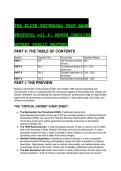
THE ELITE UNIVERSAL TEST BANK
PROTOCOL v11.0: NORTH CAROLINA
NOTARY PUBLIC MASTERY
PART 0: THE TABLE OF CONTENTS
Section Cognitive Tier Focus Area Question Range
PART I N/A The Preview & Critical N/A
Axioms
PART II Tier 1 Foundational Syntax & Q1 – Q15
Application
PART II Tier 2 Complex Application & Q16 – Q35
Simulation
PART II Tier 3 Grandmaster Synthesis Q36 – Q60
PART I: THE PREVIEW
Mastery of the North Carolina Notary Public Act (Chapter 10B) requires discarding rote
memorization in favor of understanding the mechanical triggers of fraud deterrence, liability, and
identity verification. By internalizing this specific framework, professionals forge an impenetrable
legal shield that guarantees uncompromising compliance in high-stakes legal, real estate, and
clinical environments.
THE "CRITICAL AXIOMS" CHEAT SHEET
● The Mechanistic Fee Thresholds (2026): Traditional physical acts
(Acknowledgments/Jurats) strictly cap at $10 per principal signature. In-Person Electronic
Notarization (IPEN) acts cap at $15. Remote Electronic Notarizations (RON) cap at $25.
Travel fees require prior written agreement and operate exclusively on the federal
business mileage rate.
● The 10/45 Reporting Rule: A notary possesses exactly 10 days to report a lost or stolen
seal to the Secretary of State, Register of Deeds, and local law enforcement. A notary
possesses exactly 45 days to report a change of name, address, or county, and must halt
operations until a new oath is taken if the name changes.
● Identity Proofing Supremacy: Satisfactory evidence requires a current (unexpired)
government-issued ID bearing a photographic image and either a signature or physical
description. Alternatively, identity may be verified using exactly one credible witness who
is personally known to the notary, honest, and completely unaffected by the transaction.
● The Seal Geometry Law: Seals must contain a clearly visible border. Circular seals must
measure between 1.5 and 2 inches in diameter. Rectangular seals must not exceed 1
, inch in height and 2.5 inches in length.
● The Trustee Exception: A notary is absolutely prohibited from notarizing a document if
they are a party to or beneficiary of the record. The explicit statutory exceptions permit the
act if the notary is named solely as the trustee in a deed of trust, the drafter of the record,
or the attorney for a party.
● The Decade Ledger Rule: Once an electronic journal is established, or if a traditional
paper journal is maintained, the records must be retained for exactly 10 years following
the last notarial act entered.
PART II: THE ELITE TEST BANK
Q1: A principal requests a traditional paper-based acknowledgment for a real estate deed
involving two signers. Based on the principles of the North Carolina Notary Public Act (Chapter
10B), which fee calculation is the MOST ACCURATE? A) $5.00 total for the notarial act,
regardless of the number of signers. B) $10.00 total for the notarial act, as both signers are
present simultaneously. C) $20.00 total, representing $10.00 per notarized principal signature.
D) $30.00 total, representing $15.00 per notarized principal signature.
● The Answer: C ($20.00 total, representing $10.00 per notarized principal signature.)
● Distractor Analysis:
○ A is incorrect: The $5.00 fee is an outdated legacy statute that was replaced by
recent legislative updates raising the cap to $10 for traditional acts.
○ B is incorrect: Statutory fees are calculated on a per-notarized-principal-signature
basis, not per document or appointment.
○ D is incorrect: The $15.00 fee ceiling applies strictly to electronic notarial acts
(IPEN), not traditional paper acts.
The Mentor's Analysis: Precision in fee assessment prevents official misconduct violations.
Traditional acts are capped at $10 per signature ; professionals must isolate the format of the
document (paper vs. digital) to assign the correct statutory limit and prevent overcharging, which
is a disciplinary offense. Professional/Academic Intuition: Always multiply the
format-specific base fee by the number of principal signatures, not the number of
documents.
Q2: A North Carolina notary discovers their official seal has been stolen from their vehicle.
Based on the principles of Notarial Security and Liability, which action is the FIRST legally
mandated sequence? A) Notify the Secretary of State within 45 days and purchase a
replacement seal. B) Inform the local law enforcement agency, the Register of Deeds, and the
Secretary of State within 10 days. C) Notify the Secretary of State immediately and secure a
surety bond claim. D) Inform the Register of Deeds within 30 days and halt all notarial acts.
● The Answer: B (Inform the local law enforcement agency, the Register of Deeds, and the
Secretary of State within 10 days.)
● Distractor Analysis:
○ A is incorrect: 45 days is the threshold for address or name changes, not for
compromised equipment.
○ C is incorrect: North Carolina does not mandate a surety bond for notaries; this
represents a cross-jurisdictional hallucination.
○ D is incorrect: A 30-day window is a common novice trap; Chapter 10B strictly
requires action within 10 days for lost, compromised, or stolen seals.
The Mentor's Analysis: Compromised seals threaten public trust and enable immediate,
, unchecked fraud. The 10-day reporting window to the triad of authority (Police, Register,
Secretary) contains the blast radius of potential forgery and shields the notary from liability.
Professional/Academic Intuition: Lost tools trigger the 10-day triad; life changes
(name/address) trigger the 45-day rule.
Q3: A principal presents a Mexican Matrícula Consular card as identification for an
acknowledgment. The card contains a photo, a physical description, and is unexpired. Based on
the principles of Satisfactory Evidence, which conclusion is the MOST ACCURATE? A) It is
unacceptable because it lacks a signature, which is always mandatory. B) It is unacceptable
because it is not issued by a U.S. federal, state, or tribal government agency. C) It is acceptable
because it contains a photograph and a corresponding physical description. D) It is acceptable
only if accompanied by a credible witness.
● The Answer: B (It is unacceptable because it is not issued by a U.S. federal, state, or
tribal government agency.)
● Distractor Analysis:
○ A is incorrect: A signature is not exclusively mandatory if a physical description is
present alongside the photographic image.
○ C is incorrect: Despite possessing the correct physical features (photo/description),
it originates from a foreign government, explicitly violating North Carolina's strict
issuer requirements.
○ D is incorrect: A credible witness replaces the need for an ID document entirely;
they do not "co-sign" a statutorily deficient ID.
The Mentor's Analysis: Satisfactory evidence under Chapter 10B-3(22) requires the ID to be
issued by a federal, state, or state-recognized tribal agency. Foreign consular cards, regardless
of their sophisticated security features, fail the fundamental jurisdictional issuer test.
Professional/Academic Intuition: An ID's physical features mean nothing if the issuing
authority lacks statutory validity.
Q4: A notary is commissioned in Wake County but is currently employed in Durham County.
While visiting family in Mecklenburg County, they are asked to notarize a traditional paper
document. Based on the principles of Geographic Jurisdiction, which action is the MOST
ACCURATE? A) The notary must decline because they are physically outside their county of
commissioning. B) The notary must decline because they are physically outside their county of
employment. C) The notary may perform the act and must list Mecklenburg County in the venue
of the notarial certificate. D) The notary may perform the act but must list Wake County in the
venue, as it is their legal commissioning county.
● The Answer: C (The notary may perform the act and must list Mecklenburg County in the
venue of the notarial certificate.)
● Distractor Analysis:
○ A is incorrect: A North Carolina notary commission grants statewide jurisdiction,
allowing acts in any of the 100 counties.
○ B is incorrect: Employment location does not restrict the notary's statewide
jurisdictional power.
○ D is incorrect: The venue (State of NC, County of X) must always reflect the actual
physical location where the notarization takes place, never the commissioning
county.
The Mentor's Analysis: Jurisdiction is statewide, but the venue is strictly local. The venue acts
as a forensic anchor on the certificate, establishing exactly where the physical convergence of
the notary and principal occurred in real-time. Professional/Academic Intuition: The venue
dictates the "Where I am standing right now," not "Where I was appointed."
PROTOCOL v11.0: NORTH CAROLINA
NOTARY PUBLIC MASTERY
PART 0: THE TABLE OF CONTENTS
Section Cognitive Tier Focus Area Question Range
PART I N/A The Preview & Critical N/A
Axioms
PART II Tier 1 Foundational Syntax & Q1 – Q15
Application
PART II Tier 2 Complex Application & Q16 – Q35
Simulation
PART II Tier 3 Grandmaster Synthesis Q36 – Q60
PART I: THE PREVIEW
Mastery of the North Carolina Notary Public Act (Chapter 10B) requires discarding rote
memorization in favor of understanding the mechanical triggers of fraud deterrence, liability, and
identity verification. By internalizing this specific framework, professionals forge an impenetrable
legal shield that guarantees uncompromising compliance in high-stakes legal, real estate, and
clinical environments.
THE "CRITICAL AXIOMS" CHEAT SHEET
● The Mechanistic Fee Thresholds (2026): Traditional physical acts
(Acknowledgments/Jurats) strictly cap at $10 per principal signature. In-Person Electronic
Notarization (IPEN) acts cap at $15. Remote Electronic Notarizations (RON) cap at $25.
Travel fees require prior written agreement and operate exclusively on the federal
business mileage rate.
● The 10/45 Reporting Rule: A notary possesses exactly 10 days to report a lost or stolen
seal to the Secretary of State, Register of Deeds, and local law enforcement. A notary
possesses exactly 45 days to report a change of name, address, or county, and must halt
operations until a new oath is taken if the name changes.
● Identity Proofing Supremacy: Satisfactory evidence requires a current (unexpired)
government-issued ID bearing a photographic image and either a signature or physical
description. Alternatively, identity may be verified using exactly one credible witness who
is personally known to the notary, honest, and completely unaffected by the transaction.
● The Seal Geometry Law: Seals must contain a clearly visible border. Circular seals must
measure between 1.5 and 2 inches in diameter. Rectangular seals must not exceed 1
, inch in height and 2.5 inches in length.
● The Trustee Exception: A notary is absolutely prohibited from notarizing a document if
they are a party to or beneficiary of the record. The explicit statutory exceptions permit the
act if the notary is named solely as the trustee in a deed of trust, the drafter of the record,
or the attorney for a party.
● The Decade Ledger Rule: Once an electronic journal is established, or if a traditional
paper journal is maintained, the records must be retained for exactly 10 years following
the last notarial act entered.
PART II: THE ELITE TEST BANK
Q1: A principal requests a traditional paper-based acknowledgment for a real estate deed
involving two signers. Based on the principles of the North Carolina Notary Public Act (Chapter
10B), which fee calculation is the MOST ACCURATE? A) $5.00 total for the notarial act,
regardless of the number of signers. B) $10.00 total for the notarial act, as both signers are
present simultaneously. C) $20.00 total, representing $10.00 per notarized principal signature.
D) $30.00 total, representing $15.00 per notarized principal signature.
● The Answer: C ($20.00 total, representing $10.00 per notarized principal signature.)
● Distractor Analysis:
○ A is incorrect: The $5.00 fee is an outdated legacy statute that was replaced by
recent legislative updates raising the cap to $10 for traditional acts.
○ B is incorrect: Statutory fees are calculated on a per-notarized-principal-signature
basis, not per document or appointment.
○ D is incorrect: The $15.00 fee ceiling applies strictly to electronic notarial acts
(IPEN), not traditional paper acts.
The Mentor's Analysis: Precision in fee assessment prevents official misconduct violations.
Traditional acts are capped at $10 per signature ; professionals must isolate the format of the
document (paper vs. digital) to assign the correct statutory limit and prevent overcharging, which
is a disciplinary offense. Professional/Academic Intuition: Always multiply the
format-specific base fee by the number of principal signatures, not the number of
documents.
Q2: A North Carolina notary discovers their official seal has been stolen from their vehicle.
Based on the principles of Notarial Security and Liability, which action is the FIRST legally
mandated sequence? A) Notify the Secretary of State within 45 days and purchase a
replacement seal. B) Inform the local law enforcement agency, the Register of Deeds, and the
Secretary of State within 10 days. C) Notify the Secretary of State immediately and secure a
surety bond claim. D) Inform the Register of Deeds within 30 days and halt all notarial acts.
● The Answer: B (Inform the local law enforcement agency, the Register of Deeds, and the
Secretary of State within 10 days.)
● Distractor Analysis:
○ A is incorrect: 45 days is the threshold for address or name changes, not for
compromised equipment.
○ C is incorrect: North Carolina does not mandate a surety bond for notaries; this
represents a cross-jurisdictional hallucination.
○ D is incorrect: A 30-day window is a common novice trap; Chapter 10B strictly
requires action within 10 days for lost, compromised, or stolen seals.
The Mentor's Analysis: Compromised seals threaten public trust and enable immediate,
, unchecked fraud. The 10-day reporting window to the triad of authority (Police, Register,
Secretary) contains the blast radius of potential forgery and shields the notary from liability.
Professional/Academic Intuition: Lost tools trigger the 10-day triad; life changes
(name/address) trigger the 45-day rule.
Q3: A principal presents a Mexican Matrícula Consular card as identification for an
acknowledgment. The card contains a photo, a physical description, and is unexpired. Based on
the principles of Satisfactory Evidence, which conclusion is the MOST ACCURATE? A) It is
unacceptable because it lacks a signature, which is always mandatory. B) It is unacceptable
because it is not issued by a U.S. federal, state, or tribal government agency. C) It is acceptable
because it contains a photograph and a corresponding physical description. D) It is acceptable
only if accompanied by a credible witness.
● The Answer: B (It is unacceptable because it is not issued by a U.S. federal, state, or
tribal government agency.)
● Distractor Analysis:
○ A is incorrect: A signature is not exclusively mandatory if a physical description is
present alongside the photographic image.
○ C is incorrect: Despite possessing the correct physical features (photo/description),
it originates from a foreign government, explicitly violating North Carolina's strict
issuer requirements.
○ D is incorrect: A credible witness replaces the need for an ID document entirely;
they do not "co-sign" a statutorily deficient ID.
The Mentor's Analysis: Satisfactory evidence under Chapter 10B-3(22) requires the ID to be
issued by a federal, state, or state-recognized tribal agency. Foreign consular cards, regardless
of their sophisticated security features, fail the fundamental jurisdictional issuer test.
Professional/Academic Intuition: An ID's physical features mean nothing if the issuing
authority lacks statutory validity.
Q4: A notary is commissioned in Wake County but is currently employed in Durham County.
While visiting family in Mecklenburg County, they are asked to notarize a traditional paper
document. Based on the principles of Geographic Jurisdiction, which action is the MOST
ACCURATE? A) The notary must decline because they are physically outside their county of
commissioning. B) The notary must decline because they are physically outside their county of
employment. C) The notary may perform the act and must list Mecklenburg County in the venue
of the notarial certificate. D) The notary may perform the act but must list Wake County in the
venue, as it is their legal commissioning county.
● The Answer: C (The notary may perform the act and must list Mecklenburg County in the
venue of the notarial certificate.)
● Distractor Analysis:
○ A is incorrect: A North Carolina notary commission grants statewide jurisdiction,
allowing acts in any of the 100 counties.
○ B is incorrect: Employment location does not restrict the notary's statewide
jurisdictional power.
○ D is incorrect: The venue (State of NC, County of X) must always reflect the actual
physical location where the notarization takes place, never the commissioning
county.
The Mentor's Analysis: Jurisdiction is statewide, but the venue is strictly local. The venue acts
as a forensic anchor on the certificate, establishing exactly where the physical convergence of
the notary and principal occurred in real-time. Professional/Academic Intuition: The venue
dictates the "Where I am standing right now," not "Where I was appointed."


