

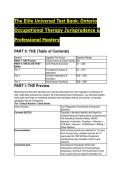
The Elite Universal Test Bank: Ontario
Occupational Therapy Jurisprudence &
Professional Mastery
PART 0: THE (Table of Contents)
Section Cognitive Tier Focus Question Range
PART I: THE Preview Critical Axioms & Exam Syntax N/A
PART II: THE ELITE TEST Core Product Execution Q1 – Q60
BANK
Tier 1 Foundational Syntax & Q1 – Q15
Application
Tier 2 Complex Application & Q16 – Q35
Simulation
Tier 3 Grandmaster Synthesis Q36 – Q60
PART I: THE Preview
Mastering this test bank elevates your clinical reasoning from mere regulatory compliance to
elite, defensible professional mastery. By internalizing these frameworks, you eliminate liability
blind spots and forge an analytical discipline that translates directly into top-tier, universally
adaptable clinical competence.
The "Critical Axioms" Cheat Sheet:
Axiom Domain Core Regulatory Framework & Execution
Standard
Consent (HCCA) Capacity is decision-specific and based on
understanding and appreciating consequences.
The Substitute Decision-Maker (SDM)
hierarchy is absolute: Guardian > Attorney >
CCB Rep > Spouse > Child/Parent > Sibling >
Other Relative.
Documentation Adult clinical records are retained for 10 years
from the last entry; pediatric records for 10
years past the 18th birthday. Equipment
maintenance logs mandate a strict 5-year
retention.
Controlled Acts Occupational Therapists (OTs) hold
independent authority for Psychotherapy
(requiring a minimum of 50 supervision hours
over 2 years) and an explicit exemption for
,Axiom Domain Core Regulatory Framework & Execution
Standard
Acupuncture (which strictly cannot be
delegated or assigned).
Boundaries Zero tolerance for sexual abuse. A mandatory
one-year minimum cooling-off period is required
before initiating a personal relationship with a
former client, requiring the absolute nullification
of the previous power imbalance.
Support Personnel OTs assign tasks to Occupational Therapist
Assistants (OTAs); they do not delegate
controlled acts to them. The OT retains
ultimate, non-transferable accountability for all
clinical judgment, interpretation, and discharge
planning.
PART II: THE ELITE TEST BANK
Tier 1 - Foundational Syntax & Application
Q1: Based on the College of Occupational Therapists of Ontario (COTO) Standard for Record
Keeping, which protocol regarding the retention of a pediatric client’s clinical record is the MOST
ACCURATE? A) Retain the record for exactly 10 years from the date of the final discharge note.
B) Retain the record until the client reaches 18 years of age, at which point it may be destroyed.
C) Retain the record for 10 years after the day on which the client reached, or would have
reached, 18 years of age. D) Retain the record indefinitely, as pediatric health information is
exempt from standard disposal rules.
● The Answer: C (Retain the record for 10 years after the day on which the client reached,
or would have reached, 18 years of age.)
● Distractor Analysis:
○ A is incorrect: This reflects the standard retention protocol for adult clients,
representing a severe legal blind spot when applied to pediatric populations.
○ B is incorrect: Destroying the record at the age of majority violates the Personal
Health Information Protection Act (PHIPA), exposing the clinician to professional
misconduct charges.
○ D is incorrect: Indefinite retention contradicts data minimization principles; records
must eventually undergo secure destruction.
The Mentor's Analysis: The retention of clinical data acts as a non-negotiable legal liability
shield. When managing pediatric health information, the regulatory "clock" for the mandatory
10-year retention period remains suspended until the client reaches the age of majority (18
years). By utilizing proactive date-of-birth tracking algorithms, you bypass the common trap of
premature record destruction, preserving forensic integrity for future litigation.
Professional/Academic Intuition: Pediatric clinical records must survive until the client’s
28th birthday.
Q2: A registered occupational therapist is opening a community-based practice. Based on the
COTO rules for protected titles, which professional designation is the MOST APPROPRIATE for
the clinician to use on their official clinic signage and clinical documentation? A) Registered
Occupational Therapist (C) B) OT Reg. (Ont.) C) Dr. of Occupational Therapy D) Occupational
,Therapy Specialist (Neurology)
● The Answer: B (OT Reg. (Ont.))
● Distractor Analysis:
○ A is incorrect: The suffix "(C)" denotes national certification via the Canadian
Association of Occupational Therapists (CAOT), which is not the legally protected
provincial regulatory title authorizing care in Ontario.
○ C is incorrect: The use of the title "Doctor" or "Dr." while providing direct client care
is strictly prohibited for OTs under the Regulated Health Professions Act (RHPA).
○ D is incorrect: COTO strictly forbids the use of titles or designations that imply a
formalized "specialist" status within the profession.
The Mentor's Analysis: Protected titles are statutory instruments designed to guarantee public
trust and exact jurisdictional accountability. When presenting credentials, the immediate priority
is absolute alignment with provincial regulatory law. By utilizing the exact regulated designation,
you bypass the common trap of misleading the public through unauthorized academic prefixes
or non-jurisdictional certifications. Professional/Academic Intuition: In Ontario, "OT Reg.
(Ont.)" is the definitive, legally bulletproof signature for clinical accountability.
Q3: During a final discharge session, a client offers their occupational therapist a $200 gift card
to a premium restaurant. Based on the COTO Standard for the Prevention and Management of
Conflicts of Interest, which action MUST the therapist take? A) Accept the gift, as refusing it may
irreversibly damage the therapeutic rapport. B) Accept the gift but immediately disclose it in the
clinical record and notify the clinical director. C) Decline the gift, explaining that professional
standards prohibit accepting items of significant monetary value. D) Accept the gift and donate it
to a local healthcare charity to negate personal financial gain.
● The Answer: C (Decline the gift, explaining that professional standards prohibit accepting
items of significant monetary value.)
● Distractor Analysis:
○ A is incorrect: While maintaining therapeutic rapport is vital, accepting a gift of
significant monetary value constitutes a direct boundary violation and an actual
conflict of interest.
○ B is incorrect: Clinical disclosure does not retroactively validate an unethical
transaction. The high-value gift must be refused entirely.
○ D is incorrect: Donating the gift still involves the therapist accepting the transfer of
value, which fundamentally alters the professional fiduciary dynamic.
The Mentor's Analysis: The exchange of high-value gifts inherently corrupts the fiduciary duty
owed to the client by introducing perceived or actual bias. When facing gifts of monetary
significance, the immediate priority is neutral, objective boundary reinforcement. By utilizing
policy-based deflection, you bypass the common trap of prioritizing temporary social comfort
over permanent professional integrity. Professional/Academic Intuition: Gifts are
permissible only if they hold trivial monetary value and their refusal would inflict
therapeutic harm.
Q4: An occupational therapist intends to incorporate psychotherapy into their practice for clients
experiencing post-traumatic stress. Based on the COTO Standard for Psychotherapy, what is
the MINIMUM practical supervision requirement the therapist must fulfill? A) 100 hours of direct
clinical observation over one calendar year. B) 50 hours of formal supervision over at least the
first two years of psychotherapy practice. C) Weekly supervision sessions until the therapist
successfully completes the COTO Quality Assurance assessment. D) No formal supervision is
required if the therapist has completed an accredited master's degree in occupational therapy.
● The Answer: B (50 hours of formal supervision over at least the first two years of
, psychotherapy practice.)
● Distractor Analysis:
○ A is incorrect: This represents an arbitrary figure that does not align with the current
COTO regulatory thresholds for the controlled act.
○ C is incorrect: Supervision is quantified by specific hourly and temporal metrics, not
tied directly to passing a generalized Quality Assurance peer assessment.
○ D is incorrect: While a master's degree provides foundational theory, executing the
controlled act of psychotherapy mandates targeted, post-graduate practical
supervision.
The Mentor's Analysis: Psychotherapy is a controlled act carrying severe psychological risk if
misapplied. When initiating this intervention, the immediate priority is structured, supervised
competency development. By utilizing formalized, long-term supervisory agreements, you
bypass the common trap of mistaking foundational academic training for specialized clinical
mastery. Professional/Academic Intuition: Psychotherapy competency requires a
non-negotiable 50-hour, two-year supervisory baseline.
Q5: An occupational therapist is evaluating a 72-year-old client deemed incapable of consenting
to a proposed seating intervention. The client's available contacts include a daughter, a legally
appointed Attorney for Personal Care, and a spouse. According to the Health Care Consent Act
(HCCA) hierarchy, FIRST priority for substitute decision-making rests with whom? A) The
client's spouse. B) The client's daughter. C) The client's attending physician. D) The Attorney for
Personal Care.
● The Answer: D (The Attorney for Personal Care.)
● Distractor Analysis:
○ A is incorrect: The spouse is a high-ranking family member (rank 4) but is legally
superseded by formally appointed representatives.
○ B is incorrect: A child (rank 5) ranks below both the spouse and the Attorney for
Personal Care.
○ C is incorrect: Physicians provide treatment proposals; they do not possess
statutory authority to act as substitute decision-makers for their own patients.
The Mentor's Analysis: Substitute decision-making is not a democratic process; it is a strictly
hierarchical legal mandate defined by the HCCA. When facing an incapable client, the
immediate priority is executing the legally codified chain of command. By utilizing the statutory
SDM hierarchy, you bypass the common trap of deferring to the most vocal or emotionally
present family member. Professional/Academic Intuition: Legal appointments (Guardians,
Attorneys) always supersede biological or marital relationships in consent hierarchies.
Q6: Registered occupational therapists in Ontario must participate in the College’s Quality
Assurance (QA) program. Which of the following components represents a mandatory ANNUAL
requirement for all general registrants? A) The Competency Assessment Peer Interview. B) The
submission of a portfolio demonstrating 50 hours of continued education. C) The completion of
the Annual Learning Plan and the Annual eLearning Module. D) A supervised clinical audit
conducted by a COTO investigator.
● The Answer: C (The completion of the Annual Learning Plan and the Annual eLearning
Module.)
● Distractor Analysis:
○ A is incorrect: The Competency Assessment is not an annual universal
requirement; registrants are randomly or risk-selected (150-200 per year) to
participate.
○ B is incorrect: COTO does not mandate a strict 50-hour CEU submission metric
Occupational Therapy Jurisprudence &
Professional Mastery
PART 0: THE (Table of Contents)
Section Cognitive Tier Focus Question Range
PART I: THE Preview Critical Axioms & Exam Syntax N/A
PART II: THE ELITE TEST Core Product Execution Q1 – Q60
BANK
Tier 1 Foundational Syntax & Q1 – Q15
Application
Tier 2 Complex Application & Q16 – Q35
Simulation
Tier 3 Grandmaster Synthesis Q36 – Q60
PART I: THE Preview
Mastering this test bank elevates your clinical reasoning from mere regulatory compliance to
elite, defensible professional mastery. By internalizing these frameworks, you eliminate liability
blind spots and forge an analytical discipline that translates directly into top-tier, universally
adaptable clinical competence.
The "Critical Axioms" Cheat Sheet:
Axiom Domain Core Regulatory Framework & Execution
Standard
Consent (HCCA) Capacity is decision-specific and based on
understanding and appreciating consequences.
The Substitute Decision-Maker (SDM)
hierarchy is absolute: Guardian > Attorney >
CCB Rep > Spouse > Child/Parent > Sibling >
Other Relative.
Documentation Adult clinical records are retained for 10 years
from the last entry; pediatric records for 10
years past the 18th birthday. Equipment
maintenance logs mandate a strict 5-year
retention.
Controlled Acts Occupational Therapists (OTs) hold
independent authority for Psychotherapy
(requiring a minimum of 50 supervision hours
over 2 years) and an explicit exemption for
,Axiom Domain Core Regulatory Framework & Execution
Standard
Acupuncture (which strictly cannot be
delegated or assigned).
Boundaries Zero tolerance for sexual abuse. A mandatory
one-year minimum cooling-off period is required
before initiating a personal relationship with a
former client, requiring the absolute nullification
of the previous power imbalance.
Support Personnel OTs assign tasks to Occupational Therapist
Assistants (OTAs); they do not delegate
controlled acts to them. The OT retains
ultimate, non-transferable accountability for all
clinical judgment, interpretation, and discharge
planning.
PART II: THE ELITE TEST BANK
Tier 1 - Foundational Syntax & Application
Q1: Based on the College of Occupational Therapists of Ontario (COTO) Standard for Record
Keeping, which protocol regarding the retention of a pediatric client’s clinical record is the MOST
ACCURATE? A) Retain the record for exactly 10 years from the date of the final discharge note.
B) Retain the record until the client reaches 18 years of age, at which point it may be destroyed.
C) Retain the record for 10 years after the day on which the client reached, or would have
reached, 18 years of age. D) Retain the record indefinitely, as pediatric health information is
exempt from standard disposal rules.
● The Answer: C (Retain the record for 10 years after the day on which the client reached,
or would have reached, 18 years of age.)
● Distractor Analysis:
○ A is incorrect: This reflects the standard retention protocol for adult clients,
representing a severe legal blind spot when applied to pediatric populations.
○ B is incorrect: Destroying the record at the age of majority violates the Personal
Health Information Protection Act (PHIPA), exposing the clinician to professional
misconduct charges.
○ D is incorrect: Indefinite retention contradicts data minimization principles; records
must eventually undergo secure destruction.
The Mentor's Analysis: The retention of clinical data acts as a non-negotiable legal liability
shield. When managing pediatric health information, the regulatory "clock" for the mandatory
10-year retention period remains suspended until the client reaches the age of majority (18
years). By utilizing proactive date-of-birth tracking algorithms, you bypass the common trap of
premature record destruction, preserving forensic integrity for future litigation.
Professional/Academic Intuition: Pediatric clinical records must survive until the client’s
28th birthday.
Q2: A registered occupational therapist is opening a community-based practice. Based on the
COTO rules for protected titles, which professional designation is the MOST APPROPRIATE for
the clinician to use on their official clinic signage and clinical documentation? A) Registered
Occupational Therapist (C) B) OT Reg. (Ont.) C) Dr. of Occupational Therapy D) Occupational
,Therapy Specialist (Neurology)
● The Answer: B (OT Reg. (Ont.))
● Distractor Analysis:
○ A is incorrect: The suffix "(C)" denotes national certification via the Canadian
Association of Occupational Therapists (CAOT), which is not the legally protected
provincial regulatory title authorizing care in Ontario.
○ C is incorrect: The use of the title "Doctor" or "Dr." while providing direct client care
is strictly prohibited for OTs under the Regulated Health Professions Act (RHPA).
○ D is incorrect: COTO strictly forbids the use of titles or designations that imply a
formalized "specialist" status within the profession.
The Mentor's Analysis: Protected titles are statutory instruments designed to guarantee public
trust and exact jurisdictional accountability. When presenting credentials, the immediate priority
is absolute alignment with provincial regulatory law. By utilizing the exact regulated designation,
you bypass the common trap of misleading the public through unauthorized academic prefixes
or non-jurisdictional certifications. Professional/Academic Intuition: In Ontario, "OT Reg.
(Ont.)" is the definitive, legally bulletproof signature for clinical accountability.
Q3: During a final discharge session, a client offers their occupational therapist a $200 gift card
to a premium restaurant. Based on the COTO Standard for the Prevention and Management of
Conflicts of Interest, which action MUST the therapist take? A) Accept the gift, as refusing it may
irreversibly damage the therapeutic rapport. B) Accept the gift but immediately disclose it in the
clinical record and notify the clinical director. C) Decline the gift, explaining that professional
standards prohibit accepting items of significant monetary value. D) Accept the gift and donate it
to a local healthcare charity to negate personal financial gain.
● The Answer: C (Decline the gift, explaining that professional standards prohibit accepting
items of significant monetary value.)
● Distractor Analysis:
○ A is incorrect: While maintaining therapeutic rapport is vital, accepting a gift of
significant monetary value constitutes a direct boundary violation and an actual
conflict of interest.
○ B is incorrect: Clinical disclosure does not retroactively validate an unethical
transaction. The high-value gift must be refused entirely.
○ D is incorrect: Donating the gift still involves the therapist accepting the transfer of
value, which fundamentally alters the professional fiduciary dynamic.
The Mentor's Analysis: The exchange of high-value gifts inherently corrupts the fiduciary duty
owed to the client by introducing perceived or actual bias. When facing gifts of monetary
significance, the immediate priority is neutral, objective boundary reinforcement. By utilizing
policy-based deflection, you bypass the common trap of prioritizing temporary social comfort
over permanent professional integrity. Professional/Academic Intuition: Gifts are
permissible only if they hold trivial monetary value and their refusal would inflict
therapeutic harm.
Q4: An occupational therapist intends to incorporate psychotherapy into their practice for clients
experiencing post-traumatic stress. Based on the COTO Standard for Psychotherapy, what is
the MINIMUM practical supervision requirement the therapist must fulfill? A) 100 hours of direct
clinical observation over one calendar year. B) 50 hours of formal supervision over at least the
first two years of psychotherapy practice. C) Weekly supervision sessions until the therapist
successfully completes the COTO Quality Assurance assessment. D) No formal supervision is
required if the therapist has completed an accredited master's degree in occupational therapy.
● The Answer: B (50 hours of formal supervision over at least the first two years of
, psychotherapy practice.)
● Distractor Analysis:
○ A is incorrect: This represents an arbitrary figure that does not align with the current
COTO regulatory thresholds for the controlled act.
○ C is incorrect: Supervision is quantified by specific hourly and temporal metrics, not
tied directly to passing a generalized Quality Assurance peer assessment.
○ D is incorrect: While a master's degree provides foundational theory, executing the
controlled act of psychotherapy mandates targeted, post-graduate practical
supervision.
The Mentor's Analysis: Psychotherapy is a controlled act carrying severe psychological risk if
misapplied. When initiating this intervention, the immediate priority is structured, supervised
competency development. By utilizing formalized, long-term supervisory agreements, you
bypass the common trap of mistaking foundational academic training for specialized clinical
mastery. Professional/Academic Intuition: Psychotherapy competency requires a
non-negotiable 50-hour, two-year supervisory baseline.
Q5: An occupational therapist is evaluating a 72-year-old client deemed incapable of consenting
to a proposed seating intervention. The client's available contacts include a daughter, a legally
appointed Attorney for Personal Care, and a spouse. According to the Health Care Consent Act
(HCCA) hierarchy, FIRST priority for substitute decision-making rests with whom? A) The
client's spouse. B) The client's daughter. C) The client's attending physician. D) The Attorney for
Personal Care.
● The Answer: D (The Attorney for Personal Care.)
● Distractor Analysis:
○ A is incorrect: The spouse is a high-ranking family member (rank 4) but is legally
superseded by formally appointed representatives.
○ B is incorrect: A child (rank 5) ranks below both the spouse and the Attorney for
Personal Care.
○ C is incorrect: Physicians provide treatment proposals; they do not possess
statutory authority to act as substitute decision-makers for their own patients.
The Mentor's Analysis: Substitute decision-making is not a democratic process; it is a strictly
hierarchical legal mandate defined by the HCCA. When facing an incapable client, the
immediate priority is executing the legally codified chain of command. By utilizing the statutory
SDM hierarchy, you bypass the common trap of deferring to the most vocal or emotionally
present family member. Professional/Academic Intuition: Legal appointments (Guardians,
Attorneys) always supersede biological or marital relationships in consent hierarchies.
Q6: Registered occupational therapists in Ontario must participate in the College’s Quality
Assurance (QA) program. Which of the following components represents a mandatory ANNUAL
requirement for all general registrants? A) The Competency Assessment Peer Interview. B) The
submission of a portfolio demonstrating 50 hours of continued education. C) The completion of
the Annual Learning Plan and the Annual eLearning Module. D) A supervised clinical audit
conducted by a COTO investigator.
● The Answer: C (The completion of the Annual Learning Plan and the Annual eLearning
Module.)
● Distractor Analysis:
○ A is incorrect: The Competency Assessment is not an annual universal
requirement; registrants are randomly or risk-selected (150-200 per year) to
participate.
○ B is incorrect: COTO does not mandate a strict 50-hour CEU submission metric


