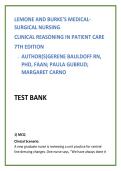
Davis Advantage for Medical-
Surgical Nursing
Making Connections to Practice
3rd Edition
• Author(s)Janice Hoffman; Nancy
Sullivan
• Print ISBN: 9781719647366
TEST BANK
,1) MCQ
Clinical Scenario:
A nurse receives handoff on four adult patients on a medical-
surgical unit.
Question Stem:
Which patient should the nurse assess first?
Answer Options:
A. Patient who reports mild incisional pain rated 4/10 after
ambulation
B. Patient who is waiting for routine discharge teaching later
today
C. Patient with new confusion, respiratory rate 28/min, and
SpO₂ 90% on 2 L/min nasal cannula
D. Patient who asks for an extra blanket and a glass of water
Correct Answer: C
Detailed Rationale:
C shows possible acute deterioration with altered mental status
and respiratory compromise. In medical-surgical nursing, the
nurse must prioritize unstable airway/breathing concerns and
changes from baseline. This is the most urgent cue.
Incorrect Option Analysis:
, • A: Pain 4/10 is important, but not immediately life-
threatening. Misconception: any postoperative pain is
emergent. Risk: delays attention to respiratory decline.
• B: Discharge teaching is important but can wait.
Misconception: education always comes before
assessment. Risk: missed deterioration.
• D: Comfort needs are low priority compared with
instability. Misconception: all requests are equal. Risk:
failure to recognize an acute change.
Nursing Process Linkage: Assessment
Clinical Judgment Competencies (NCJMM): Recognize Cues;
Prioritize Hypotheses
Difficulty Level: Easy
Bloom’s Cognitive Level: Analyze
NCLEX Client Needs Category: Physiological Adaptation
Key Learning Objective: Prioritize assessment based on signs of
patient instability and deterioration.
2) MCQ
Clinical Scenario:
A new nurse is reviewing the unit’s evidence-based fall-
prevention bundle.
Question Stem:
Which statement best demonstrates understanding of
evidence-based nursing care?
, Answer Options:
A. “I follow the practice that experienced nurses have used for
years.”
B. “I combine current research, clinical judgment, and the
patient’s preferences.”
C. “I use only the hospital policy because it is always the safest
source.”
D. “I wait until a practice is common before I consider changing
care.”
Correct Answer: B
Detailed Rationale:
Evidence-based care combines the best available evidence,
clinical expertise, and patient values/preferences. That is the
standard for safe, modern nursing practice.
Incorrect Option Analysis:
• A: Tradition alone is not evidence. Misconception: long-
standing practice is automatically best. Risk: continued use
of ineffective care.
• C: Policy should reflect evidence, but policy alone is not
the full EBP process. Risk: rigid care without individualized
judgment.
• D: Waiting for popularity delays improvement. Risk:
slower adoption of safer interventions.
Nursing Process Linkage: Planning
Clinical Judgment Competencies (NCJMM): Analyze Cues;
Surgical Nursing
Making Connections to Practice
3rd Edition
• Author(s)Janice Hoffman; Nancy
Sullivan
• Print ISBN: 9781719647366
TEST BANK
,1) MCQ
Clinical Scenario:
A nurse receives handoff on four adult patients on a medical-
surgical unit.
Question Stem:
Which patient should the nurse assess first?
Answer Options:
A. Patient who reports mild incisional pain rated 4/10 after
ambulation
B. Patient who is waiting for routine discharge teaching later
today
C. Patient with new confusion, respiratory rate 28/min, and
SpO₂ 90% on 2 L/min nasal cannula
D. Patient who asks for an extra blanket and a glass of water
Correct Answer: C
Detailed Rationale:
C shows possible acute deterioration with altered mental status
and respiratory compromise. In medical-surgical nursing, the
nurse must prioritize unstable airway/breathing concerns and
changes from baseline. This is the most urgent cue.
Incorrect Option Analysis:
, • A: Pain 4/10 is important, but not immediately life-
threatening. Misconception: any postoperative pain is
emergent. Risk: delays attention to respiratory decline.
• B: Discharge teaching is important but can wait.
Misconception: education always comes before
assessment. Risk: missed deterioration.
• D: Comfort needs are low priority compared with
instability. Misconception: all requests are equal. Risk:
failure to recognize an acute change.
Nursing Process Linkage: Assessment
Clinical Judgment Competencies (NCJMM): Recognize Cues;
Prioritize Hypotheses
Difficulty Level: Easy
Bloom’s Cognitive Level: Analyze
NCLEX Client Needs Category: Physiological Adaptation
Key Learning Objective: Prioritize assessment based on signs of
patient instability and deterioration.
2) MCQ
Clinical Scenario:
A new nurse is reviewing the unit’s evidence-based fall-
prevention bundle.
Question Stem:
Which statement best demonstrates understanding of
evidence-based nursing care?
, Answer Options:
A. “I follow the practice that experienced nurses have used for
years.”
B. “I combine current research, clinical judgment, and the
patient’s preferences.”
C. “I use only the hospital policy because it is always the safest
source.”
D. “I wait until a practice is common before I consider changing
care.”
Correct Answer: B
Detailed Rationale:
Evidence-based care combines the best available evidence,
clinical expertise, and patient values/preferences. That is the
standard for safe, modern nursing practice.
Incorrect Option Analysis:
• A: Tradition alone is not evidence. Misconception: long-
standing practice is automatically best. Risk: continued use
of ineffective care.
• C: Policy should reflect evidence, but policy alone is not
the full EBP process. Risk: rigid care without individualized
judgment.
• D: Waiting for popularity delays improvement. Risk:
slower adoption of safer interventions.
Nursing Process Linkage: Planning
Clinical Judgment Competencies (NCJMM): Analyze Cues;