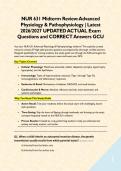
NUR 631 Midterm Review: Advanced
Physiology & Pathophysiology | Latest
2026/2027 UPDATED ACTUAL Exam
Questions and CORRECT Answers GCU
Ace your NUR 631 Advanced Physiology & Pathophysiology midterm! This expertly curated
resource contains 59 high-yield practice questions accompanied by thorough, verified answers.
Designed specifically for nursing students, this study guide cuts through the fluff and targets the
exact core concepts you need to pass your exam and boost your GPA.
Key Topics Covered
• Cellular Physiology: Membrane potentials, cellular adaptation (atrophy, hypertrophy,
hyperplasia), and the lipid bilayer.
• Immunology: Types of hypersensitivity reactions (Type I through Type IV),
immunoglobulins, and inflammatory responses.
• Endocrine & Renal: Mechanisms of diabetes, SIADH/DI, and renal function.
• Cardiovascular & Neuro: Absolute refractory periods, action potentials, and
systemic pathologies.
Why You Need This Study Guide
• Active Recall: Test your readiness before the actual exam with challenging, board-
style questions.
• Time-Saving: Skip the hours of flipping through textbooks and focusing on the exact
concepts frequently tested on the NUR 631 midterm.
• Proven Results: Created by a top-performing student to help you eliminate test
anxiety and study smarter, not harder.
Q1. When a child inherits an autosomal recessive disease, the genetic
transmission usually results from which parental status? [Multiple Choice]
A) Inherited from the father only
B) Inherited from the mother only
1
, C) Only one parent is an affected carrier
D) Both parents are carriers
Answer: Both parents are carriers
Explanation: Autosomal recessive diseases occur when a child receives a pathogenic allele from
each parent; typically both parents carry one mutant allele (are carriers) but are phenotypically
normal. If only one parent carries the allele, the child may be a carrier but usually will not be
affected. Saying it is inherited from only the mother or only the father describes X-linked or
mitochondrial patterns or simply an incorrect transmission model for typical autosomal recessive
inheritance.
Q2. The common hay fever allergy is mediated primarily by which class of
immunoglobulins? [Multiple Choice]
A) IgE
B) IgG
C) IgA
D) IgM
Answer: IgE
Explanation: Allergic reactions such as hay fever are mediated by IgE antibodies that bind to
allergens and trigger mast cell degranulation and histamine release. IgA acts at mucosal surfaces
and is not the main mediator of type I hypersensitivity. IgG and IgM serve other roles in
opsonization and primary immune responses, respectively, but are not the principal mediators of
immediate allergic (IgE-mediated) reactions.
Q3. In which structure do B lymphocytes mature and undergo changes that
commit them to becoming B cells? [Multiple Choice]
A) Bone marrow
B) Lymph nodes
C) Spleen
D) Thymus
Answer: Bone marrow
Explanation: B lymphocytes undergo maturation and the genetic changes that fix their B-cell
identity in the bone marrow. The thymus is the primary site for T-lymphocyte maturation, not B
cells. The spleen and lymph nodes are secondary lymphoid organs where mature B cells can be
2
, activated but they do not perform the primary maturation and commitment that occurs in bone
marrow.
Q4. Low plasma albumin causes edema by reducing which pressure? [Multiple
Choice]
A) Capillary permeability
B) Hydrostatic pressure
C) Plasma oncotic
D) Interstitial oncotic pressure
Answer: Plasma oncotic
Explanation: Plasma albumin is the main determinant of plasma oncotic (colloid osmotic)
pressure; when albumin falls, plasma oncotic pressure drops and fluid moves from the vascular
space into the interstitium, producing edema. Hydrostatic pressure works in the opposite
direction (pushing fluid out) and is not reduced by low albumin. Interstitial oncotic pressure is
about protein in the interstitium and increasing it would favor edema; it's not the mechanism
caused by low plasma albumin. Increased capillary permeability can cause edema too but is a
different mechanism than reduced plasma oncotic pressure from hypoalbuminemia.
Q5. Which immunoglobulin is present in blood, saliva, breast milk, and
respiratory secretions? [Multiple Choice]
A) IgG
B) IgA
C) IgE
D) IgM
Answer: IgA
Explanation: IgA is the major immunoglobulin in mucosal secretions and is found in saliva, breast
milk, respiratory secretions, and also circulates in blood. IgE mediates allergic responses (e.g.,
hay fever). IgG is the main circulating antibody in blood and crosses the placenta, and IgM is the
first antibody produced in primary immune responses — neither is the predominant secretory
immunoglobulin like IgA.
Q6. Which of these mechanisms is listed as a cause of hypernatremia? [Multiple
Choice]
A) Excess dietary potassium
B) Caused by loss of H2O
3
Physiology & Pathophysiology | Latest
2026/2027 UPDATED ACTUAL Exam
Questions and CORRECT Answers GCU
Ace your NUR 631 Advanced Physiology & Pathophysiology midterm! This expertly curated
resource contains 59 high-yield practice questions accompanied by thorough, verified answers.
Designed specifically for nursing students, this study guide cuts through the fluff and targets the
exact core concepts you need to pass your exam and boost your GPA.
Key Topics Covered
• Cellular Physiology: Membrane potentials, cellular adaptation (atrophy, hypertrophy,
hyperplasia), and the lipid bilayer.
• Immunology: Types of hypersensitivity reactions (Type I through Type IV),
immunoglobulins, and inflammatory responses.
• Endocrine & Renal: Mechanisms of diabetes, SIADH/DI, and renal function.
• Cardiovascular & Neuro: Absolute refractory periods, action potentials, and
systemic pathologies.
Why You Need This Study Guide
• Active Recall: Test your readiness before the actual exam with challenging, board-
style questions.
• Time-Saving: Skip the hours of flipping through textbooks and focusing on the exact
concepts frequently tested on the NUR 631 midterm.
• Proven Results: Created by a top-performing student to help you eliminate test
anxiety and study smarter, not harder.
Q1. When a child inherits an autosomal recessive disease, the genetic
transmission usually results from which parental status? [Multiple Choice]
A) Inherited from the father only
B) Inherited from the mother only
1
, C) Only one parent is an affected carrier
D) Both parents are carriers
Answer: Both parents are carriers
Explanation: Autosomal recessive diseases occur when a child receives a pathogenic allele from
each parent; typically both parents carry one mutant allele (are carriers) but are phenotypically
normal. If only one parent carries the allele, the child may be a carrier but usually will not be
affected. Saying it is inherited from only the mother or only the father describes X-linked or
mitochondrial patterns or simply an incorrect transmission model for typical autosomal recessive
inheritance.
Q2. The common hay fever allergy is mediated primarily by which class of
immunoglobulins? [Multiple Choice]
A) IgE
B) IgG
C) IgA
D) IgM
Answer: IgE
Explanation: Allergic reactions such as hay fever are mediated by IgE antibodies that bind to
allergens and trigger mast cell degranulation and histamine release. IgA acts at mucosal surfaces
and is not the main mediator of type I hypersensitivity. IgG and IgM serve other roles in
opsonization and primary immune responses, respectively, but are not the principal mediators of
immediate allergic (IgE-mediated) reactions.
Q3. In which structure do B lymphocytes mature and undergo changes that
commit them to becoming B cells? [Multiple Choice]
A) Bone marrow
B) Lymph nodes
C) Spleen
D) Thymus
Answer: Bone marrow
Explanation: B lymphocytes undergo maturation and the genetic changes that fix their B-cell
identity in the bone marrow. The thymus is the primary site for T-lymphocyte maturation, not B
cells. The spleen and lymph nodes are secondary lymphoid organs where mature B cells can be
2
, activated but they do not perform the primary maturation and commitment that occurs in bone
marrow.
Q4. Low plasma albumin causes edema by reducing which pressure? [Multiple
Choice]
A) Capillary permeability
B) Hydrostatic pressure
C) Plasma oncotic
D) Interstitial oncotic pressure
Answer: Plasma oncotic
Explanation: Plasma albumin is the main determinant of plasma oncotic (colloid osmotic)
pressure; when albumin falls, plasma oncotic pressure drops and fluid moves from the vascular
space into the interstitium, producing edema. Hydrostatic pressure works in the opposite
direction (pushing fluid out) and is not reduced by low albumin. Interstitial oncotic pressure is
about protein in the interstitium and increasing it would favor edema; it's not the mechanism
caused by low plasma albumin. Increased capillary permeability can cause edema too but is a
different mechanism than reduced plasma oncotic pressure from hypoalbuminemia.
Q5. Which immunoglobulin is present in blood, saliva, breast milk, and
respiratory secretions? [Multiple Choice]
A) IgG
B) IgA
C) IgE
D) IgM
Answer: IgA
Explanation: IgA is the major immunoglobulin in mucosal secretions and is found in saliva, breast
milk, respiratory secretions, and also circulates in blood. IgE mediates allergic responses (e.g.,
hay fever). IgG is the main circulating antibody in blood and crosses the placenta, and IgM is the
first antibody produced in primary immune responses — neither is the predominant secretory
immunoglobulin like IgA.
Q6. Which of these mechanisms is listed as a cause of hypernatremia? [Multiple
Choice]
A) Excess dietary potassium
B) Caused by loss of H2O
3