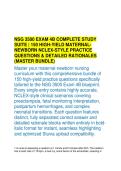
NSG 3500 EXAM 4 COMPLETE STUDY
SUITE | 150 HIGH-YIELD MATERNAL-
NEWBORN NCLEX-STYLE PRACTICE
QUESTIONS & DETAILED RATIONALES
(MASTER BUNDLE)
Master your maternal-newborn nursing curriculum
with this comprehensive bundle of 150 high-yield
practice questions specifically tailored to the Galen
NSG 3500 Exam 4 blueprint. Every single entry contains
highly accurate, NCLEX-style clinical scenarios covering
preeclampsia, fetal monitoring interpretation,
postpartum hemorrhages, and complex neonatal
transitions. Each question features distinct, fully
separated correct answer and detailed rationale blocks
, written entirely in bold-italic format for instant,
seamless highlighting and optimized Stuvia upload
compatibility.
1.A nurse is assessing a newborn at 1 minute and 5 minutes after birth. The
newborn has a heart rate of 110 bpm, a loud cry, some flexion of the extremities,
sneezing in response to a bulb syringe, and a pink body with blue extremities. Which
APGAR score should the nurse assign at the 1-minute mark?
A) 6
B) 7
C) 8
D) 9
Correct Answer: C) 8
Rationale: The APGAR scoring system evaluates five categories: heart rate,
respiratory effort, muscle tone, reflex irritability, and color. This infant scores 2
points for heart rate (>100 bpm), 2 points for respiratory effort (loud cry), 1 point
for muscle tone (some flexion), 2 points for reflex irritability (sneezing), and 1
point for color (acrocyanosis). Total score = 2+2+1+2+1 = 8.
2. A nurse is caring for a client at 36 weeks gestation who presents with a blood pressure
of 162/112 mmHg, severe right upper quadrant (RUQ) abdominal pain, and blurred
vision. Which condition should the nurse suspect?
A) Placenta previa
B) Preeclampsia with severe features
, C) Ectopic pregnancy
D) Abruptio placentae
Correct Answer: B) Preeclampsia with severe features
Rationale: Preeclampsia with severe features is characterized by a blood
pressure reading of 160/110 mmHg or higher on two occasions, alongside organ
perfusion abnormalities. Severe right upper quadrant or epigastric pain indicates
hepatic involvement (liver ischemia or capsule stretch), while blurred vision
signals central nervous system irritability.
3. While monitoring a client in active labor, the nurse notes a fetal heart rate pattern
showing late decelerations on the electronic fetal monitor. Which intervention is the
nurse's priority action?
A) Increase the rate of the oxytocin (Pitocin) infusion.
B) Assist the client into a lithotomy position.
C) Turn the client onto her left side.
D) Administer a rapid bolus of oral fluids.
Correct Answer: C) Turn the client onto her left side.
Rationale: Late decelerations indicate uteroplacental insufficiency, which
deprives the fetus of oxygen during contractions. Turning the client to her left
side relieves pressure on the vena cava, optimizes maternal cardiac output, and
improves blood flow to the placenta. The oxytocin infusion should be stopped,
not increased.
4. A nurse is preparing to care for a newborn diagnosed with a congenital diaphragmatic
hernia. Which clinical finding should the nurse anticipate during the initial physical
assessment?
A) Hyperactive bowel sounds in all four abdominal quadrants
B) A scaphoid abdomen and bowel sounds heard in the thoracic cavity
C) Symmetrical chest expansion and clear bilateral lung sounds
D) A prominent, barrel-shaped abdomen with clear breath sounds
Correct Answer: B) A scaphoid abdomen and bowel sounds heard in the thoracic
cavity
Rationale: In a congenital diaphragmatic hernia, abdominal organs herniate
through a defect in the diaphragm into the thoracic cavity. This displacement
leaves the abdominal cavity empty, causing a sunken or scaphoid abdomen,
while the presence of the intestines in the chest causes audible thoracic bowel
sounds and severe respiratory distress.
, 5. A nurse is reinforcing teaching with a postpartum client about preventing heat loss in
her newborn. The nurse explains that putting a cap on the baby's head prevents heat
loss through which mechanism?
A) Radiation
B) Conduction
C) Convection
D) Evaporation
Correct Answer: C) Convection
Rationale: Convection is the flow of heat from the body surface to the cooler
surrounding air currents. Because a newborn has a large head surface area
relative to their body mass, significant heat is lost to air currents. Placing a cap
on the newborn's head minimizes this exposed surface area and limits convective
heat loss.
6. A nurse is caring for a client receiving intravenous magnesium sulfate for preeclampsia.
Which clinical finding is the most critical indication of magnesium sulfate toxicity?
A) Mild flushing and a feeling of warmth
B) Absence of deep tendon reflexes (DTRs)
C) A urinary output of 40 mL per hour
D) A respiratory rate of 14 breaths per minute
Correct Answer: B) Absence of deep tendon reflexes (DTRs)
Rationale: Loss of deep tendon reflexes is the earliest sign of magnesium sulfate
toxicity, as magnesium acts as a central nervous system depressant and
neuromuscular blocker. Respiratory depression (usually <12 breaths/min) and
severe oliguria (<30 mL/hr) are later, more dangerous signs.
7. A nurse is assessing a postpartum client 4 hours after a vaginal delivery and notes a
firm fundus at the umbilicus, but a steady trickle of bright red vaginal blood is present.
Which condition should the nurse suspect?
A) Uterine atony
B) Retained placental fragments
C) Cervical or vaginal laceration
D) Disseminated intravascular coagulation (DIC)
Correct Answer: C) Cervical or vaginal laceration
SUITE | 150 HIGH-YIELD MATERNAL-
NEWBORN NCLEX-STYLE PRACTICE
QUESTIONS & DETAILED RATIONALES
(MASTER BUNDLE)
Master your maternal-newborn nursing curriculum
with this comprehensive bundle of 150 high-yield
practice questions specifically tailored to the Galen
NSG 3500 Exam 4 blueprint. Every single entry contains
highly accurate, NCLEX-style clinical scenarios covering
preeclampsia, fetal monitoring interpretation,
postpartum hemorrhages, and complex neonatal
transitions. Each question features distinct, fully
separated correct answer and detailed rationale blocks
, written entirely in bold-italic format for instant,
seamless highlighting and optimized Stuvia upload
compatibility.
1.A nurse is assessing a newborn at 1 minute and 5 minutes after birth. The
newborn has a heart rate of 110 bpm, a loud cry, some flexion of the extremities,
sneezing in response to a bulb syringe, and a pink body with blue extremities. Which
APGAR score should the nurse assign at the 1-minute mark?
A) 6
B) 7
C) 8
D) 9
Correct Answer: C) 8
Rationale: The APGAR scoring system evaluates five categories: heart rate,
respiratory effort, muscle tone, reflex irritability, and color. This infant scores 2
points for heart rate (>100 bpm), 2 points for respiratory effort (loud cry), 1 point
for muscle tone (some flexion), 2 points for reflex irritability (sneezing), and 1
point for color (acrocyanosis). Total score = 2+2+1+2+1 = 8.
2. A nurse is caring for a client at 36 weeks gestation who presents with a blood pressure
of 162/112 mmHg, severe right upper quadrant (RUQ) abdominal pain, and blurred
vision. Which condition should the nurse suspect?
A) Placenta previa
B) Preeclampsia with severe features
, C) Ectopic pregnancy
D) Abruptio placentae
Correct Answer: B) Preeclampsia with severe features
Rationale: Preeclampsia with severe features is characterized by a blood
pressure reading of 160/110 mmHg or higher on two occasions, alongside organ
perfusion abnormalities. Severe right upper quadrant or epigastric pain indicates
hepatic involvement (liver ischemia or capsule stretch), while blurred vision
signals central nervous system irritability.
3. While monitoring a client in active labor, the nurse notes a fetal heart rate pattern
showing late decelerations on the electronic fetal monitor. Which intervention is the
nurse's priority action?
A) Increase the rate of the oxytocin (Pitocin) infusion.
B) Assist the client into a lithotomy position.
C) Turn the client onto her left side.
D) Administer a rapid bolus of oral fluids.
Correct Answer: C) Turn the client onto her left side.
Rationale: Late decelerations indicate uteroplacental insufficiency, which
deprives the fetus of oxygen during contractions. Turning the client to her left
side relieves pressure on the vena cava, optimizes maternal cardiac output, and
improves blood flow to the placenta. The oxytocin infusion should be stopped,
not increased.
4. A nurse is preparing to care for a newborn diagnosed with a congenital diaphragmatic
hernia. Which clinical finding should the nurse anticipate during the initial physical
assessment?
A) Hyperactive bowel sounds in all four abdominal quadrants
B) A scaphoid abdomen and bowel sounds heard in the thoracic cavity
C) Symmetrical chest expansion and clear bilateral lung sounds
D) A prominent, barrel-shaped abdomen with clear breath sounds
Correct Answer: B) A scaphoid abdomen and bowel sounds heard in the thoracic
cavity
Rationale: In a congenital diaphragmatic hernia, abdominal organs herniate
through a defect in the diaphragm into the thoracic cavity. This displacement
leaves the abdominal cavity empty, causing a sunken or scaphoid abdomen,
while the presence of the intestines in the chest causes audible thoracic bowel
sounds and severe respiratory distress.
, 5. A nurse is reinforcing teaching with a postpartum client about preventing heat loss in
her newborn. The nurse explains that putting a cap on the baby's head prevents heat
loss through which mechanism?
A) Radiation
B) Conduction
C) Convection
D) Evaporation
Correct Answer: C) Convection
Rationale: Convection is the flow of heat from the body surface to the cooler
surrounding air currents. Because a newborn has a large head surface area
relative to their body mass, significant heat is lost to air currents. Placing a cap
on the newborn's head minimizes this exposed surface area and limits convective
heat loss.
6. A nurse is caring for a client receiving intravenous magnesium sulfate for preeclampsia.
Which clinical finding is the most critical indication of magnesium sulfate toxicity?
A) Mild flushing and a feeling of warmth
B) Absence of deep tendon reflexes (DTRs)
C) A urinary output of 40 mL per hour
D) A respiratory rate of 14 breaths per minute
Correct Answer: B) Absence of deep tendon reflexes (DTRs)
Rationale: Loss of deep tendon reflexes is the earliest sign of magnesium sulfate
toxicity, as magnesium acts as a central nervous system depressant and
neuromuscular blocker. Respiratory depression (usually <12 breaths/min) and
severe oliguria (<30 mL/hr) are later, more dangerous signs.
7. A nurse is assessing a postpartum client 4 hours after a vaginal delivery and notes a
firm fundus at the umbilicus, but a steady trickle of bright red vaginal blood is present.
Which condition should the nurse suspect?
A) Uterine atony
B) Retained placental fragments
C) Cervical or vaginal laceration
D) Disseminated intravascular coagulation (DIC)
Correct Answer: C) Cervical or vaginal laceration