

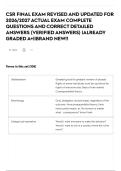
CSR FINAL EXAM REVISED AND UPDATED FOR
2026/2027 ACTUAL EXAM COMPLETE
QUESTIONS AND CORRECT DETAILED
ANSWERS (VERIFIED ANSWERS) |ALREADY
GRADED A+||BRAND NEW!!
Save
Terms in this set (108)
Utalitarianism Greatest good for greatest number of people.
Rights of some individuals must be sacrificed for
rights of everyone else. Basis of free market.
Consequentialist theory.
Deontology Duty, obligation, and principal, regardless of the
outcome. Nonconsequentialist theory. Ends
never justify means. ex. Be honest no matter
what... consequence? Anne Frank
Categorical imperative Would I want everyone to make this decision?
Would I want to live in a society where this is the
norm?
,Virtue Ethics The role of character making a choice. Focuses
more on integrity of person making decision than
the decision itself.
Moral Relativism Every society has their own beliefs. Whatever
your society believes is right. Here, there's no
progress/enlightenment.
Classical View Profit maximization and free market. Efficient
allocation of resources, supports freedom and
individuality. Proponents are Adam Smith and
Friedman.
• Maximize long term shareholders' value
• Enlightened self interest approach (by pursuing
self interest society is going to be better off)
• Pros: greatest good (invisible hand), innovation,
freedom, prices, choice, efficiency
• Cons: market failures, inequality
Adam Smith Scottish Political Economist. Father of Free trade
and capitalism. Classical View. If businesses
maximize profit, it will benefit society and the
market will correct itself. Wrote "The Wealth of
Nations"
Milton Friedman Classical View. The govt. should be a referee but
not a player in the market.
• Societies that put equality before freedom gets
neither, but societies that put freedom before
equality you get both
Free Market Transactions are bilaterally voluntary and
informed. No coercion because there is
competition (options).
, Components of price (also the 3 wages, profit, rent
forms of return)
3 factors of production land, labor, capital
Market Failure Where the pursuit of private interest does NOT
lead to the nation's allocation of goods and
services efficiently. Places where govt.
intervention might be necessary.
Types are Monopoly, monopsony, externalities,
public goods, and information limitations.
Monopoly Single provider of goods and services
Monopsony the largest/only single buyer so you can dictate
price
Externalities Social costs and their negative effects on society
(pollution, non-renewable resources).
Social costs=private costs+externalities
Tragedy of the commons Effect of externalities. Depleted resources of
common lands. Shared resources where each
actor uses it but no one takes care of it. Finite
resources vs population growth → common
resources will be depleted eventually.
2026/2027 ACTUAL EXAM COMPLETE
QUESTIONS AND CORRECT DETAILED
ANSWERS (VERIFIED ANSWERS) |ALREADY
GRADED A+||BRAND NEW!!
Save
Terms in this set (108)
Utalitarianism Greatest good for greatest number of people.
Rights of some individuals must be sacrificed for
rights of everyone else. Basis of free market.
Consequentialist theory.
Deontology Duty, obligation, and principal, regardless of the
outcome. Nonconsequentialist theory. Ends
never justify means. ex. Be honest no matter
what... consequence? Anne Frank
Categorical imperative Would I want everyone to make this decision?
Would I want to live in a society where this is the
norm?
,Virtue Ethics The role of character making a choice. Focuses
more on integrity of person making decision than
the decision itself.
Moral Relativism Every society has their own beliefs. Whatever
your society believes is right. Here, there's no
progress/enlightenment.
Classical View Profit maximization and free market. Efficient
allocation of resources, supports freedom and
individuality. Proponents are Adam Smith and
Friedman.
• Maximize long term shareholders' value
• Enlightened self interest approach (by pursuing
self interest society is going to be better off)
• Pros: greatest good (invisible hand), innovation,
freedom, prices, choice, efficiency
• Cons: market failures, inequality
Adam Smith Scottish Political Economist. Father of Free trade
and capitalism. Classical View. If businesses
maximize profit, it will benefit society and the
market will correct itself. Wrote "The Wealth of
Nations"
Milton Friedman Classical View. The govt. should be a referee but
not a player in the market.
• Societies that put equality before freedom gets
neither, but societies that put freedom before
equality you get both
Free Market Transactions are bilaterally voluntary and
informed. No coercion because there is
competition (options).
, Components of price (also the 3 wages, profit, rent
forms of return)
3 factors of production land, labor, capital
Market Failure Where the pursuit of private interest does NOT
lead to the nation's allocation of goods and
services efficiently. Places where govt.
intervention might be necessary.
Types are Monopoly, monopsony, externalities,
public goods, and information limitations.
Monopoly Single provider of goods and services
Monopsony the largest/only single buyer so you can dictate
price
Externalities Social costs and their negative effects on society
(pollution, non-renewable resources).
Social costs=private costs+externalities
Tragedy of the commons Effect of externalities. Depleted resources of
common lands. Shared resources where each
actor uses it but no one takes care of it. Finite
resources vs population growth → common
resources will be depleted eventually.


