

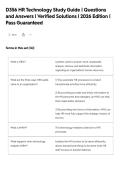
D356 HR Technology Study Guide | Questions
and Answers | Verified Solutions | 2026 Edition |
Pass Guaranteed
Save
Terms in this set (141)
What is HRIS? Systems used to acquire, store, manipulate,
analyze, retrieve, and distribute information
regarding an organization's human resources.
What are the three ways HRIS adds 1) They automate HR processes to conduct
value to an organization? transactional activities more efficiently.
2) By providing accurate and timely information to
the HR personnel and managers, an HRIS can help
them make better decisions
3) By providing new forms of information, HRIS can
help HR more fully support the strategic mission of
the firm.
What is eHRM? This technology-enabled collection of HR
processes.
What happens when technology Enables the HR function to be done differently,
enables eHRM? allows transactional things to be done while HR
staff focuses on transformational.
,What is the main function of eHRM eHRM is a way of conducting HR and HRIS is the
and HRIS? technology through which hrm is enabled.
What are the advantages of HRIS? 1) providing a comprehensive information picture
as a single, integrated database; this enables
organizations to provide structural connectivity
across units and activities and to increase the
speed of information transactions 2)
increasing competitiveness by improving HR
operations and management processes;
3) improved timeliness and quality of decision
making;
streamlining and enhancing the efficiency and
effectiveness of HR administrative functions 4)
shifting the focus of HR from the processing of
transactions to strategic HRM 5)
improving employee satisfaction by delivering HR
services more quickly and accurately. 6) the
implementation of a HRIS can lead to dramatic cost
and time savings.
, What factors decide the usage of 1) the size of the organization, with large firms
HRIS? generally reaping greater benefits;
2) the amount of top management support and
commitment;
3) the availability of resources (time, money, and
personnel);
4) the HR philosophy of the company as well as its
vision, organizational culture, structure, and
systems;
5) managerial competence in cross-functional
decision making, employee involvement, and
coaching;
6) the ability and motivation of employees in
adopting change, such as increased automation
across and between functions
What are some risks of HRIS? 1) management by computer and substitution of
technology for human judgment—managers may
begin to base performance evaluations exclusively
on the data captured by the HRIS. Thus, soft-skill
behaviors such as teamwork and customer service
may not be fully considered.
2) privacy concerns—employees and applicants
may feel that their data are being accessed and
used by those internal and external to the
organization.
3) system rigidity and lack of flexibility—
standardization of HR processes can benefit the
organization, but some systems may not allow for
the inevitable exceptions that arise and as the HR
legal environment changes.
4) employee stress and resistance to the use of
electronic performance monitoring.
5) performance reduction in complex tasks when
performance monitoring systems are used.
and Answers | Verified Solutions | 2026 Edition |
Pass Guaranteed
Save
Terms in this set (141)
What is HRIS? Systems used to acquire, store, manipulate,
analyze, retrieve, and distribute information
regarding an organization's human resources.
What are the three ways HRIS adds 1) They automate HR processes to conduct
value to an organization? transactional activities more efficiently.
2) By providing accurate and timely information to
the HR personnel and managers, an HRIS can help
them make better decisions
3) By providing new forms of information, HRIS can
help HR more fully support the strategic mission of
the firm.
What is eHRM? This technology-enabled collection of HR
processes.
What happens when technology Enables the HR function to be done differently,
enables eHRM? allows transactional things to be done while HR
staff focuses on transformational.
,What is the main function of eHRM eHRM is a way of conducting HR and HRIS is the
and HRIS? technology through which hrm is enabled.
What are the advantages of HRIS? 1) providing a comprehensive information picture
as a single, integrated database; this enables
organizations to provide structural connectivity
across units and activities and to increase the
speed of information transactions 2)
increasing competitiveness by improving HR
operations and management processes;
3) improved timeliness and quality of decision
making;
streamlining and enhancing the efficiency and
effectiveness of HR administrative functions 4)
shifting the focus of HR from the processing of
transactions to strategic HRM 5)
improving employee satisfaction by delivering HR
services more quickly and accurately. 6) the
implementation of a HRIS can lead to dramatic cost
and time savings.
, What factors decide the usage of 1) the size of the organization, with large firms
HRIS? generally reaping greater benefits;
2) the amount of top management support and
commitment;
3) the availability of resources (time, money, and
personnel);
4) the HR philosophy of the company as well as its
vision, organizational culture, structure, and
systems;
5) managerial competence in cross-functional
decision making, employee involvement, and
coaching;
6) the ability and motivation of employees in
adopting change, such as increased automation
across and between functions
What are some risks of HRIS? 1) management by computer and substitution of
technology for human judgment—managers may
begin to base performance evaluations exclusively
on the data captured by the HRIS. Thus, soft-skill
behaviors such as teamwork and customer service
may not be fully considered.
2) privacy concerns—employees and applicants
may feel that their data are being accessed and
used by those internal and external to the
organization.
3) system rigidity and lack of flexibility—
standardization of HR processes can benefit the
organization, but some systems may not allow for
the inevitable exceptions that arise and as the HR
legal environment changes.
4) employee stress and resistance to the use of
electronic performance monitoring.
5) performance reduction in complex tasks when
performance monitoring systems are used.


