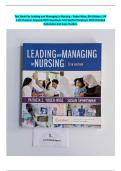
Davis Advantage for Medical-
Surgical Nursing
Making Connections to Practice
3rd Edition
• Author(s)Janice Hoffman; Nancy
Sullivan
• Print ISBN: 9781719647366
TEST BANK
,1) MCQ
Clinical Scenario
A postoperative patient says, “I feel dizzy,” while standing at
the bedside. The nurse notes a heart rate of 124/min, blood
pressure of 88/50 mm Hg, and cool, clammy skin.
Question Stem
What is the nurse’s first action?
Answer Options
A. Notify the provider immediately
B. Assist the patient back to bed and reassess vital signs
C. Encourage the patient to drink water
D. Document the findings in the chart
Correct Answer
B. Assist the patient back to bed and reassess vital signs
Detailed Rationale
The patient shows cues of possible orthostatic intolerance or
decreased circulating volume. The nurse must first protect the
patient from falling, return the patient to a safe position, and
reassess. This reflects clinical judgment: recognize cues, take
immediate safety action, then continue assessment and
escalation as needed.
Incorrect Option Analysis
, • A. Notify the provider immediately — Important, but not
the first step because the patient is currently unstable and
at risk for injury.
o Misconception: Thinking communication always
comes before safety.
o Safety risk: The patient could fall or worsen while the
nurse delays immediate intervention.
• C. Encourage the patient to drink water — May be
appropriate later if allowed, but the patient is
symptomatic and should not remain standing.
o Misconception: Assuming hydration alone fixes the
problem.
o Safety risk: Delayed intervention may lead to syncope
or injury.
• D. Document the findings in the chart — Documentation
is necessary, but only after the patient is safe and
reassessed.
o Misconception: Believing charting replaces action.
o Safety risk: Failing to intervene promptly.
Nursing Process Linkage
Assessment
Clinical Judgment Competency
Recognize Cues
, Difficulty Level
Moderate
Bloom’s Level
Apply
NCLEX Client Needs Category
Physiological Adaptation
Key Learning Objective
Prioritize immediate nursing action when abnormal assessment
findings indicate possible hemodynamic instability.
2) MCQ
Clinical Scenario
A nurse reviews data on a patient with shortness of breath,
crackles, and new peripheral edema. The nurse concludes that
the patient may have fluid volume overload.
Question Stem
Which step of the nursing process is the nurse demonstrating?
Answer Options
A. Assessment
B. Nursing diagnosis
C. Implementation
D. Evaluation
Surgical Nursing
Making Connections to Practice
3rd Edition
• Author(s)Janice Hoffman; Nancy
Sullivan
• Print ISBN: 9781719647366
TEST BANK
,1) MCQ
Clinical Scenario
A postoperative patient says, “I feel dizzy,” while standing at
the bedside. The nurse notes a heart rate of 124/min, blood
pressure of 88/50 mm Hg, and cool, clammy skin.
Question Stem
What is the nurse’s first action?
Answer Options
A. Notify the provider immediately
B. Assist the patient back to bed and reassess vital signs
C. Encourage the patient to drink water
D. Document the findings in the chart
Correct Answer
B. Assist the patient back to bed and reassess vital signs
Detailed Rationale
The patient shows cues of possible orthostatic intolerance or
decreased circulating volume. The nurse must first protect the
patient from falling, return the patient to a safe position, and
reassess. This reflects clinical judgment: recognize cues, take
immediate safety action, then continue assessment and
escalation as needed.
Incorrect Option Analysis
, • A. Notify the provider immediately — Important, but not
the first step because the patient is currently unstable and
at risk for injury.
o Misconception: Thinking communication always
comes before safety.
o Safety risk: The patient could fall or worsen while the
nurse delays immediate intervention.
• C. Encourage the patient to drink water — May be
appropriate later if allowed, but the patient is
symptomatic and should not remain standing.
o Misconception: Assuming hydration alone fixes the
problem.
o Safety risk: Delayed intervention may lead to syncope
or injury.
• D. Document the findings in the chart — Documentation
is necessary, but only after the patient is safe and
reassessed.
o Misconception: Believing charting replaces action.
o Safety risk: Failing to intervene promptly.
Nursing Process Linkage
Assessment
Clinical Judgment Competency
Recognize Cues
, Difficulty Level
Moderate
Bloom’s Level
Apply
NCLEX Client Needs Category
Physiological Adaptation
Key Learning Objective
Prioritize immediate nursing action when abnormal assessment
findings indicate possible hemodynamic instability.
2) MCQ
Clinical Scenario
A nurse reviews data on a patient with shortness of breath,
crackles, and new peripheral edema. The nurse concludes that
the patient may have fluid volume overload.
Question Stem
Which step of the nursing process is the nurse demonstrating?
Answer Options
A. Assessment
B. Nursing diagnosis
C. Implementation
D. Evaluation