

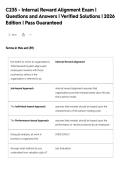
C235 - Internal Reward Alignment Exam |
Questions and Answers | Verified Solutions | 2026
Edition | Pass Guaranteed
Save
Terms in this set (39)
the extent to which an organization's Internal Reward Alignment
Total Rewards System aligns each
employee's rewards with those
received by others in the
organization is referred to as
Job-based Approach internal reward alignment assumes that
organizations provide rewards based upon the job
that a person holds.
The Individual-based Approach assumes that rewards should be based upon the
characteristics of the person holding a job.
The Performance-based Approach assumes that rewards should be based upon the
performance or results produced by an employee.
Using job analysis, all work in JOBS (ONLY)
business is organized into:
through what method do you Job Evaluation
understand how valuable a job is?
, Job Evaluation is the process by which the value of each job in an
organization is established. It provides the basis for
developing a network or configuration of pay rates
that make up a rewards structure.
A Job Structure is an organized listing of the business's jobs that
functionally groups and hierarchically arranges the
jobs for rewards purposes. Job Families, such as
Accounting, Marketing, or Computer Engineering,
typically form the largest categories. Within these
categories, other groupings are established based
upon broad job-content distinctions. The Computer
Engineering job family, for example, could be
broken up between Programming, Network
Administration, and Database Management.
he Job-value Structure represents internally positioned according to their relative
the structure of jobs value. It answers the question of what the jobs are,
how they are related, and the relative importance
of each. For example, if an organization employs
electrical engineers that design the hardware of a
smartphone and employs software engineers that
work on the software, how does that organization
ensure that the two types of engineers' pay is in
alignment? That is the broad goal of the Job-Value
Structure.
Questions and Answers | Verified Solutions | 2026
Edition | Pass Guaranteed
Save
Terms in this set (39)
the extent to which an organization's Internal Reward Alignment
Total Rewards System aligns each
employee's rewards with those
received by others in the
organization is referred to as
Job-based Approach internal reward alignment assumes that
organizations provide rewards based upon the job
that a person holds.
The Individual-based Approach assumes that rewards should be based upon the
characteristics of the person holding a job.
The Performance-based Approach assumes that rewards should be based upon the
performance or results produced by an employee.
Using job analysis, all work in JOBS (ONLY)
business is organized into:
through what method do you Job Evaluation
understand how valuable a job is?
, Job Evaluation is the process by which the value of each job in an
organization is established. It provides the basis for
developing a network or configuration of pay rates
that make up a rewards structure.
A Job Structure is an organized listing of the business's jobs that
functionally groups and hierarchically arranges the
jobs for rewards purposes. Job Families, such as
Accounting, Marketing, or Computer Engineering,
typically form the largest categories. Within these
categories, other groupings are established based
upon broad job-content distinctions. The Computer
Engineering job family, for example, could be
broken up between Programming, Network
Administration, and Database Management.
he Job-value Structure represents internally positioned according to their relative
the structure of jobs value. It answers the question of what the jobs are,
how they are related, and the relative importance
of each. For example, if an organization employs
electrical engineers that design the hardware of a
smartphone and employs software engineers that
work on the software, how does that organization
ensure that the two types of engineers' pay is in
alignment? That is the broad goal of the Job-Value
Structure.


