

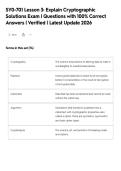
SY0-701 Lesson 3: Explain Cryptographic
Solutions Exam | Questions with 100% Correct
Answers | Verified | Latest Update 2026
Save
Terms in this set (74)
Cryptography The science and practice of altering data to make it
unintelligible to unauthorized parties.
Plaintext Unencrypted data that is meant to be encrypted
before it is transmitted, or the result of decryption
of encrypted data.
Ciphertext Data that has been enciphered and cannot be read
without the cipher key.
Algorithm Operations that transform a plaintext into a
ciphertext with cryptographic properties, also
called a cipher. There are symmetric, asymmetric,
and hash cipher types.
Cryptanalysis The science, art, and practice of breaking codes
and ciphers.
, encryption Scrambling the characters used in a message so
that the message can be seen but not understood
or modified unless it can be deciphered.
Encryption provides for a secure means of
transmitting data and authenticating users. It is also
used to store data securely. Encryption uses
different types of cipher and one or more keys. The
size of the key is one factor in determining the
strength of the encryption product.
key In cryptography, a specific piece of information
that is used in conjunction with an algorithm to
perform encryption and decryption.
Symmetric encryption Two-way encryption scheme in which encryption
and decryption are both performed by the same
key. Also known as shared-key encryption.
key length Size of a cryptographic key in bits. Longer keys
generally offer better security, but key lengths for
different ciphers are not directly comparable.
asymmetric algorithm Cipher that uses public and private keys. The keys
are mathematically linked, using either Rivel,
Shamir, Adleman (RSA) or elliptic curve
cryptography (ECC) alogrithms, but the private key
is not derivable from the public one. An
asymmetric key cannot reverse the operation it
performs, so the public key cannot decrypt what it
has encrypted, for example.
Solutions Exam | Questions with 100% Correct
Answers | Verified | Latest Update 2026
Save
Terms in this set (74)
Cryptography The science and practice of altering data to make it
unintelligible to unauthorized parties.
Plaintext Unencrypted data that is meant to be encrypted
before it is transmitted, or the result of decryption
of encrypted data.
Ciphertext Data that has been enciphered and cannot be read
without the cipher key.
Algorithm Operations that transform a plaintext into a
ciphertext with cryptographic properties, also
called a cipher. There are symmetric, asymmetric,
and hash cipher types.
Cryptanalysis The science, art, and practice of breaking codes
and ciphers.
, encryption Scrambling the characters used in a message so
that the message can be seen but not understood
or modified unless it can be deciphered.
Encryption provides for a secure means of
transmitting data and authenticating users. It is also
used to store data securely. Encryption uses
different types of cipher and one or more keys. The
size of the key is one factor in determining the
strength of the encryption product.
key In cryptography, a specific piece of information
that is used in conjunction with an algorithm to
perform encryption and decryption.
Symmetric encryption Two-way encryption scheme in which encryption
and decryption are both performed by the same
key. Also known as shared-key encryption.
key length Size of a cryptographic key in bits. Longer keys
generally offer better security, but key lengths for
different ciphers are not directly comparable.
asymmetric algorithm Cipher that uses public and private keys. The keys
are mathematically linked, using either Rivel,
Shamir, Adleman (RSA) or elliptic curve
cryptography (ECC) alogrithms, but the private key
is not derivable from the public one. An
asymmetric key cannot reverse the operation it
performs, so the public key cannot decrypt what it
has encrypted, for example.


