

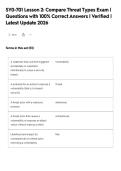
SY0-701 Lesson 2: Compare Threat Types Exam |
Questions with 100% Correct Answers | Verified |
Latest Update 2026
Save
Terms in this set (53)
A weakness that could be triggered Vulnerability
accidentally or exploited
intentionally to cause a security
breach.
A potential for an entity to exercise a Threat
vulnerability (that is, to breach
security).
A threat actor with a malicious intentional
purpose.
A threat actor that causes a unintentional
vulnerability or exposes an attack
vector without malicious intent.
Likelihood and impact (or Risk
consequence) of a threat actor
exercising a vulnerability.
, The degree of access that a threat Internal/external
actor possesses before initiating an
attack. An external threat actor has
no standing privileges, while an
internal actor has been granted
some access permissions.
A person or entity responsible for an threat actor
event that has been identified as a
security incident or as a risk.
A formal classification of the Level of sophistication/capability
resources and expertise available to
a threat actor.
The ability of threat actors to draw resources/funding
upon funding to acquire personnel,
tools, and to develop novel attack
types.
A type of attack that compromises Service disruption
the availability of an asset or
business process.
The process by which an attacker Data exfiltration
takes data that is stored inside of a
private network and moves it to an
external network.
A type of attack that falsifies an Disinformation
information resource that is normally
trusted by others.
Questions with 100% Correct Answers | Verified |
Latest Update 2026
Save
Terms in this set (53)
A weakness that could be triggered Vulnerability
accidentally or exploited
intentionally to cause a security
breach.
A potential for an entity to exercise a Threat
vulnerability (that is, to breach
security).
A threat actor with a malicious intentional
purpose.
A threat actor that causes a unintentional
vulnerability or exposes an attack
vector without malicious intent.
Likelihood and impact (or Risk
consequence) of a threat actor
exercising a vulnerability.
, The degree of access that a threat Internal/external
actor possesses before initiating an
attack. An external threat actor has
no standing privileges, while an
internal actor has been granted
some access permissions.
A person or entity responsible for an threat actor
event that has been identified as a
security incident or as a risk.
A formal classification of the Level of sophistication/capability
resources and expertise available to
a threat actor.
The ability of threat actors to draw resources/funding
upon funding to acquire personnel,
tools, and to develop novel attack
types.
A type of attack that compromises Service disruption
the availability of an asset or
business process.
The process by which an attacker Data exfiltration
takes data that is stored inside of a
private network and moves it to an
external network.
A type of attack that falsifies an Disinformation
information resource that is normally
trusted by others.


