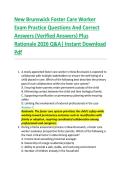
New Brunswick Family Support Worker
Assessment Exam Practice Questions
And Correct Answers (Verified Answers)
Plus Rationale 2026 Q&A| Instant
Download Pdf
1. A Family Support Worker in New Brunswick is assigned to a family
experiencing financial hardship, parenting challenges, and housing
instability. Which of the following actions best reflects a holistic,
client-centered approach to intervention?
A. Focusing solely on providing financial aid to address immediate
needs
B. Referring the family to multiple agencies without follow-up
C. Conducting a comprehensive assessment of needs, strengths, and
risks, then coordinating integrated services
D. Advising the family to resolve issues independently to promote self-
reliance
Answer: C
Rationale: A holistic, client-centered approach requires assessing the
entire family situation and coordinating services across multiple
domains rather than addressing a single issue in isolation.
2. In the context of family support services, which principle is most
aligned with empowerment-based practice?
A. Making decisions on behalf of clients to ensure compliance
B. Encouraging clients to identify their own goals and participate in
decision-making
C. Limiting client involvement to reduce confusion
, D. Prioritizing agency policies over client needs
Answer: B
Rationale: Empowerment-based practice emphasizes client
autonomy, encouraging individuals to actively participate in
decisions affecting their lives.
3. A Family Support Worker observes signs of neglect during a home
visit. What is the most appropriate immediate action?
A. Ignore the situation until more evidence is gathered
B. Confront the parents aggressively
C. Follow mandatory reporting procedures according to child
protection laws
D. Discuss the situation casually with neighbors
Answer: C
Rationale: Legal and ethical standards require immediate reporting
of suspected neglect to appropriate authorities to ensure child
safety.
4. Which of the following best describes the role of a Family Support
Worker in crisis intervention?
A. Providing long-term psychotherapy
B. Offering immediate, short-term assistance to stabilize the situation
C. Diagnosing mental health disorders
D. Conducting legal investigations
Answer: B
Rationale: Crisis intervention focuses on immediate stabilization and
support rather than long-term therapeutic treatment or diagnosis.
5. When working with culturally diverse families, what is the most
important consideration for a Family Support Worker?
A. Applying the same intervention strategies to all families
B. Ignoring cultural differences to avoid bias
C. Demonstrating cultural competence and sensitivity
D. Prioritizing personal beliefs over cultural values
Answer: C
Rationale: Cultural competence ensures respectful, relevant, and
effective support tailored to the family’s background and values.
, 6. A Family Support Worker must maintain professional boundaries.
Which scenario represents a boundary violation?
A. Referring a client to community services
B. Accepting a small thank-you card from a client
C. Developing a personal friendship outside of work
D. Scheduling regular case review meetings
Answer: C
Rationale: Forming personal relationships outside professional roles
compromises objectivity and ethical boundaries.
7. Which of the following is a key component of effective case
management?
A. Ignoring documentation to save time
B. Coordinating services and monitoring client progress
C. Delegating all responsibilities to other agencies
D. Limiting communication with clients
Answer: B
Rationale: Case management involves coordination, monitoring, and
evaluation of services to meet client needs effectively.
8. A Family Support Worker is assisting a parent struggling with
substance abuse. What is the most appropriate approach?
A. Blaming the parent for their behavior
B. Ignoring the issue to maintain rapport
C. Providing supportive counseling and referrals to treatment services
D. Reporting the parent immediately without assessment
Answer: C
Rationale: Supportive intervention combined with referrals promotes
recovery while maintaining a therapeutic relationship.
9. Which skill is essential when assessing a family’s needs?
A. Passive listening
B. Critical thinking and observation
C. Avoidance of sensitive topics
D. Strict adherence to scripts
Answer: B
Rationale: Effective assessment requires analytical thinking and
careful observation to identify underlying issues.
Assessment Exam Practice Questions
And Correct Answers (Verified Answers)
Plus Rationale 2026 Q&A| Instant
Download Pdf
1. A Family Support Worker in New Brunswick is assigned to a family
experiencing financial hardship, parenting challenges, and housing
instability. Which of the following actions best reflects a holistic,
client-centered approach to intervention?
A. Focusing solely on providing financial aid to address immediate
needs
B. Referring the family to multiple agencies without follow-up
C. Conducting a comprehensive assessment of needs, strengths, and
risks, then coordinating integrated services
D. Advising the family to resolve issues independently to promote self-
reliance
Answer: C
Rationale: A holistic, client-centered approach requires assessing the
entire family situation and coordinating services across multiple
domains rather than addressing a single issue in isolation.
2. In the context of family support services, which principle is most
aligned with empowerment-based practice?
A. Making decisions on behalf of clients to ensure compliance
B. Encouraging clients to identify their own goals and participate in
decision-making
C. Limiting client involvement to reduce confusion
, D. Prioritizing agency policies over client needs
Answer: B
Rationale: Empowerment-based practice emphasizes client
autonomy, encouraging individuals to actively participate in
decisions affecting their lives.
3. A Family Support Worker observes signs of neglect during a home
visit. What is the most appropriate immediate action?
A. Ignore the situation until more evidence is gathered
B. Confront the parents aggressively
C. Follow mandatory reporting procedures according to child
protection laws
D. Discuss the situation casually with neighbors
Answer: C
Rationale: Legal and ethical standards require immediate reporting
of suspected neglect to appropriate authorities to ensure child
safety.
4. Which of the following best describes the role of a Family Support
Worker in crisis intervention?
A. Providing long-term psychotherapy
B. Offering immediate, short-term assistance to stabilize the situation
C. Diagnosing mental health disorders
D. Conducting legal investigations
Answer: B
Rationale: Crisis intervention focuses on immediate stabilization and
support rather than long-term therapeutic treatment or diagnosis.
5. When working with culturally diverse families, what is the most
important consideration for a Family Support Worker?
A. Applying the same intervention strategies to all families
B. Ignoring cultural differences to avoid bias
C. Demonstrating cultural competence and sensitivity
D. Prioritizing personal beliefs over cultural values
Answer: C
Rationale: Cultural competence ensures respectful, relevant, and
effective support tailored to the family’s background and values.
, 6. A Family Support Worker must maintain professional boundaries.
Which scenario represents a boundary violation?
A. Referring a client to community services
B. Accepting a small thank-you card from a client
C. Developing a personal friendship outside of work
D. Scheduling regular case review meetings
Answer: C
Rationale: Forming personal relationships outside professional roles
compromises objectivity and ethical boundaries.
7. Which of the following is a key component of effective case
management?
A. Ignoring documentation to save time
B. Coordinating services and monitoring client progress
C. Delegating all responsibilities to other agencies
D. Limiting communication with clients
Answer: B
Rationale: Case management involves coordination, monitoring, and
evaluation of services to meet client needs effectively.
8. A Family Support Worker is assisting a parent struggling with
substance abuse. What is the most appropriate approach?
A. Blaming the parent for their behavior
B. Ignoring the issue to maintain rapport
C. Providing supportive counseling and referrals to treatment services
D. Reporting the parent immediately without assessment
Answer: C
Rationale: Supportive intervention combined with referrals promotes
recovery while maintaining a therapeutic relationship.
9. Which skill is essential when assessing a family’s needs?
A. Passive listening
B. Critical thinking and observation
C. Avoidance of sensitive topics
D. Strict adherence to scripts
Answer: B
Rationale: Effective assessment requires analytical thinking and
careful observation to identify underlying issues.