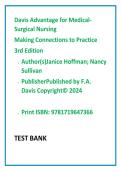
Davis Advantage for Medical-
Surgical Nursing
Making Connections to Practice
3rd Edition
• Author(s)Janice Hoffman; Nancy
Sullivan
• PublisherPublished by F.A.
Davis Copyright© 2024
• Print ISBN: 9781719647366
TEST BANK
,1) MCQ
Clinical Scenario: A nurse is orienting to a busy adult medical-
surgical unit. A patient who had abdominal surgery 6 hours ago
reports increasing dizziness when standing.
Question Stem: Which nursing action best reflects the clinical
judgment process?
Answer Options:
A. Document the dizziness in the chart and reassess at the end
of the shift
B. Determine whether the patient has orthostatic changes, then
implement safety measures
C. Reassure the patient that dizziness is expected after surgery
D. Ask the unlicensed assistive personnel (UAP) to encourage
fluids and ambulation
Correct Answer: B
Detailed Rationale:
Clinical judgment begins with recognizing cues and analyzing
them before acting. Dizziness after surgery may indicate
hypovolemia, orthostatic hypotension, medication effects, or
bleeding. The nurse should assess orthostatic vital signs and
immediately reduce fall risk. This action links assessment to
intervention and prioritization.
Incorrect Option Analysis:
, • A: Incorrect; delays response. Misconception:
documentation substitutes for assessment. Risk: fall,
syncope, missed deterioration.
• C: Incorrect; normalizes a potentially abnormal cue.
Misconception: postoperative symptoms are always
expected. Risk: delayed recognition of complications.
• D: Incorrect; UAP should not independently assess or
manage a new symptom. Misconception: delegation can
replace nursing judgment. Risk: unsafe ambulation and
missed hypotension.
Nursing Process Linkage: Assessment
NCJMM Competencies: Recognize Cues, Analyze Cues, Take
Action
Difficulty: Moderate
Bloom’s Level: Analyze
NCLEX Client Needs: Physiological Adaptation
Key Learning Objective: Use assessment findings to identify
potential deterioration and initiate safe nursing action.
2) MCQ
Clinical Scenario: A patient asks why the nurse is reviewing the
latest wound-care guideline before changing a dressing.
Question Stem: Which response best explains evidence-based
nursing care?
, Answer Options:
A. “We follow whichever method the hospital used last year.”
B. “Evidence-based care combines research, clinical expertise,
and your preferences.”
C. “The best care is the one that takes the least time.”
D. “Only physicians use research to make care decisions.”
Correct Answer: B
Detailed Rationale:
Evidence-based nursing care integrates current research
evidence, clinical judgment, and patient values/preferences.
This supports safe, effective, individualized care. Guideline
review before wound care shows the nurse is using current
evidence rather than tradition or convenience.
Incorrect Option Analysis:
• A: Incorrect; tradition alone is not evidence.
Misconception: “we have always done it this way.” Risk:
outdated care, infection, poor healing.
• C: Incorrect; efficiency is not the standard for best
practice. Misconception: faster equals better. Risk:
compromised quality and safety.
• D: Incorrect; nurses use evidence in practice.
Misconception: research is physician-only. Risk: weak
professional accountability and lower quality care.
Nursing Process Linkage: Planning
NCJMM Competencies: Generate Solutions, Take Action
Surgical Nursing
Making Connections to Practice
3rd Edition
• Author(s)Janice Hoffman; Nancy
Sullivan
• PublisherPublished by F.A.
Davis Copyright© 2024
• Print ISBN: 9781719647366
TEST BANK
,1) MCQ
Clinical Scenario: A nurse is orienting to a busy adult medical-
surgical unit. A patient who had abdominal surgery 6 hours ago
reports increasing dizziness when standing.
Question Stem: Which nursing action best reflects the clinical
judgment process?
Answer Options:
A. Document the dizziness in the chart and reassess at the end
of the shift
B. Determine whether the patient has orthostatic changes, then
implement safety measures
C. Reassure the patient that dizziness is expected after surgery
D. Ask the unlicensed assistive personnel (UAP) to encourage
fluids and ambulation
Correct Answer: B
Detailed Rationale:
Clinical judgment begins with recognizing cues and analyzing
them before acting. Dizziness after surgery may indicate
hypovolemia, orthostatic hypotension, medication effects, or
bleeding. The nurse should assess orthostatic vital signs and
immediately reduce fall risk. This action links assessment to
intervention and prioritization.
Incorrect Option Analysis:
, • A: Incorrect; delays response. Misconception:
documentation substitutes for assessment. Risk: fall,
syncope, missed deterioration.
• C: Incorrect; normalizes a potentially abnormal cue.
Misconception: postoperative symptoms are always
expected. Risk: delayed recognition of complications.
• D: Incorrect; UAP should not independently assess or
manage a new symptom. Misconception: delegation can
replace nursing judgment. Risk: unsafe ambulation and
missed hypotension.
Nursing Process Linkage: Assessment
NCJMM Competencies: Recognize Cues, Analyze Cues, Take
Action
Difficulty: Moderate
Bloom’s Level: Analyze
NCLEX Client Needs: Physiological Adaptation
Key Learning Objective: Use assessment findings to identify
potential deterioration and initiate safe nursing action.
2) MCQ
Clinical Scenario: A patient asks why the nurse is reviewing the
latest wound-care guideline before changing a dressing.
Question Stem: Which response best explains evidence-based
nursing care?
, Answer Options:
A. “We follow whichever method the hospital used last year.”
B. “Evidence-based care combines research, clinical expertise,
and your preferences.”
C. “The best care is the one that takes the least time.”
D. “Only physicians use research to make care decisions.”
Correct Answer: B
Detailed Rationale:
Evidence-based nursing care integrates current research
evidence, clinical judgment, and patient values/preferences.
This supports safe, effective, individualized care. Guideline
review before wound care shows the nurse is using current
evidence rather than tradition or convenience.
Incorrect Option Analysis:
• A: Incorrect; tradition alone is not evidence.
Misconception: “we have always done it this way.” Risk:
outdated care, infection, poor healing.
• C: Incorrect; efficiency is not the standard for best
practice. Misconception: faster equals better. Risk:
compromised quality and safety.
• D: Incorrect; nurses use evidence in practice.
Misconception: research is physician-only. Risk: weak
professional accountability and lower quality care.
Nursing Process Linkage: Planning
NCJMM Competencies: Generate Solutions, Take Action