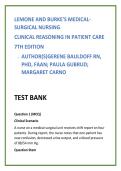
Davis Advantage for Medical-
Surgical Nursing
Making Connections to Practice
3rd Edition
• Author(s)Janice Hoffman; Nancy
Sullivan
• PublisherPublished by F.A.
Davis Copyright© 2024
• Print ISBN: 9781719647366
TEST BANK
,1) MCQ
Clinical Scenario:
A postoperative patient says, “I feel faint,” and becomes pale
and restless. The blood pressure is 86/50 mm Hg and the heart
rate is 124/min.
Question Stem:
What should the nurse do first?
Answer Options:
A. Notify the provider and document the findings
B. Assess the incision and check for bleeding
C. Encourage oral fluids and reassess in 30 minutes
D. Reassure the patient and continue routine care
Correct Answer:
B. Assess the incision and check for bleeding
Detailed Rationale:
The patient shows signs of possible acute blood loss or
hypoperfusion. The nurse must recognize cues and assess for a
likely cause before escalating care. Checking the incision and
bleeding source is the most appropriate first action because it
supports rapid clinical judgment and targeted intervention.
Incorrect Option Analysis:
• A. Incorrect because it skips assessment and moves too
quickly to reporting.
, o Misconception: “Calling the provider is always first.”
o Safety risk: Delay in identifying active bleeding.
• C. Incorrect because oral fluids are not appropriate for an
unstable patient with probable hypovolemia.
o Misconception: “Low BP always means give fluids by
mouth.”
o Safety risk: Aspiration risk and delayed treatment.
• D. Incorrect because the patient is unstable and needs
immediate assessment.
o Misconception: “Reassurance is enough for distress.”
o Safety risk: Missed hemorrhage and deterioration.
Nursing Process Linkage:
Assessment
Clinical Judgment Competencies (NCJMM):
Recognize Cues; Analyze Cues
Difficulty Level: Difficult
Bloom’s Cognitive Level: Analyze
NCLEX Client Needs Category:
Physiological Adaptation
Key Learning Objective:
Identify the priority first action when a patient shows signs of
acute deterioration.
, 2) MCQ
Clinical Scenario:
A patient with limited English proficiency is scheduled for
informed consent before surgery. The patient asks that their
adult child interpret.
Question Stem:
What is the best nursing action?
Answer Options:
A. Use the adult child to interpret because the patient
requested it
B. Ask the provider to obtain verbal consent without
interpretation
C. Request a professional interpreter and include the family
member if the patient wishes
D. Delay the consent until the child is available tomorrow
Correct Answer:
C. Request a professional interpreter and include the family
member if the patient wishes
Detailed Rationale:
Patient-centered care respects preferences, but informed
consent also requires accurate communication. A professional
interpreter supports safe, ethical, and legally sound
communication. Family may be included if the patient wants,
but should not replace a qualified interpreter for consent.
Surgical Nursing
Making Connections to Practice
3rd Edition
• Author(s)Janice Hoffman; Nancy
Sullivan
• PublisherPublished by F.A.
Davis Copyright© 2024
• Print ISBN: 9781719647366
TEST BANK
,1) MCQ
Clinical Scenario:
A postoperative patient says, “I feel faint,” and becomes pale
and restless. The blood pressure is 86/50 mm Hg and the heart
rate is 124/min.
Question Stem:
What should the nurse do first?
Answer Options:
A. Notify the provider and document the findings
B. Assess the incision and check for bleeding
C. Encourage oral fluids and reassess in 30 minutes
D. Reassure the patient and continue routine care
Correct Answer:
B. Assess the incision and check for bleeding
Detailed Rationale:
The patient shows signs of possible acute blood loss or
hypoperfusion. The nurse must recognize cues and assess for a
likely cause before escalating care. Checking the incision and
bleeding source is the most appropriate first action because it
supports rapid clinical judgment and targeted intervention.
Incorrect Option Analysis:
• A. Incorrect because it skips assessment and moves too
quickly to reporting.
, o Misconception: “Calling the provider is always first.”
o Safety risk: Delay in identifying active bleeding.
• C. Incorrect because oral fluids are not appropriate for an
unstable patient with probable hypovolemia.
o Misconception: “Low BP always means give fluids by
mouth.”
o Safety risk: Aspiration risk and delayed treatment.
• D. Incorrect because the patient is unstable and needs
immediate assessment.
o Misconception: “Reassurance is enough for distress.”
o Safety risk: Missed hemorrhage and deterioration.
Nursing Process Linkage:
Assessment
Clinical Judgment Competencies (NCJMM):
Recognize Cues; Analyze Cues
Difficulty Level: Difficult
Bloom’s Cognitive Level: Analyze
NCLEX Client Needs Category:
Physiological Adaptation
Key Learning Objective:
Identify the priority first action when a patient shows signs of
acute deterioration.
, 2) MCQ
Clinical Scenario:
A patient with limited English proficiency is scheduled for
informed consent before surgery. The patient asks that their
adult child interpret.
Question Stem:
What is the best nursing action?
Answer Options:
A. Use the adult child to interpret because the patient
requested it
B. Ask the provider to obtain verbal consent without
interpretation
C. Request a professional interpreter and include the family
member if the patient wishes
D. Delay the consent until the child is available tomorrow
Correct Answer:
C. Request a professional interpreter and include the family
member if the patient wishes
Detailed Rationale:
Patient-centered care respects preferences, but informed
consent also requires accurate communication. A professional
interpreter supports safe, ethical, and legally sound
communication. Family may be included if the patient wants,
but should not replace a qualified interpreter for consent.