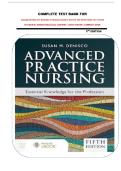
Davis Advantage for Medical-
Surgical Nursing
Making Connections to Practice
3rd Edition
• Author(s)Janice Hoffman; Nancy
Sullivan
• PublisherPublished by F.A.
Davis Copyright© 2024
• Print ISBN: 9781719647366
TEST BANK
,1) MCQ
Clinical Scenario:
A postoperative patient received IV morphine 30 minutes ago.
The nurse notes the patient is now more difficult to arouse
than during the last assessment.
Question Stem:
Which nursing action best demonstrates clinical judgment?
Answer Options:
A. Document that the patient is sleeping because surgery is
painful.
B. Reassess respirations, oxygen saturation, and sedation level
before giving any additional opioid.
C. Ask the UAP to check the patient’s temperature.
D. Give the next opioid dose to prevent breakthrough pain.
Correct Answer:
B
Detailed Rationale:
Clinical judgment begins with recognizing a change in cues,
analyzing the significance of that change, and taking action that
protects the patient. Increased sedation after an opioid may
signal respiratory depression. The nurse must reassess
respirations, oxygenation, and sedation before giving more
medication.
Incorrect Option Analysis:
, • A: Incorrect. This assumes the change is expected and
ignores a possible adverse drug effect. Misconception:
sleepiness after opioids is always harmless. Risk: missed
respiratory depression.
• C: Incorrect. Temperature is not the priority cue here.
Misconception: any change requires any assessment. Risk:
delays response to opioid toxicity.
• D: Incorrect. Giving more opioid without reassessment is
unsafe. Misconception: pain control outweighs safety
checks. Risk: worsening sedation and hypoventilation.
Nursing Process Linkage:
Assessment
Clinical Judgment Competencies (NCJMM):
Recognize Cues; Analyze Cues; Take Action
Difficulty Level: Moderate
Bloom’s Cognitive Level: Apply
NCLEX Client Needs Category: Pharmacological and Parenteral
Therapies; Physiological Adaptation
Key Learning Objective:
Identify the nurse’s first action when patient cues suggest
possible medication-related deterioration.
2) MCQ
, Clinical Scenario:
A patient reports dizziness when standing after being in bed
most of the morning.
Question Stem:
What should the nurse do first?
Answer Options:
A. Document orthostatic hypotension in the chart.
B. Obtain orthostatic vital signs.
C. Encourage the patient to drink more fluids.
D. Apply a fall-risk wristband.
Correct Answer:
B
Detailed Rationale:
The first step in the nursing process is assessment. The report
of dizziness on standing suggests orthostatic changes, but the
nurse should confirm this with orthostatic vital signs before
planning interventions.
Incorrect Option Analysis:
• A: Incorrect. Documentation should occur after
assessment, not before. Misconception: symptoms alone
are enough for diagnosis. Risk: inaccurate care planning.
• C: Incorrect. Fluids may be helpful, but only after
assessment. Misconception: immediate treatment is
better than objective data. Risk: missing a more serious
cause of dizziness.
Surgical Nursing
Making Connections to Practice
3rd Edition
• Author(s)Janice Hoffman; Nancy
Sullivan
• PublisherPublished by F.A.
Davis Copyright© 2024
• Print ISBN: 9781719647366
TEST BANK
,1) MCQ
Clinical Scenario:
A postoperative patient received IV morphine 30 minutes ago.
The nurse notes the patient is now more difficult to arouse
than during the last assessment.
Question Stem:
Which nursing action best demonstrates clinical judgment?
Answer Options:
A. Document that the patient is sleeping because surgery is
painful.
B. Reassess respirations, oxygen saturation, and sedation level
before giving any additional opioid.
C. Ask the UAP to check the patient’s temperature.
D. Give the next opioid dose to prevent breakthrough pain.
Correct Answer:
B
Detailed Rationale:
Clinical judgment begins with recognizing a change in cues,
analyzing the significance of that change, and taking action that
protects the patient. Increased sedation after an opioid may
signal respiratory depression. The nurse must reassess
respirations, oxygenation, and sedation before giving more
medication.
Incorrect Option Analysis:
, • A: Incorrect. This assumes the change is expected and
ignores a possible adverse drug effect. Misconception:
sleepiness after opioids is always harmless. Risk: missed
respiratory depression.
• C: Incorrect. Temperature is not the priority cue here.
Misconception: any change requires any assessment. Risk:
delays response to opioid toxicity.
• D: Incorrect. Giving more opioid without reassessment is
unsafe. Misconception: pain control outweighs safety
checks. Risk: worsening sedation and hypoventilation.
Nursing Process Linkage:
Assessment
Clinical Judgment Competencies (NCJMM):
Recognize Cues; Analyze Cues; Take Action
Difficulty Level: Moderate
Bloom’s Cognitive Level: Apply
NCLEX Client Needs Category: Pharmacological and Parenteral
Therapies; Physiological Adaptation
Key Learning Objective:
Identify the nurse’s first action when patient cues suggest
possible medication-related deterioration.
2) MCQ
, Clinical Scenario:
A patient reports dizziness when standing after being in bed
most of the morning.
Question Stem:
What should the nurse do first?
Answer Options:
A. Document orthostatic hypotension in the chart.
B. Obtain orthostatic vital signs.
C. Encourage the patient to drink more fluids.
D. Apply a fall-risk wristband.
Correct Answer:
B
Detailed Rationale:
The first step in the nursing process is assessment. The report
of dizziness on standing suggests orthostatic changes, but the
nurse should confirm this with orthostatic vital signs before
planning interventions.
Incorrect Option Analysis:
• A: Incorrect. Documentation should occur after
assessment, not before. Misconception: symptoms alone
are enough for diagnosis. Risk: inaccurate care planning.
• C: Incorrect. Fluids may be helpful, but only after
assessment. Misconception: immediate treatment is
better than objective data. Risk: missing a more serious
cause of dizziness.