

NUR 2101_Communication Exam | Questions and
Answers | Verified Solutions | 2026 Edition | Pass
Guaranteed
Save
Terms in this set (126)
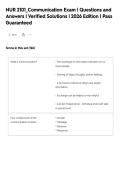
What is Communication? ~ The exchange of information between two or
more people
~ Sharing of ideas, thoughts, and/or feelings
~ A process to influence others and obtain
information
~ Exchange can be helpful or not helpful
~ Can be intrapersonal - individual level (self-talk)
or group level
Four components of the ^ Sender
communication process: ^ Message
^ Receiver
^ Response
,Sender ^ Person or group who wished to convey a
message to another
^ Involves encoding which is the selection of
specific signs or symbols (codes) to transmit the
message such as which language to use, how to
arrange the words to use, what tone of voice, or
what gestures to use
Message What is actually said or written, the body language
that accompanies the words, and how the message
is transmitted
Receiver ^ The listener who must listen, observe, and attend
^ The decoder who must interpret what the sender
intended
^ Decode - to relate the message perceived to the
receiver's storehouse of knowledge and
experience and to sort out the meaning of the
message
^ Ineffective communication occurs when the
message sent is misinterpreted
Response ^ The message that the receiver returns to the
sender
^ Also called feedback - can be verbal, nonverbal,
or both
Modes of Communication ^ Verbal
^ Nonverbal
^ Electronic
,Verbal uses spoken or written word
Nonverbal uses gestures, facial expressions, touch, and other
forms - makes up the majority of communication
Electronic Email
Verbal Communication ^ Pace and intonation
^ Simplicity
^ Clarity and brevity
^ Timing and relevance
^ Adaptability
^ Credibility
^ Humor
When choosing what to say consider these ....
, Nonverbal Communication ^ Personal appearance
^ Posture and gait
^ Facial expressions: Eye contact
^ Gestures: Use of touch
^ Also known as body language.
^ Either reinforces or contradicts what is said
verbally.
^ There can be a cultural impact on nonverbal
language.
^ Sometimes your need have the client verbally
validate their nonverbal communication. For
example - the client is just nodding understanding
after you have provided some instruction. You have
to follow up by asking them to validate their
nonverbal communication by repeating back the
instructions you just provided.
Nonverbal communication sometimes conveys
meaning more effectively than words.
Electronic Communication ^ Internet
^ Teaching
^ Documentation
^ SBAR
^ Telenursing
^ Healthcare websites
^ Nursing informatics
Answers | Verified Solutions | 2026 Edition | Pass
Guaranteed
Save
Terms in this set (126)
What is Communication? ~ The exchange of information between two or
more people
~ Sharing of ideas, thoughts, and/or feelings
~ A process to influence others and obtain
information
~ Exchange can be helpful or not helpful
~ Can be intrapersonal - individual level (self-talk)
or group level
Four components of the ^ Sender
communication process: ^ Message
^ Receiver
^ Response
,Sender ^ Person or group who wished to convey a
message to another
^ Involves encoding which is the selection of
specific signs or symbols (codes) to transmit the
message such as which language to use, how to
arrange the words to use, what tone of voice, or
what gestures to use
Message What is actually said or written, the body language
that accompanies the words, and how the message
is transmitted
Receiver ^ The listener who must listen, observe, and attend
^ The decoder who must interpret what the sender
intended
^ Decode - to relate the message perceived to the
receiver's storehouse of knowledge and
experience and to sort out the meaning of the
message
^ Ineffective communication occurs when the
message sent is misinterpreted
Response ^ The message that the receiver returns to the
sender
^ Also called feedback - can be verbal, nonverbal,
or both
Modes of Communication ^ Verbal
^ Nonverbal
^ Electronic
,Verbal uses spoken or written word
Nonverbal uses gestures, facial expressions, touch, and other
forms - makes up the majority of communication
Electronic Email
Verbal Communication ^ Pace and intonation
^ Simplicity
^ Clarity and brevity
^ Timing and relevance
^ Adaptability
^ Credibility
^ Humor
When choosing what to say consider these ....
, Nonverbal Communication ^ Personal appearance
^ Posture and gait
^ Facial expressions: Eye contact
^ Gestures: Use of touch
^ Also known as body language.
^ Either reinforces or contradicts what is said
verbally.
^ There can be a cultural impact on nonverbal
language.
^ Sometimes your need have the client verbally
validate their nonverbal communication. For
example - the client is just nodding understanding
after you have provided some instruction. You have
to follow up by asking them to validate their
nonverbal communication by repeating back the
instructions you just provided.
Nonverbal communication sometimes conveys
meaning more effectively than words.
Electronic Communication ^ Internet
^ Teaching
^ Documentation
^ SBAR
^ Telenursing
^ Healthcare websites
^ Nursing informatics


