

NASM CES Textbook Chapter 3 Exam | Questions
and Answers | Verified Solutions | 2026 Edition |
Pass Guaranteed
Save
Terms in this set (16)
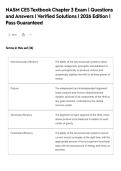
Neuromuscular efficiency The ability of the neuromuscular system to allow
agonist, antagonists, synergists, and stabilizers to
work synergistically to produce, reduce, and
dynamically stabilize the HMS in all three planes of
motion.
Posture The independent and interdependent alignment
(static posture) and function (transitional and
dynamic posture) of all components of the HMS at
any given moment, controlled by the central
nervous system.
Structural efficiency The alignment of each segment of the HMS, which
allows posture to be balanced in relation to one's
center of gravity
Functional efficiency The ability of the neuromuscular system to recruit
correct muscle synergies, at the right time, with the
appropriate amount of force to perform functional
tasks with the least amount of energy and stress on
the HMS.
and Answers | Verified Solutions | 2026 Edition |
Pass Guaranteed
Save
Terms in this set (16)
Neuromuscular efficiency The ability of the neuromuscular system to allow
agonist, antagonists, synergists, and stabilizers to
work synergistically to produce, reduce, and
dynamically stabilize the HMS in all three planes of
motion.
Posture The independent and interdependent alignment
(static posture) and function (transitional and
dynamic posture) of all components of the HMS at
any given moment, controlled by the central
nervous system.
Structural efficiency The alignment of each segment of the HMS, which
allows posture to be balanced in relation to one's
center of gravity
Functional efficiency The ability of the neuromuscular system to recruit
correct muscle synergies, at the right time, with the
appropriate amount of force to perform functional
tasks with the least amount of energy and stress on
the HMS.


