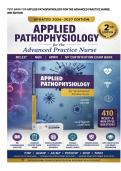
TEST BANK FOR APPLIED PATHOPHYSIOLOGY FOR THE ADVANCED PRACTICE NURSE,
2ND EDITION
,TABLE OF CONTENTS
Applied Pathophysiology for the Advanced Practice Nurse, 2nd Edition
NCLEX® & NGN-Style Exam Bank
Advanced Practice Nurse (APRN/NP) Review Edition
Chapter Title Questions Page
1 Cellular Function 1–20 1
2 Immunity 21–49 14
3 Hematopoietic Function 50–80 34
4 Cardiovascular Function 81–110 53
5 Pulmonary Function 111–140 75
6 Fluid, Electrolyte, and Acid-Base Homeostasis 141–170 98
7 Urinary Function 171–200 120
8 Reproductive Function 201–230 143
9 Gastrointestinal Function 231–260 165
10 Endocrine Function 261–290 187
11 Neural Function 291–320 209
12 Musculoskeletal Function 321–350 231
13 Integumentary Function 351–380 244
14 Sensory Function 381–410 251
EXAM BANK FEATURES
✓ 410 NCLEX®-Style Questions
✓ Next Generation NCLEX (NGN) Clinical Reasoning Concepts
✓ Advanced Practice Nurse (APRN) Focus
✓ Evidence-Based Pathophysiology Concepts
✓ Disease Mechanisms & Clinical Manifestations
,✓ Differential Diagnosis Integration
✓ Detailed Rationales for Every Answer
✓ Concise "Why Not" Explanations
✓ Clinical Pearls & Practice Tips
✓ Key Terminology & Exam Keywords
✓ Patient-Centered Clinical Scenarios
✓ Systems-Based Learning Approach
✓ Graduate Nursing & NP Board Preparation
✓ Perfect for DNP, MSN, FNP, AGNP, ACNP, PMHNP & APRN Students
DOCUMENT OVERVIEW
Title: Applied Pathophysiology for the Advanced Practice Nurse, 2nd Edition Exam Bank
Total Chapters: 14
Total Questions: 410
Question Format: NCLEX® / NGN Style Multiple Choice
Difficulty Level: Advanced Undergraduate, Graduate Nursing, APRN & Nurse Practitioner
Includes:
• Correct Answers
• Detailed Rationales
• Clinical Pearls
• Keywords
• Advanced Pathophysiology Concepts
• Evidence-Based Practice Integration
Designed For:
• Nurse Practitioner Students
• Advanced Practice Registered Nurses
• MSN Students
• DNP Students
, • NCLEX Preparation
• APRN Certification Review
• Advanced Pathophysiology Courses
Source Document: Applied Pathophysiology for the Advanced Practice Nurse, 2nd Edition
Chapter 1: Cellular Function
Applied Pathophysiology for the Advanced Practice Nurse, 2nd Edition
NCLEX & NGN Style Exam Bank
Question 1
A nurse practitioner is explaining cellular homeostasis to a patient. Which cellular structure is primarily
responsible for regulating the movement of substances into and out of the cell?
A. Nucleus
B. Cell membrane
C. Golgi apparatus
D. Ribosome
Correct Answer: B. Cell membrane
Rationale:
The cell membrane serves as a selectively permeable barrier that regulates the movement of ions, nutrients,
water, and waste products into and out of the cell. This function is essential for maintaining cellular
homeostasis and proper cellular function.
Why Not the Other Options?
A. Nucleus – Controls genetic activity but does not regulate substance movement.
C. Golgi apparatus – Packages and modifies proteins.
D. Ribosome – Responsible for protein synthesis.
NCLEX Clinical Pearl:
Cell membrane dysfunction is often the first event in cellular injury.
Keywords: Homeostasis, Cell Membrane, Transport Mechanisms, Permeability
Question 2
,A patient with severe dehydration develops hypernatremia. Water moves out of the cells primarily through
which process?
A. Active transport
B. Diffusion
C. Osmosis
D. Filtration
Correct Answer: C. Osmosis
Rationale:
Osmosis is the movement of water across a semipermeable membrane from an area of lower solute
concentration to higher solute concentration. Hypernatremia creates a hypertonic extracellular environment
causing water to leave cells.
Why Not the Other Options?
A. Active transport – Requires ATP for solute movement.
B. Diffusion – Refers primarily to solute movement.
D. Filtration – Driven by hydrostatic pressure.
NCLEX Clinical Pearl:
Neurologic symptoms of hypernatremia result from cellular dehydration in the brain.
Keywords: Osmosis, Hypernatremia, Cell Shrinkage, Water Balance
Question 3
A patient experiences ischemia following an acute myocardial infarction. Which event occurs first at the
cellular level?
A. DNA mutation
B. ATP depletion
C. Fibrosis
D. Scar formation
Correct Answer: B. ATP depletion
Rationale:
Oxygen deprivation rapidly impairs oxidative phosphorylation, leading to ATP depletion. Reduced ATP causes
failure of sodium-potassium pumps, cellular swelling, and eventual cell death if ischemia persists.
Why Not the Other Options?
,A. DNA mutation – Not the initial event.
C. Fibrosis – Occurs during healing.
D. Scar formation – Late consequence of tissue injury.
NCLEX Clinical Pearl:
ATP depletion is a hallmark of reversible cellular injury.
Keywords: Ischemia, ATP, Cellular Injury, Hypoxia
Question 4
Which organelle is responsible for producing most of the cell's ATP?
A. Lysosome
B. Ribosome
C. Mitochondrion
D. Nucleus
Correct Answer: C. Mitochondrion
Rationale:
Mitochondria generate ATP through aerobic cellular respiration. They are often called the "powerhouses" of
the cell and are highly susceptible to hypoxic injury.
Why Not the Other Options?
A. Lysosome – Digestion of cellular debris.
B. Ribosome – Protein synthesis.
D. Nucleus – Genetic control center.
NCLEX Clinical Pearl:
Cells with high metabolic activity contain large numbers of mitochondria.
Keywords: Mitochondria, ATP Production, Aerobic Respiration
Question 5
A nurse practitioner reviews laboratory findings indicating metabolic acidosis. Cellular compensation initially
involves movement of:
A. Potassium into cells
B. Hydrogen ions into cells
,C. Calcium into cells
D. Sodium into cells
Correct Answer: B. Hydrogen ions into cells
Rationale:
During metabolic acidosis, cells buffer excess hydrogen ions by moving them intracellularly. Potassium often
shifts out of cells in exchange, increasing serum potassium levels.
Why Not the Other Options?
A. Potassium moves out rather than into cells.
C. Calcium movement is not the primary compensatory mechanism.
D. Sodium shifts are less significant.
NCLEX Clinical Pearl:
Acidosis frequently causes hyperkalemia.
Keywords: Acidosis, Buffering, Hydrogen Ions, Hyperkalemia
Question 6
A patient has a genetic disorder affecting lysosomal enzymes. Which cellular process is most directly impaired?
A. Protein synthesis
B. Intracellular digestion
C. DNA replication
D. ATP production
Correct Answer: B. Intracellular digestion
Rationale:
Lysosomes contain digestive enzymes responsible for breaking down cellular waste and foreign materials.
Defects lead to lysosomal storage diseases.
Why Not the Other Options?
A. Ribosomes control protein synthesis.
C. DNA replication occurs in the nucleus.
D. ATP production occurs in mitochondria.
NCLEX Clinical Pearl:
Lysosomal storage disorders cause progressive organ dysfunction.
Keywords: Lysosome, Cellular Waste, Storage Disease
,Question 7
A patient develops edema after cellular injury. Which mechanism most likely contributes?
A. Increased ATP production
B. Failure of sodium-potassium pumps
C. Enhanced protein synthesis
D. Increased mitochondrial function
Correct Answer: B. Failure of sodium-potassium pumps
Rationale:
ATP depletion causes sodium-potassium pump failure, leading to intracellular sodium and water accumulation,
resulting in cellular swelling.
Why Not the Other Options?
A. ATP production decreases.
C. Protein synthesis declines.
D. Mitochondrial function is impaired.
NCLEX Clinical Pearl:
Cellular swelling is the earliest sign of reversible injury.
Keywords: Cellular Swelling, ATP, Sodium-Potassium Pump
Question 8
Which transport mechanism requires energy expenditure by the cell?
A. Diffusion
B. Osmosis
C. Facilitated diffusion
D. Active transport
Correct Answer: D. Active transport
Rationale:
Active transport requires ATP to move substances against a concentration gradient.
Why Not the Other Options?
A. Diffusion is passive.
, B. Osmosis is passive.
C. Facilitated diffusion uses carrier proteins but no ATP.
NCLEX Clinical Pearl:
The sodium-potassium pump is a classic example of active transport.
Keywords: Active Transport, ATP, Concentration Gradient
Question 9
A patient is exposed to ionizing radiation. Which cellular structure is most vulnerable?
A. Plasma membrane
B. DNA
C. Cytoplasm
D. Golgi apparatus
Correct Answer: B. DNA
Rationale:
Radiation causes direct DNA damage, mutations, and chromosomal abnormalities that may lead to cancer or
cell death.
Why Not the Other Options?
A. Membrane damage occurs but is secondary.
C. Cytoplasm is less sensitive.
D. Golgi apparatus is not the primary target.
NCLEX Clinical Pearl:
Rapidly dividing cells are particularly susceptible to radiation injury.
Keywords: Radiation, DNA Damage, Mutation
Question 10
Apoptosis differs from necrosis because apoptosis:
A. Causes inflammation
B. Results from severe trauma
C. Is a programmed process
D. Always involves infection
2ND EDITION
,TABLE OF CONTENTS
Applied Pathophysiology for the Advanced Practice Nurse, 2nd Edition
NCLEX® & NGN-Style Exam Bank
Advanced Practice Nurse (APRN/NP) Review Edition
Chapter Title Questions Page
1 Cellular Function 1–20 1
2 Immunity 21–49 14
3 Hematopoietic Function 50–80 34
4 Cardiovascular Function 81–110 53
5 Pulmonary Function 111–140 75
6 Fluid, Electrolyte, and Acid-Base Homeostasis 141–170 98
7 Urinary Function 171–200 120
8 Reproductive Function 201–230 143
9 Gastrointestinal Function 231–260 165
10 Endocrine Function 261–290 187
11 Neural Function 291–320 209
12 Musculoskeletal Function 321–350 231
13 Integumentary Function 351–380 244
14 Sensory Function 381–410 251
EXAM BANK FEATURES
✓ 410 NCLEX®-Style Questions
✓ Next Generation NCLEX (NGN) Clinical Reasoning Concepts
✓ Advanced Practice Nurse (APRN) Focus
✓ Evidence-Based Pathophysiology Concepts
✓ Disease Mechanisms & Clinical Manifestations
,✓ Differential Diagnosis Integration
✓ Detailed Rationales for Every Answer
✓ Concise "Why Not" Explanations
✓ Clinical Pearls & Practice Tips
✓ Key Terminology & Exam Keywords
✓ Patient-Centered Clinical Scenarios
✓ Systems-Based Learning Approach
✓ Graduate Nursing & NP Board Preparation
✓ Perfect for DNP, MSN, FNP, AGNP, ACNP, PMHNP & APRN Students
DOCUMENT OVERVIEW
Title: Applied Pathophysiology for the Advanced Practice Nurse, 2nd Edition Exam Bank
Total Chapters: 14
Total Questions: 410
Question Format: NCLEX® / NGN Style Multiple Choice
Difficulty Level: Advanced Undergraduate, Graduate Nursing, APRN & Nurse Practitioner
Includes:
• Correct Answers
• Detailed Rationales
• Clinical Pearls
• Keywords
• Advanced Pathophysiology Concepts
• Evidence-Based Practice Integration
Designed For:
• Nurse Practitioner Students
• Advanced Practice Registered Nurses
• MSN Students
• DNP Students
, • NCLEX Preparation
• APRN Certification Review
• Advanced Pathophysiology Courses
Source Document: Applied Pathophysiology for the Advanced Practice Nurse, 2nd Edition
Chapter 1: Cellular Function
Applied Pathophysiology for the Advanced Practice Nurse, 2nd Edition
NCLEX & NGN Style Exam Bank
Question 1
A nurse practitioner is explaining cellular homeostasis to a patient. Which cellular structure is primarily
responsible for regulating the movement of substances into and out of the cell?
A. Nucleus
B. Cell membrane
C. Golgi apparatus
D. Ribosome
Correct Answer: B. Cell membrane
Rationale:
The cell membrane serves as a selectively permeable barrier that regulates the movement of ions, nutrients,
water, and waste products into and out of the cell. This function is essential for maintaining cellular
homeostasis and proper cellular function.
Why Not the Other Options?
A. Nucleus – Controls genetic activity but does not regulate substance movement.
C. Golgi apparatus – Packages and modifies proteins.
D. Ribosome – Responsible for protein synthesis.
NCLEX Clinical Pearl:
Cell membrane dysfunction is often the first event in cellular injury.
Keywords: Homeostasis, Cell Membrane, Transport Mechanisms, Permeability
Question 2
,A patient with severe dehydration develops hypernatremia. Water moves out of the cells primarily through
which process?
A. Active transport
B. Diffusion
C. Osmosis
D. Filtration
Correct Answer: C. Osmosis
Rationale:
Osmosis is the movement of water across a semipermeable membrane from an area of lower solute
concentration to higher solute concentration. Hypernatremia creates a hypertonic extracellular environment
causing water to leave cells.
Why Not the Other Options?
A. Active transport – Requires ATP for solute movement.
B. Diffusion – Refers primarily to solute movement.
D. Filtration – Driven by hydrostatic pressure.
NCLEX Clinical Pearl:
Neurologic symptoms of hypernatremia result from cellular dehydration in the brain.
Keywords: Osmosis, Hypernatremia, Cell Shrinkage, Water Balance
Question 3
A patient experiences ischemia following an acute myocardial infarction. Which event occurs first at the
cellular level?
A. DNA mutation
B. ATP depletion
C. Fibrosis
D. Scar formation
Correct Answer: B. ATP depletion
Rationale:
Oxygen deprivation rapidly impairs oxidative phosphorylation, leading to ATP depletion. Reduced ATP causes
failure of sodium-potassium pumps, cellular swelling, and eventual cell death if ischemia persists.
Why Not the Other Options?
,A. DNA mutation – Not the initial event.
C. Fibrosis – Occurs during healing.
D. Scar formation – Late consequence of tissue injury.
NCLEX Clinical Pearl:
ATP depletion is a hallmark of reversible cellular injury.
Keywords: Ischemia, ATP, Cellular Injury, Hypoxia
Question 4
Which organelle is responsible for producing most of the cell's ATP?
A. Lysosome
B. Ribosome
C. Mitochondrion
D. Nucleus
Correct Answer: C. Mitochondrion
Rationale:
Mitochondria generate ATP through aerobic cellular respiration. They are often called the "powerhouses" of
the cell and are highly susceptible to hypoxic injury.
Why Not the Other Options?
A. Lysosome – Digestion of cellular debris.
B. Ribosome – Protein synthesis.
D. Nucleus – Genetic control center.
NCLEX Clinical Pearl:
Cells with high metabolic activity contain large numbers of mitochondria.
Keywords: Mitochondria, ATP Production, Aerobic Respiration
Question 5
A nurse practitioner reviews laboratory findings indicating metabolic acidosis. Cellular compensation initially
involves movement of:
A. Potassium into cells
B. Hydrogen ions into cells
,C. Calcium into cells
D. Sodium into cells
Correct Answer: B. Hydrogen ions into cells
Rationale:
During metabolic acidosis, cells buffer excess hydrogen ions by moving them intracellularly. Potassium often
shifts out of cells in exchange, increasing serum potassium levels.
Why Not the Other Options?
A. Potassium moves out rather than into cells.
C. Calcium movement is not the primary compensatory mechanism.
D. Sodium shifts are less significant.
NCLEX Clinical Pearl:
Acidosis frequently causes hyperkalemia.
Keywords: Acidosis, Buffering, Hydrogen Ions, Hyperkalemia
Question 6
A patient has a genetic disorder affecting lysosomal enzymes. Which cellular process is most directly impaired?
A. Protein synthesis
B. Intracellular digestion
C. DNA replication
D. ATP production
Correct Answer: B. Intracellular digestion
Rationale:
Lysosomes contain digestive enzymes responsible for breaking down cellular waste and foreign materials.
Defects lead to lysosomal storage diseases.
Why Not the Other Options?
A. Ribosomes control protein synthesis.
C. DNA replication occurs in the nucleus.
D. ATP production occurs in mitochondria.
NCLEX Clinical Pearl:
Lysosomal storage disorders cause progressive organ dysfunction.
Keywords: Lysosome, Cellular Waste, Storage Disease
,Question 7
A patient develops edema after cellular injury. Which mechanism most likely contributes?
A. Increased ATP production
B. Failure of sodium-potassium pumps
C. Enhanced protein synthesis
D. Increased mitochondrial function
Correct Answer: B. Failure of sodium-potassium pumps
Rationale:
ATP depletion causes sodium-potassium pump failure, leading to intracellular sodium and water accumulation,
resulting in cellular swelling.
Why Not the Other Options?
A. ATP production decreases.
C. Protein synthesis declines.
D. Mitochondrial function is impaired.
NCLEX Clinical Pearl:
Cellular swelling is the earliest sign of reversible injury.
Keywords: Cellular Swelling, ATP, Sodium-Potassium Pump
Question 8
Which transport mechanism requires energy expenditure by the cell?
A. Diffusion
B. Osmosis
C. Facilitated diffusion
D. Active transport
Correct Answer: D. Active transport
Rationale:
Active transport requires ATP to move substances against a concentration gradient.
Why Not the Other Options?
A. Diffusion is passive.
, B. Osmosis is passive.
C. Facilitated diffusion uses carrier proteins but no ATP.
NCLEX Clinical Pearl:
The sodium-potassium pump is a classic example of active transport.
Keywords: Active Transport, ATP, Concentration Gradient
Question 9
A patient is exposed to ionizing radiation. Which cellular structure is most vulnerable?
A. Plasma membrane
B. DNA
C. Cytoplasm
D. Golgi apparatus
Correct Answer: B. DNA
Rationale:
Radiation causes direct DNA damage, mutations, and chromosomal abnormalities that may lead to cancer or
cell death.
Why Not the Other Options?
A. Membrane damage occurs but is secondary.
C. Cytoplasm is less sensitive.
D. Golgi apparatus is not the primary target.
NCLEX Clinical Pearl:
Rapidly dividing cells are particularly susceptible to radiation injury.
Keywords: Radiation, DNA Damage, Mutation
Question 10
Apoptosis differs from necrosis because apoptosis:
A. Causes inflammation
B. Results from severe trauma
C. Is a programmed process
D. Always involves infection