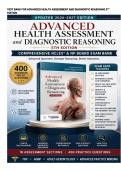
TEST BANK FOR ADVANCED HEALTH ASSESSMENT AND DIAGNOSTIC REASONING 5 TH
EDITION
,TABLE OF CONTENTS
Comprehensive NCLEX-Style Exam Bank
Updated 2026–2027
PART I: STRATEGIES FOR EFFECTIVE HEALTH ASSESSMENT
Section Questions
Interview and History-Taking Strategies 1–20
Physical Examination Strategies 21–40
Documentation Strategies 41–60
Cultural and Spiritual Assessment 61–80
Nutritional Assessment 81–100
PART II: ADVANCED ASSESSMENT OF SYSTEMIC DISORDERS
Section Questions
Mental Health Disorders 101–120
Integumentary Disorders 121–140
Eye Disorders 141–160
Ear Disorders 161–180
Nose, Sinus, Mouth, and Throat Disorders 181–200
Respiratory Disorders 201–220
Cardiovascular Disorders 221–240
Endocrine Disorders 241–260
Gastrointestinal Disorders 261–280
Neurological Disorders 281–300
Male Genitourinary Disorders 301–320
Female Genitourinary and Breast Disorders 321–340
Musculoskeletal Disorders 341–400
,EXAM BANK FEATURES
✓ 400 Advanced NCLEX-Style Questions
✓ Next-Generation NCLEX (NGN)
✓ Clinical Judgment Measurement Model (CJMM)
✓ Priority & Delegation Questions
✓ Select-All-That-Apply (SATA)
✓ Advanced Clinical Case Scenarios
✓ Differential Diagnosis Questions
✓ Evidence-Based Assessment Strategies
✓ Advanced Diagnostic Reasoning
✓ NP Board Certification Preparation
✓ Comprehensive Rationales
✓ Why-Not Explanations for Incorrect Options
✓ High-Yield Clinical Keywords
✓ Graduate-Level Clinical Application
✓ Advanced Health Assessment Concepts
Total Sections: 18
Total Questions: 400
Format: NCLEX-RN • NGN • FNP • AGNP • NP Board Review
Updated 2026–2027
,Advanced Health Assessment & Diagnostic Reasoning
Part I: Strategies for Effective Health Assessment
Chapter 1: Interview and History-Taking Strategies
Question 1
A nurse practitioner is interviewing a 52-year-old patient with poorly controlled hypertension. Which opening
statement is most likely to facilitate a patient-centered interview?
A. "Why haven't you been taking your medications?"
B. "Tell me about your experiences managing your blood pressure."
C. "Do you understand the risks of hypertension?"
D. "You need to start exercising more."
Correct Answer: B
Rationale: Open-ended questions encourage patients to share their perceptions, concerns, and experiences.
They promote rapport and yield richer information than closed-ended or judgmental questions.
Why Not A: Sounds accusatory and may make the patient defensive.
Why Not C: Closed-ended and limits exploration.
Why Not D: Provides advice before adequate assessment.
Keywords: Open-ended questions, patient-centered interview, rapport
Question 2
During a health history, a patient becomes tearful while discussing recent life events. What is the most
appropriate response?
A. Change the subject to reduce discomfort.
B. Continue asking questions without acknowledgment.
C. Say, "I can see this is difficult for you. Tell me more if you'd like."
D. Advise the patient to seek counseling immediately.
Correct Answer: C
Rationale: Therapeutic communication involves recognizing emotions and allowing the patient space to
express concerns.
Why Not A: Ignores emotional cues.
Why Not B: Demonstrates lack of empathy.
Why Not D: Premature intervention without assessment.
Keywords: Empathy, therapeutic communication, emotional cues
Question 3
,Which component of the health history provides information about hereditary risk factors?
A. Review of systems
B. Social history
C. Family history
D. Chief complaint
Correct Answer: C
Rationale: Family history identifies genetic and familial conditions such as hypertension, diabetes, and certain
cancers.
Why Not A: Focuses on current symptoms.
Why Not B: Addresses lifestyle and environment.
Why Not D: States the reason for seeking care.
Keywords: Family history, genetics, risk factors
Question 4
A patient reports chest discomfort. Which question best explores symptom characteristics using OLDCARTS?
A. "Have you ever had heart disease?"
B. "When did the discomfort begin and what makes it worse?"
C. "Do your parents have heart disease?"
D. "Are you taking medications?"
Correct Answer: B
Rationale: OLDCARTS evaluates onset, location, duration, characteristics, aggravating factors, relieving factors,
timing, and severity.
Why Not A: Past history only.
Why Not C: Family history.
Why Not D: Medication history.
Keywords: OLDCARTS, symptom analysis, history taking
Question 5
A nurse practitioner notices a patient repeatedly looking at the floor and avoiding eye contact. Which action is
most appropriate?
A. Interpret it as dishonesty.
B. Ignore the behavior.
C. Consider cultural and emotional influences before drawing conclusions.
D. End the interview.
Correct Answer: C
,Rationale: Nonverbal communication varies by culture, personality, and emotional state.
Why Not A: Assumes meaning without evidence.
Why Not B: May miss important cues.
Why Not D: Unnecessary.
Keywords: Nonverbal communication, culture, assessment
Question 6
Which statement demonstrates active listening?
A. Interrupting to clarify every detail.
B. Completing the patient's sentences.
C. Maintaining attention and reflecting key concerns.
D. Asking only yes/no questions.
Correct Answer: C
Rationale: Active listening promotes trust and accurate data collection.
Why Not A: Can disrupt communication.
Why Not B: Assumes understanding.
Why Not D: Restricts discussion.
Keywords: Active listening, communication skills
Question 7
A patient states, "I feel tired all the time." What is the best follow-up question?
A. "Are you depressed?"
B. "What do you think is causing the fatigue?"
C. "Do you exercise daily?"
D. "Have you tried vitamins?"
Correct Answer: B
Rationale: Encourages patient perspective and exploration of symptoms.
Why Not A: Leading question.
Why Not C: Too narrow initially.
Why Not D: Premature intervention.
Keywords: Follow-up questions, symptom exploration
Question 8
Which interview technique should be avoided?
,A. Clarification
B. Reflection
C. Leading questions
D. Summarization
Correct Answer: C
Rationale: Leading questions may bias patient responses.
Why Not A: Improves understanding.
Why Not B: Demonstrates empathy.
Why Not D: Confirms accuracy.
Keywords: Interview techniques, leading questions
Question 9
A patient presents with shortness of breath. Which information should be obtained first?
A. Detailed family history
B. Immediate symptom assessment
C. Occupational history
D. Spiritual history
Correct Answer: B
Rationale: Priority assessment focuses on potentially life-threatening symptoms.
Why Not A: Important but not immediate.
Why Not C: Secondary.
Why Not D: Not priority.
Keywords: Prioritization, acute assessment
Question 10
When obtaining a chief complaint, it should ideally be recorded:
A. In medical terminology only.
B. In the provider's own words.
C. Using the patient's own words.
D. After the physical examination.
Correct Answer: C
Rationale: The chief complaint should reflect the patient's stated concern.
Why Not A: May alter meaning.
Why Not B: Risks interpretation bias.
,Why Not D: Obtained at the beginning.
Keywords: Chief complaint, documentation
Question 11
Which statement best describes the review of systems?
A. Comprehensive symptom inventory organized by body systems.
B. Physical examination findings.
C. Family history assessment.
D. Medication reconciliation only.
Correct Answer: A
Rationale: ROS systematically identifies symptoms across organ systems.
Why Not B: Different component.
Why Not C: Separate history section.
Why Not D: Too limited.
Keywords: Review of systems, ROS
Question 12
A patient with limited English proficiency arrives for an appointment. Which action is best?
A. Use a family member as interpreter.
B. Use a qualified medical interpreter.
C. Communicate only through gestures.
D. Skip complex questions.
Correct Answer: B
Rationale: Professional interpreters improve accuracy, confidentiality, and safety.
Why Not A: Potential bias and inaccuracies.
Why Not C: Inadequate communication.
Why Not D: Compromises assessment.
Keywords: Interpreter services, cultural competence
Question 13
Which element belongs in the social history?
A. Immunization record
B. Alcohol and tobacco use
C. Family cancer history
D. Current symptom severity
,Correct Answer: B
Rationale: Social history explores behaviors and environmental influences on health.
Why Not A: Past medical history.
Why Not C: Family history.
Why Not D: Present illness.
Keywords: Social history, lifestyle assessment
Question 14
A patient reports taking herbal supplements. The nurse practitioner should:
A. Ignore them because they are natural.
B. Document and assess for interactions.
C. Recommend discontinuation immediately.
D. Record them only if prescribed.
Correct Answer: B
Rationale: Herbal products may cause adverse effects and drug interactions.
Why Not A: Unsafe assumption.
Why Not C: Requires assessment first.
Why Not D: All substances should be documented.
Keywords: Medication history, supplements
Question 15
Which behavior demonstrates cultural humility?
A. Assuming all members of a culture share the same beliefs.
B. Learning about the patient's individual perspective.
C. Relying on stereotypes.
D. Avoiding cultural discussions.
Correct Answer: B
Rationale: Cultural humility emphasizes respect, self-reflection, and individualized care.
Why Not A: Promotes stereotyping.
Why Not C: Inaccurate.
Why Not D: Misses important information.
Keywords: Cultural humility, patient-centered care
Question 16
, A patient states, "My headaches are getting worse." Which symptom characteristic should be explored next?
A. Favorite foods
B. Severity and timing
C. Education level
D. Marital status
Correct Answer: B
Rationale: Severity and timing are essential components of symptom analysis.
Why Not A: Usually unrelated.
Why Not C: Not immediately relevant.
Why Not D: Not priority.
Keywords: Symptom analysis, headache assessment
Question 17
Which statement by the clinician best reflects reflection?
A. "You seem worried about these symptoms."
B. "Answer yes or no."
C. "That isn't important."
D. "Let's move on."
Correct Answer: A
Rationale: Reflection identifies and validates emotional content.
Why Not B: Restrictive.
Why Not C: Dismissive.
Why Not D: Interrupts communication.
Keywords: Reflection, therapeutic interviewing
Question 18
A patient repeatedly changes topics during the interview. What is the best response?
A. End the interview.
B. Redirect gently while acknowledging concerns.
C. Ignore important comments.
D. Confront the patient.
Correct Answer: B
Rationale: Redirection maintains focus while preserving rapport.
Why Not A: Premature.
EDITION
,TABLE OF CONTENTS
Comprehensive NCLEX-Style Exam Bank
Updated 2026–2027
PART I: STRATEGIES FOR EFFECTIVE HEALTH ASSESSMENT
Section Questions
Interview and History-Taking Strategies 1–20
Physical Examination Strategies 21–40
Documentation Strategies 41–60
Cultural and Spiritual Assessment 61–80
Nutritional Assessment 81–100
PART II: ADVANCED ASSESSMENT OF SYSTEMIC DISORDERS
Section Questions
Mental Health Disorders 101–120
Integumentary Disorders 121–140
Eye Disorders 141–160
Ear Disorders 161–180
Nose, Sinus, Mouth, and Throat Disorders 181–200
Respiratory Disorders 201–220
Cardiovascular Disorders 221–240
Endocrine Disorders 241–260
Gastrointestinal Disorders 261–280
Neurological Disorders 281–300
Male Genitourinary Disorders 301–320
Female Genitourinary and Breast Disorders 321–340
Musculoskeletal Disorders 341–400
,EXAM BANK FEATURES
✓ 400 Advanced NCLEX-Style Questions
✓ Next-Generation NCLEX (NGN)
✓ Clinical Judgment Measurement Model (CJMM)
✓ Priority & Delegation Questions
✓ Select-All-That-Apply (SATA)
✓ Advanced Clinical Case Scenarios
✓ Differential Diagnosis Questions
✓ Evidence-Based Assessment Strategies
✓ Advanced Diagnostic Reasoning
✓ NP Board Certification Preparation
✓ Comprehensive Rationales
✓ Why-Not Explanations for Incorrect Options
✓ High-Yield Clinical Keywords
✓ Graduate-Level Clinical Application
✓ Advanced Health Assessment Concepts
Total Sections: 18
Total Questions: 400
Format: NCLEX-RN • NGN • FNP • AGNP • NP Board Review
Updated 2026–2027
,Advanced Health Assessment & Diagnostic Reasoning
Part I: Strategies for Effective Health Assessment
Chapter 1: Interview and History-Taking Strategies
Question 1
A nurse practitioner is interviewing a 52-year-old patient with poorly controlled hypertension. Which opening
statement is most likely to facilitate a patient-centered interview?
A. "Why haven't you been taking your medications?"
B. "Tell me about your experiences managing your blood pressure."
C. "Do you understand the risks of hypertension?"
D. "You need to start exercising more."
Correct Answer: B
Rationale: Open-ended questions encourage patients to share their perceptions, concerns, and experiences.
They promote rapport and yield richer information than closed-ended or judgmental questions.
Why Not A: Sounds accusatory and may make the patient defensive.
Why Not C: Closed-ended and limits exploration.
Why Not D: Provides advice before adequate assessment.
Keywords: Open-ended questions, patient-centered interview, rapport
Question 2
During a health history, a patient becomes tearful while discussing recent life events. What is the most
appropriate response?
A. Change the subject to reduce discomfort.
B. Continue asking questions without acknowledgment.
C. Say, "I can see this is difficult for you. Tell me more if you'd like."
D. Advise the patient to seek counseling immediately.
Correct Answer: C
Rationale: Therapeutic communication involves recognizing emotions and allowing the patient space to
express concerns.
Why Not A: Ignores emotional cues.
Why Not B: Demonstrates lack of empathy.
Why Not D: Premature intervention without assessment.
Keywords: Empathy, therapeutic communication, emotional cues
Question 3
,Which component of the health history provides information about hereditary risk factors?
A. Review of systems
B. Social history
C. Family history
D. Chief complaint
Correct Answer: C
Rationale: Family history identifies genetic and familial conditions such as hypertension, diabetes, and certain
cancers.
Why Not A: Focuses on current symptoms.
Why Not B: Addresses lifestyle and environment.
Why Not D: States the reason for seeking care.
Keywords: Family history, genetics, risk factors
Question 4
A patient reports chest discomfort. Which question best explores symptom characteristics using OLDCARTS?
A. "Have you ever had heart disease?"
B. "When did the discomfort begin and what makes it worse?"
C. "Do your parents have heart disease?"
D. "Are you taking medications?"
Correct Answer: B
Rationale: OLDCARTS evaluates onset, location, duration, characteristics, aggravating factors, relieving factors,
timing, and severity.
Why Not A: Past history only.
Why Not C: Family history.
Why Not D: Medication history.
Keywords: OLDCARTS, symptom analysis, history taking
Question 5
A nurse practitioner notices a patient repeatedly looking at the floor and avoiding eye contact. Which action is
most appropriate?
A. Interpret it as dishonesty.
B. Ignore the behavior.
C. Consider cultural and emotional influences before drawing conclusions.
D. End the interview.
Correct Answer: C
,Rationale: Nonverbal communication varies by culture, personality, and emotional state.
Why Not A: Assumes meaning without evidence.
Why Not B: May miss important cues.
Why Not D: Unnecessary.
Keywords: Nonverbal communication, culture, assessment
Question 6
Which statement demonstrates active listening?
A. Interrupting to clarify every detail.
B. Completing the patient's sentences.
C. Maintaining attention and reflecting key concerns.
D. Asking only yes/no questions.
Correct Answer: C
Rationale: Active listening promotes trust and accurate data collection.
Why Not A: Can disrupt communication.
Why Not B: Assumes understanding.
Why Not D: Restricts discussion.
Keywords: Active listening, communication skills
Question 7
A patient states, "I feel tired all the time." What is the best follow-up question?
A. "Are you depressed?"
B. "What do you think is causing the fatigue?"
C. "Do you exercise daily?"
D. "Have you tried vitamins?"
Correct Answer: B
Rationale: Encourages patient perspective and exploration of symptoms.
Why Not A: Leading question.
Why Not C: Too narrow initially.
Why Not D: Premature intervention.
Keywords: Follow-up questions, symptom exploration
Question 8
Which interview technique should be avoided?
,A. Clarification
B. Reflection
C. Leading questions
D. Summarization
Correct Answer: C
Rationale: Leading questions may bias patient responses.
Why Not A: Improves understanding.
Why Not B: Demonstrates empathy.
Why Not D: Confirms accuracy.
Keywords: Interview techniques, leading questions
Question 9
A patient presents with shortness of breath. Which information should be obtained first?
A. Detailed family history
B. Immediate symptom assessment
C. Occupational history
D. Spiritual history
Correct Answer: B
Rationale: Priority assessment focuses on potentially life-threatening symptoms.
Why Not A: Important but not immediate.
Why Not C: Secondary.
Why Not D: Not priority.
Keywords: Prioritization, acute assessment
Question 10
When obtaining a chief complaint, it should ideally be recorded:
A. In medical terminology only.
B. In the provider's own words.
C. Using the patient's own words.
D. After the physical examination.
Correct Answer: C
Rationale: The chief complaint should reflect the patient's stated concern.
Why Not A: May alter meaning.
Why Not B: Risks interpretation bias.
,Why Not D: Obtained at the beginning.
Keywords: Chief complaint, documentation
Question 11
Which statement best describes the review of systems?
A. Comprehensive symptom inventory organized by body systems.
B. Physical examination findings.
C. Family history assessment.
D. Medication reconciliation only.
Correct Answer: A
Rationale: ROS systematically identifies symptoms across organ systems.
Why Not B: Different component.
Why Not C: Separate history section.
Why Not D: Too limited.
Keywords: Review of systems, ROS
Question 12
A patient with limited English proficiency arrives for an appointment. Which action is best?
A. Use a family member as interpreter.
B. Use a qualified medical interpreter.
C. Communicate only through gestures.
D. Skip complex questions.
Correct Answer: B
Rationale: Professional interpreters improve accuracy, confidentiality, and safety.
Why Not A: Potential bias and inaccuracies.
Why Not C: Inadequate communication.
Why Not D: Compromises assessment.
Keywords: Interpreter services, cultural competence
Question 13
Which element belongs in the social history?
A. Immunization record
B. Alcohol and tobacco use
C. Family cancer history
D. Current symptom severity
,Correct Answer: B
Rationale: Social history explores behaviors and environmental influences on health.
Why Not A: Past medical history.
Why Not C: Family history.
Why Not D: Present illness.
Keywords: Social history, lifestyle assessment
Question 14
A patient reports taking herbal supplements. The nurse practitioner should:
A. Ignore them because they are natural.
B. Document and assess for interactions.
C. Recommend discontinuation immediately.
D. Record them only if prescribed.
Correct Answer: B
Rationale: Herbal products may cause adverse effects and drug interactions.
Why Not A: Unsafe assumption.
Why Not C: Requires assessment first.
Why Not D: All substances should be documented.
Keywords: Medication history, supplements
Question 15
Which behavior demonstrates cultural humility?
A. Assuming all members of a culture share the same beliefs.
B. Learning about the patient's individual perspective.
C. Relying on stereotypes.
D. Avoiding cultural discussions.
Correct Answer: B
Rationale: Cultural humility emphasizes respect, self-reflection, and individualized care.
Why Not A: Promotes stereotyping.
Why Not C: Inaccurate.
Why Not D: Misses important information.
Keywords: Cultural humility, patient-centered care
Question 16
, A patient states, "My headaches are getting worse." Which symptom characteristic should be explored next?
A. Favorite foods
B. Severity and timing
C. Education level
D. Marital status
Correct Answer: B
Rationale: Severity and timing are essential components of symptom analysis.
Why Not A: Usually unrelated.
Why Not C: Not immediately relevant.
Why Not D: Not priority.
Keywords: Symptom analysis, headache assessment
Question 17
Which statement by the clinician best reflects reflection?
A. "You seem worried about these symptoms."
B. "Answer yes or no."
C. "That isn't important."
D. "Let's move on."
Correct Answer: A
Rationale: Reflection identifies and validates emotional content.
Why Not B: Restrictive.
Why Not C: Dismissive.
Why Not D: Interrupts communication.
Keywords: Reflection, therapeutic interviewing
Question 18
A patient repeatedly changes topics during the interview. What is the best response?
A. End the interview.
B. Redirect gently while acknowledging concerns.
C. Ignore important comments.
D. Confront the patient.
Correct Answer: B
Rationale: Redirection maintains focus while preserving rapport.
Why Not A: Premature.