

Comprehensive Human Biology and Physiology: Cell Structure, Membrane
Feedback, and Transport
Study online at https://quizlet.com/_joaytd
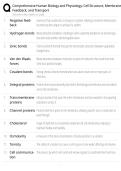
1. Negative feed- A process that counteracts a change in a system, helping to maintain homeostasis
back by reducing the output or activity of a system.
2. Hydrogen bonds Weak attractions between a hydrogen atom covalently bonded to an electronega-
tive atom and another electronegative atom.
3. Ionic bonds Chemical bonds formed through the electrostatic attraction between oppositely
charged ions.
4. Van der Waals Weak attractions between molecules or parts of molecules that result from tran-
forces sient local partial charges.
5. Covalent bonds Strong chemical bonds formed when two atoms share one or more pairs of
electrons.
6. Integral proteins Proteins that are permanently attached to the biological membrane and can extend
across the membrane.
7. Transmembrane Integral proteins that span the entire membrane and are involved in transporting
proteins substances across it.
8. Channel proteins Proteins that form pores in the membrane, allowing specific ions or molecules to
pass through.
9. Cholesterol A type of lipid that is an essential component of cell membranes, helping to
maintain fluidity and stability.
10. Osmolarity A measure of the total concentration of solute particles in a solution.
11. Tonicity The ability of a solution to cause a cell to gain or lose water, affecting cell volume.
12. Cell communica- The process by which cells send and receive signals to coordinate their functions.
tion
1/6
, Comprehensive Human Biology and Physiology: Cell Structure, Membrane
Feedback, and Transport
Study online at https://quizlet.com/_joaytd
13. Receptor A protein that binds to specific signaling molecules, initiating a cellular response.
14. Metabolism The sum of all chemical reactions that occur within a living organism to maintain
life.
15. Anabolism The metabolic process that builds larger molecules from smaller ones, requiring
energy.
16. Oxidation A chemical reaction that involves the loss of electrons or an increase in oxidation
state.
17. Exergonic Reactions that release energy, often occurring spontaneously.
18. Endergonic Reactions that require an input of energy to proceed.
19. Specificity The ability of a receptor or enzyme to bind to a specific ligand or substrate.
20. Anatomical and Differences in the structure and function of organs and systems among individuals.
physiological
variation
21. Galen An ancient Greek physician whose work influenced medical science for centuries.
22. Aristotle A Greek philosopher who made significant contributions to various fields, includ-
ing biology.
23. Maimonides A medieval Jewish philosopher and physician known for his works on medicine and
ethics.
24. Vesalius A Renaissance anatomist known for his detailed studies of human anatomy.
25. Microvilli Small, finger-like projections on the surface of some cells that increase surface area
for absorption.
2/6
Feedback, and Transport
Study online at https://quizlet.com/_joaytd
1. Negative feed- A process that counteracts a change in a system, helping to maintain homeostasis
back by reducing the output or activity of a system.
2. Hydrogen bonds Weak attractions between a hydrogen atom covalently bonded to an electronega-
tive atom and another electronegative atom.
3. Ionic bonds Chemical bonds formed through the electrostatic attraction between oppositely
charged ions.
4. Van der Waals Weak attractions between molecules or parts of molecules that result from tran-
forces sient local partial charges.
5. Covalent bonds Strong chemical bonds formed when two atoms share one or more pairs of
electrons.
6. Integral proteins Proteins that are permanently attached to the biological membrane and can extend
across the membrane.
7. Transmembrane Integral proteins that span the entire membrane and are involved in transporting
proteins substances across it.
8. Channel proteins Proteins that form pores in the membrane, allowing specific ions or molecules to
pass through.
9. Cholesterol A type of lipid that is an essential component of cell membranes, helping to
maintain fluidity and stability.
10. Osmolarity A measure of the total concentration of solute particles in a solution.
11. Tonicity The ability of a solution to cause a cell to gain or lose water, affecting cell volume.
12. Cell communica- The process by which cells send and receive signals to coordinate their functions.
tion
1/6
, Comprehensive Human Biology and Physiology: Cell Structure, Membrane
Feedback, and Transport
Study online at https://quizlet.com/_joaytd
13. Receptor A protein that binds to specific signaling molecules, initiating a cellular response.
14. Metabolism The sum of all chemical reactions that occur within a living organism to maintain
life.
15. Anabolism The metabolic process that builds larger molecules from smaller ones, requiring
energy.
16. Oxidation A chemical reaction that involves the loss of electrons or an increase in oxidation
state.
17. Exergonic Reactions that release energy, often occurring spontaneously.
18. Endergonic Reactions that require an input of energy to proceed.
19. Specificity The ability of a receptor or enzyme to bind to a specific ligand or substrate.
20. Anatomical and Differences in the structure and function of organs and systems among individuals.
physiological
variation
21. Galen An ancient Greek physician whose work influenced medical science for centuries.
22. Aristotle A Greek philosopher who made significant contributions to various fields, includ-
ing biology.
23. Maimonides A medieval Jewish philosopher and physician known for his works on medicine and
ethics.
24. Vesalius A Renaissance anatomist known for his detailed studies of human anatomy.
25. Microvilli Small, finger-like projections on the surface of some cells that increase surface area
for absorption.
2/6


