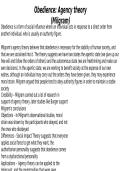
Obedience: Agency theory
(Milgram)
Obedience is a form of social influence where an individual acts in response to a direct order from
another individual, who is usually an authority figure.
Milgram's agency theory believes that obedience is necessary for the stability of human society, and
that we are socialised into it. The theory suggests we have two states the agentic state (we give up our
free will and follow the orders of others) and the autonomous state (we are freethinking and make our
own decisions). In the agentic state, we are working to benefit society at the expense of our own
wishes, although an individual may carry out the orders they have been given, they may experience
moral strain. Milgram argued that people tend to obey authority figures in order to maintain a stable
society
Credibility – Milgram carried out a lot of research in
support of agency theory, later studies like Burger support
Milgram's conclusions
Objections – In Milgram's observational studies, moral
strain was shown by the participants who obeyed, and not
the ones who disobeyed
Differences – Social Impact Theory suggests that everyone
applies social force to get what they want, the
authoritarian personality suggests that obedience comes
from a dysfunctional personality
Applications – Agency theory can be applied to the
, Milgram's study into obedience
Aim – Milgram wanted to investigate how obedient participants would be when following orders would
mean breaking their moral code and harming another person
Sample – 40 male ppts’, all from the U.S.
Procedures – Offered $4 plus 50 cents car fare for any volunteer, ppts’ met by researcher and 'Mr
Wallace’, a confederate. Pptwas instructed to increase shocks on shock generator by 15v each time a
question answered incorrectly. Ppt could not see learner, but could hear him, he complained about his
heart and said that he wanted to be let out, at the 300v level, he pounded on the wall, and after the
315v level was silent
Results – All 40 participants went to at least 300v, and 65% went up to maximum of 450v, participants
were then debriefed and were told the full aims and nature of the study as well as being reunited with
Mr Wallace
Generalisability – Volunteers are likely to be particularly obedient, although the
Conclusions – The study shows the power of authority over our behaviour
sample was all-American and all-male and so is unrepresentative of wider
society
Reliability – Milgram's procedure is very reliable because it can be replicated, as
seen by Burger's study in 2009, although Perry criticises Milgram for not
following standardised procedures
Applications – Can explain the atrocities of the Holocaust
Validity – Milgram's study lack ecological validity as the task is artificial
Ethics – The main criticism is that the wellbeing of the participants was ignored,
they were deceived and did not give informed consent, there were also 'prods'
when they tried to withdraw
(Milgram)
Obedience is a form of social influence where an individual acts in response to a direct order from
another individual, who is usually an authority figure.
Milgram's agency theory believes that obedience is necessary for the stability of human society, and
that we are socialised into it. The theory suggests we have two states the agentic state (we give up our
free will and follow the orders of others) and the autonomous state (we are freethinking and make our
own decisions). In the agentic state, we are working to benefit society at the expense of our own
wishes, although an individual may carry out the orders they have been given, they may experience
moral strain. Milgram argued that people tend to obey authority figures in order to maintain a stable
society
Credibility – Milgram carried out a lot of research in
support of agency theory, later studies like Burger support
Milgram's conclusions
Objections – In Milgram's observational studies, moral
strain was shown by the participants who obeyed, and not
the ones who disobeyed
Differences – Social Impact Theory suggests that everyone
applies social force to get what they want, the
authoritarian personality suggests that obedience comes
from a dysfunctional personality
Applications – Agency theory can be applied to the
, Milgram's study into obedience
Aim – Milgram wanted to investigate how obedient participants would be when following orders would
mean breaking their moral code and harming another person
Sample – 40 male ppts’, all from the U.S.
Procedures – Offered $4 plus 50 cents car fare for any volunteer, ppts’ met by researcher and 'Mr
Wallace’, a confederate. Pptwas instructed to increase shocks on shock generator by 15v each time a
question answered incorrectly. Ppt could not see learner, but could hear him, he complained about his
heart and said that he wanted to be let out, at the 300v level, he pounded on the wall, and after the
315v level was silent
Results – All 40 participants went to at least 300v, and 65% went up to maximum of 450v, participants
were then debriefed and were told the full aims and nature of the study as well as being reunited with
Mr Wallace
Generalisability – Volunteers are likely to be particularly obedient, although the
Conclusions – The study shows the power of authority over our behaviour
sample was all-American and all-male and so is unrepresentative of wider
society
Reliability – Milgram's procedure is very reliable because it can be replicated, as
seen by Burger's study in 2009, although Perry criticises Milgram for not
following standardised procedures
Applications – Can explain the atrocities of the Holocaust
Validity – Milgram's study lack ecological validity as the task is artificial
Ethics – The main criticism is that the wellbeing of the participants was ignored,
they were deceived and did not give informed consent, there were also 'prods'
when they tried to withdraw