

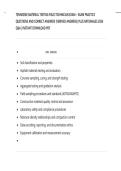
TENNESSEE MATERIAL TESTING FIELD TECHNICIAN EXAM – EXAM PRACTICE
QUESTIONS AND CORRECT ANSWERS (VERIFIED ANSWERS) PLUS RATIONALES 2026
Q&A | INSTANT DOWNLOAD PDF
CORE DOMAINS
Soil classification and properties
Asphalt materials testing and evaluation
Concrete sampling, curing, and strength testing
Aggregate testing and gradation analysis
Field sampling procedures and standards (ASTM/AASHTO)
Construction materials quality control and assurance
Laboratory safety and compliance procedures
Moisture-density relationships and compaction control
Data recording, reporting, and documentation ethics
Equipment calibration and measurement accuracy
, INTRODUCTION
This exam assesses the knowledge and field competency required of a Material Testing
Field Technician working in construction quality control environments. It evaluates
understanding of soils, asphalt, concrete, and aggregate testing procedures, along with
applicable ASTM and AASHTO standards. Candidates are tested on both theoretical
knowledge and practical decision-making skills required in real-world field conditions. The
questions include multiple-choice and scenario-based formats designed to measure
accuracy, technical judgment, safety awareness, and proper documentation practices.
Successful performance demonstrates readiness to perform material sampling, testing, and
reporting in compliance with engineering and construction standards.
*
SECTION ONE (QUESTIONS 1–50)
Question 1
What is the primary purpose of soil compaction in construction?
A. Increase soil color consistency
B. Reduce soil permeability and increase density
,C. Increase organic content
D. Improve soil acidity
🟢 Correct Answer: B. Reduce soil permeability and increase density
🔴 Explanation: Compaction reduces air voids, increases soil density, and improves load-
bearing capacity while reducing water infiltration.
Question 2
Which test is commonly used to determine moisture content of soil?
A. Slump test
B. Proctor test
C. Oven-dry method
D. Marshall test
🟢 Correct Answer: C. Oven-dry method
🔴 Explanation: The oven-dry method accurately determines moisture content by drying
soil and comparing wet vs dry mass.
, Question 3
What does the Proctor test determine?
A. Asphalt viscosity
B. Concrete strength
C. Soil maximum dry density and optimum moisture content
D. Aggregate abrasion resistance
🟢 Correct Answer: C. Soil maximum dry density and optimum moisture content
🔴 Explanation: The Proctor test establishes compaction characteristics for soil under
controlled moisture levels.
Question 4
Which material is most commonly tested using the Marshall stability test?
A. Soil
B. Concrete
C. Asphalt
D. Steel
🟢 Correct Answer: C. Asphalt
QUESTIONS AND CORRECT ANSWERS (VERIFIED ANSWERS) PLUS RATIONALES 2026
Q&A | INSTANT DOWNLOAD PDF
CORE DOMAINS
Soil classification and properties
Asphalt materials testing and evaluation
Concrete sampling, curing, and strength testing
Aggregate testing and gradation analysis
Field sampling procedures and standards (ASTM/AASHTO)
Construction materials quality control and assurance
Laboratory safety and compliance procedures
Moisture-density relationships and compaction control
Data recording, reporting, and documentation ethics
Equipment calibration and measurement accuracy
, INTRODUCTION
This exam assesses the knowledge and field competency required of a Material Testing
Field Technician working in construction quality control environments. It evaluates
understanding of soils, asphalt, concrete, and aggregate testing procedures, along with
applicable ASTM and AASHTO standards. Candidates are tested on both theoretical
knowledge and practical decision-making skills required in real-world field conditions. The
questions include multiple-choice and scenario-based formats designed to measure
accuracy, technical judgment, safety awareness, and proper documentation practices.
Successful performance demonstrates readiness to perform material sampling, testing, and
reporting in compliance with engineering and construction standards.
*
SECTION ONE (QUESTIONS 1–50)
Question 1
What is the primary purpose of soil compaction in construction?
A. Increase soil color consistency
B. Reduce soil permeability and increase density
,C. Increase organic content
D. Improve soil acidity
🟢 Correct Answer: B. Reduce soil permeability and increase density
🔴 Explanation: Compaction reduces air voids, increases soil density, and improves load-
bearing capacity while reducing water infiltration.
Question 2
Which test is commonly used to determine moisture content of soil?
A. Slump test
B. Proctor test
C. Oven-dry method
D. Marshall test
🟢 Correct Answer: C. Oven-dry method
🔴 Explanation: The oven-dry method accurately determines moisture content by drying
soil and comparing wet vs dry mass.
, Question 3
What does the Proctor test determine?
A. Asphalt viscosity
B. Concrete strength
C. Soil maximum dry density and optimum moisture content
D. Aggregate abrasion resistance
🟢 Correct Answer: C. Soil maximum dry density and optimum moisture content
🔴 Explanation: The Proctor test establishes compaction characteristics for soil under
controlled moisture levels.
Question 4
Which material is most commonly tested using the Marshall stability test?
A. Soil
B. Concrete
C. Asphalt
D. Steel
🟢 Correct Answer: C. Asphalt


