1
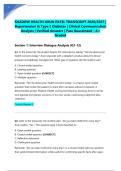
SHADOW HEALTH ARUN PATEL TRANSCRIPT 2026/2027 |
Hypertension & Type 2 Diabetes | Clinical Communication
Analysis | Verified Answers | Pass Guaranteed - A+
Graded
Section 1: Interview Dialogue Analysis (Q1-12)
Q1. In the transcript, the student begins the interview by asking: "Tell me about your
health concerns today." Arun responds with a detailed narrative about his blood
pressure and diabetes management. What type of question did the student use?
A. Closed-ended question
B. Leading question
C. Open-ended question [CORRECT]
D. Multiple question
Rationale: "Tell me about your health concerns today" is a classic open-ended
question that invites the patient to share their narrative without constraint; it
demonstrates proper Shadow Health scoring technique by allowing Arun to set his
own agenda and express concerns in his own words, maximizing subjective data
collection.
Correct Answer: C
Q2. Later in the transcript, the student asks: "Do you take metformin every day?"
Arun replies, "Yes." This question type is best classified as:
A. Open-ended question
B. Closed-ended question [CORRECT]
C. Reflective statement
D. Clarification question
Rationale: "Do you take metformin every day?" is a closed-ended (yes/no) question
that yields limited information; while useful for confirming specific facts after open-
,2
ended exploration, overuse of closed-ended questions early in the interview restricts
data collection and reduces Shadow Health transcript scoring potential.
Correct Answer: B
Q3. The student asks: "You don't have any chest pain, do you?" This question is
problematic because it is:
A. Too open-ended
B. A leading question that suggests the desired answer [CORRECT]
C. A properly phrased screening question
D. A reflective statement
Rationale: "You don't have any chest pain, do you?" is a leading question that cues
the patient toward a negative response; in Shadow Health scoring, leading questions
reduce transcript quality because patients may agree to please the interviewer rather
than disclose true symptoms, compromising cardiovascular risk assessment.
Correct Answer: B
Q4. The student asks: "How long have you had high blood pressure, and what
medications are you taking for it, and do they cause any side effects?" Arun only
answers the first part. This illustrates:
A. Effective use of the REACCT model
B. A multiple question that overwhelms the patient [CORRECT]
C. Proper agenda-setting technique
D. Successful summarization
Rationale: Asking three questions simultaneously constitutes a multiple question,
which confuses patients and produces incomplete responses; in Shadow Health
transcripts, this reduces scoring because only partial data is obtained, and the
student must circle back to ask about medications and side effects separately.
Correct Answer: B
, 3
Q5. Arun states: "I've been feeling really tired lately, more than usual." The student
responds: "So you're feeling more fatigued than your baseline." This communication
technique is:
A. Clarification
B. Reflection [CORRECT]
C. Summarization
D. Confrontation
Rationale: The student's response is reflection—a technique that mirrors the patient's
stated feeling back to them using similar but slightly rephrased language; reflection
validates the patient's experience, encourages elaboration, and is a high-scoring
therapeutic communication technique in Shadow Health assessments.
Correct Answer: B
Q6. Arun mentions: "My wife says I snore really loudly and sometimes stop
breathing." The student responds: "That sounds like sleep apnea. Have you been
tested?" This response is problematic because it:
A. Uses premature labeling and diagnosis before full assessment [CORRECT]
B. Appropriately identifies a red flag
C. Uses proper teach-back technique
D. Demonstrates effective summarization
Rationale: Labeling the symptom as "sleep apnea" before completing the history
constitutes premature diagnosis and may bias subsequent responses; in Shadow
Health scoring, this reduces communication quality because it shifts from patient-
centered exploration to clinician-directed labeling, potentially missing nuanced
symptom descriptions.
Correct Answer: A
SHADOW HEALTH ARUN PATEL TRANSCRIPT 2026/2027 |
Hypertension & Type 2 Diabetes | Clinical Communication
Analysis | Verified Answers | Pass Guaranteed - A+
Graded
Section 1: Interview Dialogue Analysis (Q1-12)
Q1. In the transcript, the student begins the interview by asking: "Tell me about your
health concerns today." Arun responds with a detailed narrative about his blood
pressure and diabetes management. What type of question did the student use?
A. Closed-ended question
B. Leading question
C. Open-ended question [CORRECT]
D. Multiple question
Rationale: "Tell me about your health concerns today" is a classic open-ended
question that invites the patient to share their narrative without constraint; it
demonstrates proper Shadow Health scoring technique by allowing Arun to set his
own agenda and express concerns in his own words, maximizing subjective data
collection.
Correct Answer: C
Q2. Later in the transcript, the student asks: "Do you take metformin every day?"
Arun replies, "Yes." This question type is best classified as:
A. Open-ended question
B. Closed-ended question [CORRECT]
C. Reflective statement
D. Clarification question
Rationale: "Do you take metformin every day?" is a closed-ended (yes/no) question
that yields limited information; while useful for confirming specific facts after open-
,2
ended exploration, overuse of closed-ended questions early in the interview restricts
data collection and reduces Shadow Health transcript scoring potential.
Correct Answer: B
Q3. The student asks: "You don't have any chest pain, do you?" This question is
problematic because it is:
A. Too open-ended
B. A leading question that suggests the desired answer [CORRECT]
C. A properly phrased screening question
D. A reflective statement
Rationale: "You don't have any chest pain, do you?" is a leading question that cues
the patient toward a negative response; in Shadow Health scoring, leading questions
reduce transcript quality because patients may agree to please the interviewer rather
than disclose true symptoms, compromising cardiovascular risk assessment.
Correct Answer: B
Q4. The student asks: "How long have you had high blood pressure, and what
medications are you taking for it, and do they cause any side effects?" Arun only
answers the first part. This illustrates:
A. Effective use of the REACCT model
B. A multiple question that overwhelms the patient [CORRECT]
C. Proper agenda-setting technique
D. Successful summarization
Rationale: Asking three questions simultaneously constitutes a multiple question,
which confuses patients and produces incomplete responses; in Shadow Health
transcripts, this reduces scoring because only partial data is obtained, and the
student must circle back to ask about medications and side effects separately.
Correct Answer: B
, 3
Q5. Arun states: "I've been feeling really tired lately, more than usual." The student
responds: "So you're feeling more fatigued than your baseline." This communication
technique is:
A. Clarification
B. Reflection [CORRECT]
C. Summarization
D. Confrontation
Rationale: The student's response is reflection—a technique that mirrors the patient's
stated feeling back to them using similar but slightly rephrased language; reflection
validates the patient's experience, encourages elaboration, and is a high-scoring
therapeutic communication technique in Shadow Health assessments.
Correct Answer: B
Q6. Arun mentions: "My wife says I snore really loudly and sometimes stop
breathing." The student responds: "That sounds like sleep apnea. Have you been
tested?" This response is problematic because it:
A. Uses premature labeling and diagnosis before full assessment [CORRECT]
B. Appropriately identifies a red flag
C. Uses proper teach-back technique
D. Demonstrates effective summarization
Rationale: Labeling the symptom as "sleep apnea" before completing the history
constitutes premature diagnosis and may bias subsequent responses; in Shadow
Health scoring, this reduces communication quality because it shifts from patient-
centered exploration to clinician-directed labeling, potentially missing nuanced
symptom descriptions.
Correct Answer: A