

BUSINESS . 2026/2027 LATEST UPDATE
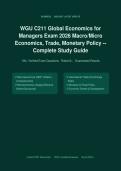
WGU C211 Global Economics for
Managers Exam 2026 Macro/Micro
Economics, Trade, Monetary Policy --
Complete Study Guide
100+ Verified Exam Questions . Rated A+ . Guaranteed Results
V Macroeconomics (GDP, Inflation, V International Trade & Exchange
Unemployment) Rates
V Microeconomics (Supply/Demand, V Monetary & Fiscal Policy
Market Structures) V Economic Growth & Development
Instant PDF Download . 100% Verified Answers . Score 90%+
, BEST SELLER . BUSINESS
WGU C211 Global Economics for
Managers Exam 2026 Macro/Micro A+
Rated
Economics, Trade, Monetary Policy
2026/2027 -- Q&A with Verified Answers
Every section. Every topic. 100% correct answers guaranteed. Used
by 5,000+ business students to pass on their first attempt.
GDP Inflation Unemployment Supply/Demand Market Structures
Trade Exchange Rates Monetary Policy Fiscal Policy
Economic Growth Development HDI Gini Coefficient
Used by 5,000+ students . 100% Verified Answers . 2026/2027 Latest Update
Instant PDF Download
, SECTION 1 | Macroeconomics (GDP, Inflation, Unemployment) | Q1-Q20 | WGU C211 Global Economics for Managers Exam 2026
Macro/Micro Economics, Trade, Monetary Policy 2026/2027
Macroeconomics
Q1 Question 1 of 100
A country's statistical agency reports that nominal GDP rose by 8% over the past year
while real GDP increased by only 3%. An economist reviewing these figures wants to
understand what accounts for the gap between the two growth rates. What does the
difference between nominal and real GDP growth primarily reflect?
A) Changes in the overall price level throughout the economy
B) Increases in the total volume of goods and services produced
C) Shifts in the labor force participation rate across demographics
D) Variations in government spending on infrastructure projects
Correct Answer: A
Rationale:
The difference between nominal and real GDP growth captures the effect of price changes, commonly
measured by the GDP deflator. Nominal GDP can rise due to either higher output or higher prices, while
real GDP strips out inflation, so the gap reflects rising price levels rather than real production gains.
Q2 Question 2 of 100
An analyst at the Bureau of Labor Statistics is calculating the Consumer Price Index for the
current year. She collects price data on a fixed basket of consumer goods and compares it
to the base year prices. After computing the index, she notices it has risen from 240 to 252.
Based on this change, what is the approximate annual inflation rate?
A) 2.0 percent, derived by dividing the index change by the new index value
B) 5.0 percent, calculated as the percentage change from the old to the new index
C) 3.5 percent, based on an average of the old and new index values
D) 4.8 percent, obtained by dividing the new index by the old index
Correct Answer: B
Rationale:
The inflation rate is calculated as the percentage change in the CPI: (252 - 240) / 240 = 12/240 = 0.05 or
5 percent. Choice A incorrectly uses 252 as the denominator, while choices C and D do not correspond
to the correct percentage calculation.
WGU C211 Global Economics for Managers Exam 2026 Macro/Micro Economics, Trade, Monetary Policy -- 2026/2027 | Passing Score: 80% | Page 3 of 53
, Q3 Question 3 of 100
A manufacturing firm experiences a sharp increase in production costs after global oil
prices surge unexpectedly. The company passes these higher costs on to consumers by
raising product prices, even though consumer demand has not increased. This situation
best illustrates which type of inflation?
A) Demand-pull inflation driven by excess aggregate demand in the economy
B) Monetary inflation resulting from excessive expansion of the money supply
C) Cost-push inflation resulting from rising input costs being passed to consumers
D) Structural inflation caused by long-term imbalances in labor markets
Correct Answer: C
Rationale:
Cost-push inflation occurs when rising production costs push prices upward even without an increase in
aggregate demand. Demand-pull inflation requires excess demand, which is absent here, making choice
A incorrect for this scenario.
Q4 Question 4 of 100
A recent college graduate with a degree in finance has been actively submitting job
applications for three months after leaving her previous employer to find a better
opportunity. She attends interviews weekly and remains confident she will secure a
position soon. This individual is classified as experiencing what type of unemployment?
A) Cyclical unemployment due to a downturn in the overall business cycle
B) Structural unemployment caused by a fundamental mismatch of skills
C) Seasonal unemployment linked to periodic demand changes in her industry
D) Frictional unemployment associated with the normal process of job search
Correct Answer: D
Rationale:
Frictional unemployment describes workers who are temporarily between jobs while searching for new
positions that better match their preferences and qualifications. Structural unemployment involves skill
mismatches, and cyclical unemployment results from economic downturns, neither of which applies
here.
WGU C211 Global Economics for Managers Exam 2026 Macro/Micro Economics, Trade, Monetary Policy -- 2026/2027 | Passing Score: 80% | Page 4 of 53
WGU C211 Global Economics for
Managers Exam 2026 Macro/Micro
Economics, Trade, Monetary Policy --
Complete Study Guide
100+ Verified Exam Questions . Rated A+ . Guaranteed Results
V Macroeconomics (GDP, Inflation, V International Trade & Exchange
Unemployment) Rates
V Microeconomics (Supply/Demand, V Monetary & Fiscal Policy
Market Structures) V Economic Growth & Development
Instant PDF Download . 100% Verified Answers . Score 90%+
, BEST SELLER . BUSINESS
WGU C211 Global Economics for
Managers Exam 2026 Macro/Micro A+
Rated
Economics, Trade, Monetary Policy
2026/2027 -- Q&A with Verified Answers
Every section. Every topic. 100% correct answers guaranteed. Used
by 5,000+ business students to pass on their first attempt.
GDP Inflation Unemployment Supply/Demand Market Structures
Trade Exchange Rates Monetary Policy Fiscal Policy
Economic Growth Development HDI Gini Coefficient
Used by 5,000+ students . 100% Verified Answers . 2026/2027 Latest Update
Instant PDF Download
, SECTION 1 | Macroeconomics (GDP, Inflation, Unemployment) | Q1-Q20 | WGU C211 Global Economics for Managers Exam 2026
Macro/Micro Economics, Trade, Monetary Policy 2026/2027
Macroeconomics
Q1 Question 1 of 100
A country's statistical agency reports that nominal GDP rose by 8% over the past year
while real GDP increased by only 3%. An economist reviewing these figures wants to
understand what accounts for the gap between the two growth rates. What does the
difference between nominal and real GDP growth primarily reflect?
A) Changes in the overall price level throughout the economy
B) Increases in the total volume of goods and services produced
C) Shifts in the labor force participation rate across demographics
D) Variations in government spending on infrastructure projects
Correct Answer: A
Rationale:
The difference between nominal and real GDP growth captures the effect of price changes, commonly
measured by the GDP deflator. Nominal GDP can rise due to either higher output or higher prices, while
real GDP strips out inflation, so the gap reflects rising price levels rather than real production gains.
Q2 Question 2 of 100
An analyst at the Bureau of Labor Statistics is calculating the Consumer Price Index for the
current year. She collects price data on a fixed basket of consumer goods and compares it
to the base year prices. After computing the index, she notices it has risen from 240 to 252.
Based on this change, what is the approximate annual inflation rate?
A) 2.0 percent, derived by dividing the index change by the new index value
B) 5.0 percent, calculated as the percentage change from the old to the new index
C) 3.5 percent, based on an average of the old and new index values
D) 4.8 percent, obtained by dividing the new index by the old index
Correct Answer: B
Rationale:
The inflation rate is calculated as the percentage change in the CPI: (252 - 240) / 240 = 12/240 = 0.05 or
5 percent. Choice A incorrectly uses 252 as the denominator, while choices C and D do not correspond
to the correct percentage calculation.
WGU C211 Global Economics for Managers Exam 2026 Macro/Micro Economics, Trade, Monetary Policy -- 2026/2027 | Passing Score: 80% | Page 3 of 53
, Q3 Question 3 of 100
A manufacturing firm experiences a sharp increase in production costs after global oil
prices surge unexpectedly. The company passes these higher costs on to consumers by
raising product prices, even though consumer demand has not increased. This situation
best illustrates which type of inflation?
A) Demand-pull inflation driven by excess aggregate demand in the economy
B) Monetary inflation resulting from excessive expansion of the money supply
C) Cost-push inflation resulting from rising input costs being passed to consumers
D) Structural inflation caused by long-term imbalances in labor markets
Correct Answer: C
Rationale:
Cost-push inflation occurs when rising production costs push prices upward even without an increase in
aggregate demand. Demand-pull inflation requires excess demand, which is absent here, making choice
A incorrect for this scenario.
Q4 Question 4 of 100
A recent college graduate with a degree in finance has been actively submitting job
applications for three months after leaving her previous employer to find a better
opportunity. She attends interviews weekly and remains confident she will secure a
position soon. This individual is classified as experiencing what type of unemployment?
A) Cyclical unemployment due to a downturn in the overall business cycle
B) Structural unemployment caused by a fundamental mismatch of skills
C) Seasonal unemployment linked to periodic demand changes in her industry
D) Frictional unemployment associated with the normal process of job search
Correct Answer: D
Rationale:
Frictional unemployment describes workers who are temporarily between jobs while searching for new
positions that better match their preferences and qualifications. Structural unemployment involves skill
mismatches, and cyclical unemployment results from economic downturns, neither of which applies
here.
WGU C211 Global Economics for Managers Exam 2026 Macro/Micro Economics, Trade, Monetary Policy -- 2026/2027 | Passing Score: 80% | Page 4 of 53


