Question 1 15/ 15 pts
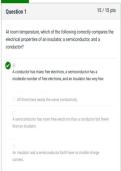
At room temperature, which of the following correctly compares the
electrical properties of an insulator, a semiconductor, and a
conductor?
o A conductor has many free electrons, a semiconductor has a
moderate number of free electrons, and an insulator has very few.
All three have nearly the same conductivity.
A semiconductor has more free electrons than a conductor but fewer
than an insulator.
An insulator and a semiconductor both have no mobile charge
carriers.
,Question 2 15/15 pts
Two large, parallel conducting plates are separated by a distance of
d = 2 mm. Each plate has an area of A = 0.02 m?2. The region
between the plates is filled with a material with dielectric constant
€, = 3. Find the capacitance (in pF’, one decimal place) of the
capacitor.
O
, Question 3 15/ 15 pts
Two large, parallel conducting plates are separated by a distance of
d = 2 mm. Each plate has an area of A = 0.02 m?. The region
between the plates is filled with air. Find the potential difference (in
kV, one decimal place) if a charge of Q= 8.7 uC is stored on the
capacitor.
o=
At room temperature, which of the following correctly compares the
electrical properties of an insulator, a semiconductor, and a
conductor?
o A conductor has many free electrons, a semiconductor has a
moderate number of free electrons, and an insulator has very few.
All three have nearly the same conductivity.
A semiconductor has more free electrons than a conductor but fewer
than an insulator.
An insulator and a semiconductor both have no mobile charge
carriers.
,Question 2 15/15 pts
Two large, parallel conducting plates are separated by a distance of
d = 2 mm. Each plate has an area of A = 0.02 m?2. The region
between the plates is filled with a material with dielectric constant
€, = 3. Find the capacitance (in pF’, one decimal place) of the
capacitor.
O
, Question 3 15/ 15 pts
Two large, parallel conducting plates are separated by a distance of
d = 2 mm. Each plate has an area of A = 0.02 m?. The region
between the plates is filled with air. Find the potential difference (in
kV, one decimal place) if a charge of Q= 8.7 uC is stored on the
capacitor.
o=