

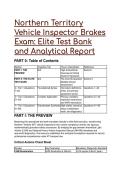
Northern Territory
Vehicle Inspector Brakes
Exam: Elite Test Bank
and Analytical Report
PART 0: Table of Contents
Section Cognitive Tier Focus / Description Reference
PART I: THE N/A High-Instructional Section I
PREVIEW Overview & Critical
Axioms Framework
PART II: THE ELITE N/A The Core 60-Question Section II
TEST BANK Multiple-Choice
Assessment
├─ Tier 1 (Questions Foundational Syntax Hard-deck definitions, Questions 1–20
1–20) limits, and primary
equipment syntax
├─ Tier 2 (Questions Complex Application Process variables, Questions 21–40
21–40) inspection sequences,
and MVR interactions
└─ Tier 3 (Questions Grandmaster Synthesis High-stakes scenarios, Questions 41–60
41–60) heavy combination
math, and diagnostics
PART I: THE PREVIEW
Mastering this specialized test bank translates directly to elite field execution, transforming
Northern Territory (NT) vehicle inspections from routine compliance checks into rigorous,
mathematically grounded safety assurances. By bridging the gap between theoretical Light
Vehicle (LVIM) and National Heavy Vehicle Inspection Manual (NHVIM) standards and
real-world diagnostics, this resource establishes the analytical foundations required for top-tier
professional competencies under NT transport law.
Critical Axioms Cheat Sheet
Domain Key Parameter Mandatory Diagnostic Standard
LVIM Deceleration GVM thresholds at 35km/h. <2.5t require 5.8m/s² peak /
,Domain Key Parameter Mandatory Diagnostic Standard
3.8m/s² average. ≥2.5t require
4.4m/s² peak / 2.8m/s² average.
NHVIM Pneumatics Leakage Limits (kPa/min). Applied: 20kPa (prime mover) +
5kPa/trailer. Released: 15kPa
(prime mover) + 5kPa/trailer.
NHVIM Hardware Friction & Rotor Limits. Pads must not wear below
3mm (bonded/rivet). Rotors
reject at >1.5mm groove depth.
NT Jurisdiction Defect Clearance Authority. Private authorised inspectors
cannot clear defects; this is
strictly reserved for NT
Government Transport
Inspectors.
Towing Physics Un-braked A-frame Mass. The towing vehicle unladen
mass MUST be ≥ 3.5 times the
towed vehicle laden mass.
PART II: THE ELITE TEST BANK
Tier 1 - Foundational Syntax & Application
Q1: An authorised vehicle inspector is testing a passenger car with a gross vehicle mass (GVM)
of 2.1 tonnes using a decelerometer from a speed of 35km/h. Based on the NT Light Vehicle
Inspection Manual (LVIM) standards, what is the absolute minimum acceptable peak
deceleration rate? A) 2.8m/s² B) 3.8m/s² C) 5.8m/s² D) 4.4m/s²
● The Answer: C (5.8m/s²)
● Distractor Analysis:
○ A is incorrect: 2.8m/s² is the required average deceleration rate for vehicles ≥2.5t.
○ B is incorrect: 3.8m/s² is the required average deceleration rate for vehicles <2.5t,
not the peak.
○ D is incorrect: 4.4m/s² is the peak rate for vehicles over 2.5t, which does not apply
to this 2.1t vehicle.
The Mentor's Analysis: Deceleration metrics are inherently mass-dependent. When evaluating
light vehicles under 2.5 tonnes, the immediate priority is verifying the braking system achieves
the higher performance kinetic threshold. By utilizing the 5.8m/s² standard, the inspector
bypasses the common trap of applying heavy-vehicle leniencies to lightweight passenger cars.
Professional/Academic Intuition: Always isolate the vehicle's GVM threshold (<2.5t vs
≥2.5t) before establishing the peak and average decelerometer target data.
Q2: During an NHVIM assessment of a heavy rigid truck, the inspector tests the air brake
compressor build-up time. After completely draining the air reserve, the compressor must build
air pressure to 80% of the vehicle's governor cut-out pressure within what maximum timeframe?
A) 2 minutes B) 3 minutes C) 5 minutes D) 10 minutes
● The Answer: C (5 minutes)
● Distractor Analysis:
○ A is incorrect: This is a legacy European specification, not the Australian NHVIM
standard.
○ B is incorrect: While optimal for modern compressors, the regulatory limit provides a
, broader legal window.
○ D is incorrect: Allowing 10 minutes indicates severe compressor wear or system
leaks, constituting a major safety failure.
The Mentor's Analysis: Pneumatic replenishment speed is critical for multi-stop or downhill
endurance braking. When testing the compressor, the priority is verifying volumetric efficiency.
By timing strictly to the 5-minute mark, the inspector prevents catastrophic air depletion on
continuous mountain grades. Professional/Academic Intuition: A compressor that cannot
hit 80% cut-out in 300 seconds represents a compromised pneumatic heart and an
immediate rejection.
Q3: A light vehicle is presented for an NT roadworthy inspection. The inspector checks the
parking brake performance on a static ramp. To meet the minimum compliance standard, the
parking brake must hold the vehicle stationary on a gradient of at least: A) 8% B) 10% C) 12%
D) 15%
● The Answer: C (12%)
● Distractor Analysis:
○ A is incorrect: 8% is mathematically insufficient and represents a highly degraded
brake cable or shoe adjustment.
○ B is incorrect: 10% is a common novice estimation but falls short of the statutory NT
mandate.
○ D is incorrect: While exceeding the standard guarantees safety, 15% is not the
minimum regulatory requirement.
The Mentor's Analysis: Parking brake efficiency ensures stationary kinetic energy remains at
zero under gravitational load. When validating mechanical hold, the priority is the strict 12%
gradient test. By utilizing this exact gradient, the assessment standardizes gravitational
resistance globally. Professional/Academic Intuition: The 12% gradient rule is the absolute
hard deck for static mechanical braking efficiency across all light vehicle platforms.
Q4: An inspector is examining a bonded brake pad on a heavy vehicle under the NHVIM. The
manufacturer's minimum thickness is unavailable. What is the absolute minimum allowable
thickness of the friction material from the mounting surface? A) 1.5mm B) 2.0mm C) 3.0mm D)
5.0mm
● The Answer: C (3.0mm)
● Distractor Analysis:
○ A is incorrect: 1.5mm applies to acceptable groove depths on rotors, not pad
thickness.
○ B is incorrect: 2.0mm is a common light vehicle manufacturer limit but violates
heavy vehicle rules.
○ D is incorrect: 5.0mm is a safe operational thickness but exceeds the statutory
minimum rejection threshold.
The Mentor's Analysis: Thermal mass relies entirely on friction material volume. When
manufacturer data is absent, the immediate priority is applying the NHVIM default limit. By
enforcing the 3.0mm hard deck, the inspector prevents localized pad shear and
backing-plate-to-rotor contact. Professional/Academic Intuition: In the absence of OEM
data, 3.0mm is the universal barrier between safe operation and catastrophic mechanical
shear.
Q5: An inspector is testing a heavy vehicle's air brake system integrity with the engine stopped
and the service brake applied. To pass the NHVIM standard, the maximum allowable air
pressure drop per minute for the prime mover alone is: A) 10kPa B) 15kPa C) 20kPa D) 25kPa
● The Answer: C (20kPa)
Vehicle Inspector Brakes
Exam: Elite Test Bank
and Analytical Report
PART 0: Table of Contents
Section Cognitive Tier Focus / Description Reference
PART I: THE N/A High-Instructional Section I
PREVIEW Overview & Critical
Axioms Framework
PART II: THE ELITE N/A The Core 60-Question Section II
TEST BANK Multiple-Choice
Assessment
├─ Tier 1 (Questions Foundational Syntax Hard-deck definitions, Questions 1–20
1–20) limits, and primary
equipment syntax
├─ Tier 2 (Questions Complex Application Process variables, Questions 21–40
21–40) inspection sequences,
and MVR interactions
└─ Tier 3 (Questions Grandmaster Synthesis High-stakes scenarios, Questions 41–60
41–60) heavy combination
math, and diagnostics
PART I: THE PREVIEW
Mastering this specialized test bank translates directly to elite field execution, transforming
Northern Territory (NT) vehicle inspections from routine compliance checks into rigorous,
mathematically grounded safety assurances. By bridging the gap between theoretical Light
Vehicle (LVIM) and National Heavy Vehicle Inspection Manual (NHVIM) standards and
real-world diagnostics, this resource establishes the analytical foundations required for top-tier
professional competencies under NT transport law.
Critical Axioms Cheat Sheet
Domain Key Parameter Mandatory Diagnostic Standard
LVIM Deceleration GVM thresholds at 35km/h. <2.5t require 5.8m/s² peak /
,Domain Key Parameter Mandatory Diagnostic Standard
3.8m/s² average. ≥2.5t require
4.4m/s² peak / 2.8m/s² average.
NHVIM Pneumatics Leakage Limits (kPa/min). Applied: 20kPa (prime mover) +
5kPa/trailer. Released: 15kPa
(prime mover) + 5kPa/trailer.
NHVIM Hardware Friction & Rotor Limits. Pads must not wear below
3mm (bonded/rivet). Rotors
reject at >1.5mm groove depth.
NT Jurisdiction Defect Clearance Authority. Private authorised inspectors
cannot clear defects; this is
strictly reserved for NT
Government Transport
Inspectors.
Towing Physics Un-braked A-frame Mass. The towing vehicle unladen
mass MUST be ≥ 3.5 times the
towed vehicle laden mass.
PART II: THE ELITE TEST BANK
Tier 1 - Foundational Syntax & Application
Q1: An authorised vehicle inspector is testing a passenger car with a gross vehicle mass (GVM)
of 2.1 tonnes using a decelerometer from a speed of 35km/h. Based on the NT Light Vehicle
Inspection Manual (LVIM) standards, what is the absolute minimum acceptable peak
deceleration rate? A) 2.8m/s² B) 3.8m/s² C) 5.8m/s² D) 4.4m/s²
● The Answer: C (5.8m/s²)
● Distractor Analysis:
○ A is incorrect: 2.8m/s² is the required average deceleration rate for vehicles ≥2.5t.
○ B is incorrect: 3.8m/s² is the required average deceleration rate for vehicles <2.5t,
not the peak.
○ D is incorrect: 4.4m/s² is the peak rate for vehicles over 2.5t, which does not apply
to this 2.1t vehicle.
The Mentor's Analysis: Deceleration metrics are inherently mass-dependent. When evaluating
light vehicles under 2.5 tonnes, the immediate priority is verifying the braking system achieves
the higher performance kinetic threshold. By utilizing the 5.8m/s² standard, the inspector
bypasses the common trap of applying heavy-vehicle leniencies to lightweight passenger cars.
Professional/Academic Intuition: Always isolate the vehicle's GVM threshold (<2.5t vs
≥2.5t) before establishing the peak and average decelerometer target data.
Q2: During an NHVIM assessment of a heavy rigid truck, the inspector tests the air brake
compressor build-up time. After completely draining the air reserve, the compressor must build
air pressure to 80% of the vehicle's governor cut-out pressure within what maximum timeframe?
A) 2 minutes B) 3 minutes C) 5 minutes D) 10 minutes
● The Answer: C (5 minutes)
● Distractor Analysis:
○ A is incorrect: This is a legacy European specification, not the Australian NHVIM
standard.
○ B is incorrect: While optimal for modern compressors, the regulatory limit provides a
, broader legal window.
○ D is incorrect: Allowing 10 minutes indicates severe compressor wear or system
leaks, constituting a major safety failure.
The Mentor's Analysis: Pneumatic replenishment speed is critical for multi-stop or downhill
endurance braking. When testing the compressor, the priority is verifying volumetric efficiency.
By timing strictly to the 5-minute mark, the inspector prevents catastrophic air depletion on
continuous mountain grades. Professional/Academic Intuition: A compressor that cannot
hit 80% cut-out in 300 seconds represents a compromised pneumatic heart and an
immediate rejection.
Q3: A light vehicle is presented for an NT roadworthy inspection. The inspector checks the
parking brake performance on a static ramp. To meet the minimum compliance standard, the
parking brake must hold the vehicle stationary on a gradient of at least: A) 8% B) 10% C) 12%
D) 15%
● The Answer: C (12%)
● Distractor Analysis:
○ A is incorrect: 8% is mathematically insufficient and represents a highly degraded
brake cable or shoe adjustment.
○ B is incorrect: 10% is a common novice estimation but falls short of the statutory NT
mandate.
○ D is incorrect: While exceeding the standard guarantees safety, 15% is not the
minimum regulatory requirement.
The Mentor's Analysis: Parking brake efficiency ensures stationary kinetic energy remains at
zero under gravitational load. When validating mechanical hold, the priority is the strict 12%
gradient test. By utilizing this exact gradient, the assessment standardizes gravitational
resistance globally. Professional/Academic Intuition: The 12% gradient rule is the absolute
hard deck for static mechanical braking efficiency across all light vehicle platforms.
Q4: An inspector is examining a bonded brake pad on a heavy vehicle under the NHVIM. The
manufacturer's minimum thickness is unavailable. What is the absolute minimum allowable
thickness of the friction material from the mounting surface? A) 1.5mm B) 2.0mm C) 3.0mm D)
5.0mm
● The Answer: C (3.0mm)
● Distractor Analysis:
○ A is incorrect: 1.5mm applies to acceptable groove depths on rotors, not pad
thickness.
○ B is incorrect: 2.0mm is a common light vehicle manufacturer limit but violates
heavy vehicle rules.
○ D is incorrect: 5.0mm is a safe operational thickness but exceeds the statutory
minimum rejection threshold.
The Mentor's Analysis: Thermal mass relies entirely on friction material volume. When
manufacturer data is absent, the immediate priority is applying the NHVIM default limit. By
enforcing the 3.0mm hard deck, the inspector prevents localized pad shear and
backing-plate-to-rotor contact. Professional/Academic Intuition: In the absence of OEM
data, 3.0mm is the universal barrier between safe operation and catastrophic mechanical
shear.
Q5: An inspector is testing a heavy vehicle's air brake system integrity with the engine stopped
and the service brake applied. To pass the NHVIM standard, the maximum allowable air
pressure drop per minute for the prime mover alone is: A) 10kPa B) 15kPa C) 20kPa D) 25kPa
● The Answer: C (20kPa)


