

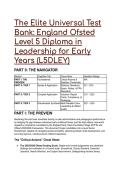
The Elite Universal Test
Bank: England Ofsted
Level 5 Diploma in
Leadership for Early
Years (L5DLEY)
PART 0: THE NAVIGATOR
Section Cognitive Tier Focus Area Question Range
PART I: THE Foundational Critical Axioms & N/A
PREVIEW Statutory Thresholds
PART II: TIER 1 Syntax & Application Statutory Directives, Q1 – Q10
Space, Ratios, & PFA
Standards
PART II: TIER 2 Complex Application Inclusion, Report Q11 – Q20
Cards, Compliance, &
Pedagogy
PART II: TIER 3 Grandmaster Synthesis Multi-Variable Crisis Q21 – Q30
Leadership & Ofsted
Audits
PART I: THE PREVIEW
Mastering this test bank translates directly to elite administrative and pedagogical performance
by bridging the gap between advanced early childhood theory and the high-stakes, real-world
regulatory compliance mandated by the England Early Years Foundation Stage (EYFS) and
Ofsted 2025/2026 frameworks. This document forges candidates into A-level Senior
Practitioners capable of navigating profound liability, optimizing holistic child development, and
surviving rigorous, narrative-driven Ofsted inspections.
The "Critical Axioms" Cheat Sheet
● The 2025/2026 Ofsted Grading Scale: Single-word overall judgements are abolished.
Settings are evaluated on a 5-point scale: Exceptional, Strong Standard, Expected
Standard, Needs Attention, and Urgent Improvement. Safeguarding remains binary
, (Met/Not Met).
● The Experience-Based Route (EBR): Practitioners without standard Level 3
qualifications can count in Level 3 ratios after completing 751–900 supervised hours, but
they must hold a suitable Level 2 English qualification and a Paediatric First Aid (PFA)
certificate. EBR staff cannot exceed 50% of the Level 3 ratio quota at any premises.
● Paediatric First Aid (PFA) Imperatives: As of September 2025, apprentices (16+),
students on placement, and volunteers (17+) must hold a PFA certificate to count in
ratios. A PFA-trained practitioner must be physically in the room, and within sight and
hearing, during all meals and snacks.
● Statutory Space Regulations: Indoor usable space must strictly provide 3.5m² for
children under two, 2.5m² for two-year-olds, and 2.3m² for children aged three to five.
Thoroughfares, dedicated staff areas, and cloakrooms are unequivocally excluded from
this calculation.
● Safer Recruitment & Attendance: Open references ("to whom it may concern") are
strictly prohibited. References must be secured directly from the current or most recent
employer. Settings must also enforce an attendance policy that actively monitors and
responds to prolonged or unexplained absences as a direct safeguarding trigger.
PART II: THE ELITE TEST BANK
TIER 1: Foundational Syntax & Application
Q1: A Senior Practitioner is calculating the maximum capacity for a newly acquired early years
room designated entirely for two-year-olds. The room measures 60 square meters in total.
However, 5 square meters are designated for built-in storage cupboards, and 5 square meters
act as a thoroughfare to a fire exit. Based on the principles of the EYFS statutory framework,
which conclusion is the MOST ACCURATE regarding the maximum number of children
permitted? A) The room can accommodate 24 children, as the total physical footprint of the
room dictates the legal capacity regardless of internal fixtures. B) The room can accommodate
14 children, applying the safest possible baseline calculation for early years spaces to ensure
maximum infection control. C) The room can accommodate 20 children, as the capacity is
strictly determined by dividing the usable space by the designated statutory square meterage for
this age cohort. D) The room can accommodate 21 children, assuming the practitioner applies
the calculation used for preschool-aged children to maximize setting revenue.
● The Answer: C (The room can accommodate 20 children, as the capacity is strictly
determined by dividing the usable space by the designated statutory square meterage for
this age cohort.)
● Distractor Analysis:
○ A is incorrect: 24 children is the calculation if the entire 60 square meters were
usable (.5 = 24). The EYFS explicitly prohibits the inclusion of non-usable
space such as storage and thoroughfares.
○ B is incorrect: 14 children relies on the 3.5m² requirement for children under two (50
/ 3.5 = 14.2). This is a misapplication of the statutory age cohort metrics.
○ D is incorrect: 21 children relies on the 2.3m² requirement for children aged three to
five (.3 = 21.7). Applying an older cohort's metric to two-year-olds constitutes
a severe regulatory breach resulting in overcrowding.
The Mentor's Analysis: The statutory space requirement for two-year-olds is strictly 2.5m² of
, usable floor space per child. Elite practitioners must systematically deduct storage and
thoroughfares before calculation (60m² - 10m² = 50m² usable space; .5 = 20). By
establishing an accurate base space requirement, you bypass the severe regulatory trap of
overcrowding and subsequent Ofsted enforcement action. Professional/Academic Intuition:
Never calculate capacity on gross square footage; usable space is a strictly defined legal
metric that explicitly excludes transit and storage.
Q2: Under the 2025/2026 EYFS workforce updates, a setting employs ten staff members who
operate within the Level 3 staff-to-child ratios. The manager wishes to utilize the new
Experience-Based Route (EBR) to alleviate chronic staffing pressures and budget constraints.
Based on the principles of statutory workforce compliance, which action is the MOST
ACCURATE regarding the maximum deployment of these staff members? A) The manager may
deploy 2 staff members with EBR status, as the government strictly limits alternative
qualification routes to a minor fraction of the workforce. B) The manager may deploy 3 staff
members with EBR status, ensuring that the vast majority of the floor staff hold traditional,
full-time academic diplomas. C) The manager may deploy exactly 5 staff members with EBR
status, provided they meet all other underlying English and first aid prerequisites. D) The
manager may deploy all 10 staff members with EBR status, as the updated framework
deregulated ratio qualifications to stimulate sector growth.
● The Answer: C (The manager may deploy exactly 5 staff members with EBR status,
provided they meet all other underlying English and first aid prerequisites.)
● Distractor Analysis:
○ A is incorrect: While conservative, this artificially limits the setting's operational
flexibility and does not reflect the actual statutory threshold designed to aid
recruitment.
○ B is incorrect: Though technically compliant as it falls under the maximum
allowance, it fails to identify the maximum legal threshold permitted by the current
framework.
○ D is incorrect: Allowing 100% of the Level 3 ratio to be filled by EBR staff directly
violates the specific statutory cap designed to protect the overall pedagogical
quality of the setting.
The Mentor's Analysis: The Department for Education explicitly mandates that no more than
50% of educators counting in the Level 3 ratios at any one time at a particular premises can
hold Experience-Based Route (EBR) status. Utilizing the EBR properly mitigates workforce
shortages, but pushing past this mathematical cap instantly invalidates the setting's statutory
compliance. Professional/Academic Intuition: The EBR is an operational pipeline, not a
total workforce replacement; you must never exceed the 50% saturation cap for Level 3
ratio deployment.
Q3: A nursery manager is conducting an internal audit on safer eating practices. During
lunchtime, fifteen children are eating in the main dining hall supervised by a Level 2 practitioner.
The setting's designated Paediatric First Aid (PFA) trained staff member is in the adjacent
administrative office, clearly visible through an internal glass window, but the office door is
securely closed. Based on the principles of the updated EYFS Safer Eating framework, which
conclusion is the MOST ACCURATE? A) The setting is fully compliant because the PFA-trained
staff member remains on the physical premises and maintains a direct line of sight. B) The
setting is non-compliant because the PFA-trained staff member must be physically situated
within the same room and within immediate hearing range. C) The setting is legally compliant
provided the Level 2 practitioner holds an active Emergency Paediatric First Aid (EPFA)
certificate to bridge the gap. D) The setting is non-compliant because safer eating protocols
Bank: England Ofsted
Level 5 Diploma in
Leadership for Early
Years (L5DLEY)
PART 0: THE NAVIGATOR
Section Cognitive Tier Focus Area Question Range
PART I: THE Foundational Critical Axioms & N/A
PREVIEW Statutory Thresholds
PART II: TIER 1 Syntax & Application Statutory Directives, Q1 – Q10
Space, Ratios, & PFA
Standards
PART II: TIER 2 Complex Application Inclusion, Report Q11 – Q20
Cards, Compliance, &
Pedagogy
PART II: TIER 3 Grandmaster Synthesis Multi-Variable Crisis Q21 – Q30
Leadership & Ofsted
Audits
PART I: THE PREVIEW
Mastering this test bank translates directly to elite administrative and pedagogical performance
by bridging the gap between advanced early childhood theory and the high-stakes, real-world
regulatory compliance mandated by the England Early Years Foundation Stage (EYFS) and
Ofsted 2025/2026 frameworks. This document forges candidates into A-level Senior
Practitioners capable of navigating profound liability, optimizing holistic child development, and
surviving rigorous, narrative-driven Ofsted inspections.
The "Critical Axioms" Cheat Sheet
● The 2025/2026 Ofsted Grading Scale: Single-word overall judgements are abolished.
Settings are evaluated on a 5-point scale: Exceptional, Strong Standard, Expected
Standard, Needs Attention, and Urgent Improvement. Safeguarding remains binary
, (Met/Not Met).
● The Experience-Based Route (EBR): Practitioners without standard Level 3
qualifications can count in Level 3 ratios after completing 751–900 supervised hours, but
they must hold a suitable Level 2 English qualification and a Paediatric First Aid (PFA)
certificate. EBR staff cannot exceed 50% of the Level 3 ratio quota at any premises.
● Paediatric First Aid (PFA) Imperatives: As of September 2025, apprentices (16+),
students on placement, and volunteers (17+) must hold a PFA certificate to count in
ratios. A PFA-trained practitioner must be physically in the room, and within sight and
hearing, during all meals and snacks.
● Statutory Space Regulations: Indoor usable space must strictly provide 3.5m² for
children under two, 2.5m² for two-year-olds, and 2.3m² for children aged three to five.
Thoroughfares, dedicated staff areas, and cloakrooms are unequivocally excluded from
this calculation.
● Safer Recruitment & Attendance: Open references ("to whom it may concern") are
strictly prohibited. References must be secured directly from the current or most recent
employer. Settings must also enforce an attendance policy that actively monitors and
responds to prolonged or unexplained absences as a direct safeguarding trigger.
PART II: THE ELITE TEST BANK
TIER 1: Foundational Syntax & Application
Q1: A Senior Practitioner is calculating the maximum capacity for a newly acquired early years
room designated entirely for two-year-olds. The room measures 60 square meters in total.
However, 5 square meters are designated for built-in storage cupboards, and 5 square meters
act as a thoroughfare to a fire exit. Based on the principles of the EYFS statutory framework,
which conclusion is the MOST ACCURATE regarding the maximum number of children
permitted? A) The room can accommodate 24 children, as the total physical footprint of the
room dictates the legal capacity regardless of internal fixtures. B) The room can accommodate
14 children, applying the safest possible baseline calculation for early years spaces to ensure
maximum infection control. C) The room can accommodate 20 children, as the capacity is
strictly determined by dividing the usable space by the designated statutory square meterage for
this age cohort. D) The room can accommodate 21 children, assuming the practitioner applies
the calculation used for preschool-aged children to maximize setting revenue.
● The Answer: C (The room can accommodate 20 children, as the capacity is strictly
determined by dividing the usable space by the designated statutory square meterage for
this age cohort.)
● Distractor Analysis:
○ A is incorrect: 24 children is the calculation if the entire 60 square meters were
usable (.5 = 24). The EYFS explicitly prohibits the inclusion of non-usable
space such as storage and thoroughfares.
○ B is incorrect: 14 children relies on the 3.5m² requirement for children under two (50
/ 3.5 = 14.2). This is a misapplication of the statutory age cohort metrics.
○ D is incorrect: 21 children relies on the 2.3m² requirement for children aged three to
five (.3 = 21.7). Applying an older cohort's metric to two-year-olds constitutes
a severe regulatory breach resulting in overcrowding.
The Mentor's Analysis: The statutory space requirement for two-year-olds is strictly 2.5m² of
, usable floor space per child. Elite practitioners must systematically deduct storage and
thoroughfares before calculation (60m² - 10m² = 50m² usable space; .5 = 20). By
establishing an accurate base space requirement, you bypass the severe regulatory trap of
overcrowding and subsequent Ofsted enforcement action. Professional/Academic Intuition:
Never calculate capacity on gross square footage; usable space is a strictly defined legal
metric that explicitly excludes transit and storage.
Q2: Under the 2025/2026 EYFS workforce updates, a setting employs ten staff members who
operate within the Level 3 staff-to-child ratios. The manager wishes to utilize the new
Experience-Based Route (EBR) to alleviate chronic staffing pressures and budget constraints.
Based on the principles of statutory workforce compliance, which action is the MOST
ACCURATE regarding the maximum deployment of these staff members? A) The manager may
deploy 2 staff members with EBR status, as the government strictly limits alternative
qualification routes to a minor fraction of the workforce. B) The manager may deploy 3 staff
members with EBR status, ensuring that the vast majority of the floor staff hold traditional,
full-time academic diplomas. C) The manager may deploy exactly 5 staff members with EBR
status, provided they meet all other underlying English and first aid prerequisites. D) The
manager may deploy all 10 staff members with EBR status, as the updated framework
deregulated ratio qualifications to stimulate sector growth.
● The Answer: C (The manager may deploy exactly 5 staff members with EBR status,
provided they meet all other underlying English and first aid prerequisites.)
● Distractor Analysis:
○ A is incorrect: While conservative, this artificially limits the setting's operational
flexibility and does not reflect the actual statutory threshold designed to aid
recruitment.
○ B is incorrect: Though technically compliant as it falls under the maximum
allowance, it fails to identify the maximum legal threshold permitted by the current
framework.
○ D is incorrect: Allowing 100% of the Level 3 ratio to be filled by EBR staff directly
violates the specific statutory cap designed to protect the overall pedagogical
quality of the setting.
The Mentor's Analysis: The Department for Education explicitly mandates that no more than
50% of educators counting in the Level 3 ratios at any one time at a particular premises can
hold Experience-Based Route (EBR) status. Utilizing the EBR properly mitigates workforce
shortages, but pushing past this mathematical cap instantly invalidates the setting's statutory
compliance. Professional/Academic Intuition: The EBR is an operational pipeline, not a
total workforce replacement; you must never exceed the 50% saturation cap for Level 3
ratio deployment.
Q3: A nursery manager is conducting an internal audit on safer eating practices. During
lunchtime, fifteen children are eating in the main dining hall supervised by a Level 2 practitioner.
The setting's designated Paediatric First Aid (PFA) trained staff member is in the adjacent
administrative office, clearly visible through an internal glass window, but the office door is
securely closed. Based on the principles of the updated EYFS Safer Eating framework, which
conclusion is the MOST ACCURATE? A) The setting is fully compliant because the PFA-trained
staff member remains on the physical premises and maintains a direct line of sight. B) The
setting is non-compliant because the PFA-trained staff member must be physically situated
within the same room and within immediate hearing range. C) The setting is legally compliant
provided the Level 2 practitioner holds an active Emergency Paediatric First Aid (EPFA)
certificate to bridge the gap. D) The setting is non-compliant because safer eating protocols


