

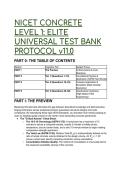
NICET CONCRETE
LEVEL 1: ELITE
UNIVERSAL TEST BANK
PROTOCOL v11.0
PART 0: THE TABLE OF CONTENTS
Section Cognitive Tier Subject Focus
PART I The Preview Critical Axioms & Core
Directives
PART II Tier 1 (Questions 1–15) Foundational Syntax &
Application (ASTM Hard Decks)
PART II Tier 2 (Questions 16–35) Complex Application &
Simulation (Multi-Variable
Scenarios)
PART II Tier 3 (Questions 36–50) Grandmaster Synthesis
(High-Stakes Field
Engineering)
PART I: THE PREVIEW
Mastering this test bank eliminates the gap between theoretical knowledge and field execution,
forging technicians whose analytical precision guarantees structural integrity and code
compliance. By internalizing these rigid ASTM standards, you transition from merely passing an
exam to dictating quality control on the world’s most demanding concrete placements.
● The "Critical Axioms" Cheat Sheet:
○ The 15-5-15 Chronology (ASTM C172): A technician has a maximum of 15
minutes to secure a composite sample, exactly 5 minutes to initiate slump,
temperature, and air content tests, and a strict 15-minute window to begin molding
compressive strength specimens.
○ The Yield Law (ASTM C138): Relative Yield (R_y) is mathematically defined as the
ratio of actual concrete volume obtained to the design volume. An R_y < 1.00
proves a short load, directly impacting contractor volume calculations.
○ Consolidation Dictates Quality: The method of consolidation is irrevocably tied to
the measured workability (slump) of the concrete.
,Slump Measurement Mandatory Consolidation Method (ASTM
C138/C31)
Less than 1 inch (25 mm) Internal Vibration strictly required
1 to 3 inches (25 mm to 75 mm) Rodding OR Internal Vibration permitted
Greater than 3 inches (75 mm) Rodding strictly required (Vibration forbidden)
* High-Strength Thermal Constraints (ASTM C31):
Specified Strength (f'_c) Required Initial Curing Temperature
Less than 6,000 psi (40 MPa) 60°F to 80°F (16°C to 27°C)
6,000 psi (40 MPa) or Greater 68°F to 78°F (20°C to 26°C)
* Unbonded Capping Limits (ASTM C1231): Elastomeric neoprene pads are restricted by both
usage cycles and concrete compressive strength, capping at a maximum of 100 uses.
Qualification testing is mandatory for strengths between 7,000 and 12,000 psi, and unbonded
caps are strictly forbidden above 12,000 psi.
PART II: THE ELITE TEST BANK
Tier 1: Foundational Syntax & Application
Q1: You are sampling concrete from a revolving drum truck mixer for acceptance testing.
Following ASTM C172, you must obtain two or more portions from the middle of the batch. What
is the absolute maximum allowable time elapsed between obtaining the first and final portions of
the composite sample? A) 5 minutes B) 10 minutes C) 15 minutes D) 30 minutes
● The Answer: C (15 minutes)
● Distractor Analysis:
○ A is incorrect: 5 minutes is the maximum allowable time to initiate the slump,
temperature, and air content tests after the composite sample has been fully
fabricated and transported.
○ B is incorrect: 10 minutes is a legacy field metric often confused with the duration
required to mix the concrete after adding water, not the sampling window.
○ D is incorrect: 30 minutes represents the maximum time a molded specimen can sit
before being transferred to its initial curing environment.
The Mentor's Analysis: Time is the enemy of fresh concrete. The 15-minute sampling window
prevents the first portion from undergoing initial hydration while you wait for the final portion. By
adhering to this hard deck, you bypass the trap of testing a sample with an artificially depressed
slump. Professional/Academic Intuition: Once the final portion is collected, the clock
accelerates: you have exactly 5 minutes to start your fresh tests.
Q2: During a winter pour, you are tasked with measuring the temperature of freshly mixed
hydraulic-cement concrete (ASTM C1064). You insert the thermometer into the composite
sample. What is the minimum required concrete cover in all directions around the sensing
portion of the temperature measuring device? A) 1 inch (25 mm) B) 2 inches (50 mm) C) 3
inches (75 mm) D) 4 inches (100 mm)
● The Answer: C (3 inches (75 mm))
● Distractor Analysis:
○ A is incorrect: 1 inch is the required penetration depth for a tamping rod into the
underlying layer during consolidation, not the sensor depth.
○ B is incorrect: 2 inches is the nominal maximum size of aggregate that requires
wet-sieving prior to molding standard 6x12 cylinders.
, ○ D is incorrect: 4 inches represents the top diameter of a standard slump cone.
The Mentor's Analysis: Temperature gradients in concrete drop rapidly near the exposed
surface due to ambient air exchange. Submerging the sensor with a minimum 3-inch (75 mm)
cover ensures you are reading the internal core heat of hydration, entirely isolated from ambient
interference. Professional/Academic Intuition: Always press the concrete gently around
the thermometer stem at the surface to prevent ambient air from channeling down to the
sensor.
Q3: You are performing a slump test (ASTM C143) on a commercial floor slab mix. You must fill
the cone in three layers. How is the volume of each layer defined to ensure compliance with the
standard? A) Three equal layers by height (4 inches, 8 inches, 12 inches). B) Three equal layers
by volume, corresponding to heights of 2 5/8 inches and 6 1/8 inches. C) Three equal layers by
mass, estimated by the technician during shovel placement. D) Two equal layers by volume,
rodded 25 times each.
● The Answer: B (Three equal layers by volume, corresponding to heights of 2 5/8 inches
and 6 1/8 inches.)
● Distractor Analysis:
○ A is incorrect: The frustum of a cone means the bottom holds significantly more
volume than the top. Filling by equal height drastically under-consolidates the
bottom layer and over-consolidates the top.
○ C is incorrect: Field technicians cannot reliably estimate mass while rapidly
shoveling fresh concrete into a mold.
○ D is incorrect: Two equal layers are used for volumetric air meters (ASTM C173)
and 4x8 cylinders (ASTM C31), not the slump cone.
The Mentor's Analysis: The geometry of the slump cone dictates its consolidation rules.
Because the base is 8 inches and the top is 4 inches, one-third of the volume is reached at just
2 5/8 inches of height. By failing to fill by volume, novices inherently compromise the frictional
interlock of the aggregates. Professional/Academic Intuition: Memorize the fractions: Layer
1 is 2 5/8", Layer 2 is 6 1/8", Layer 3 is to the top rim.
Q4: Based on ASTM C138, when calculating the density (unit weight) of concrete, the mass of
the empty measure (M_m) must be subtracted from the mass of the measure filled with concrete
(M_c). What mathematical operation is required NEXT to find the Density (D)? A) Multiply by the
theoretical unit weight provided by the batch plant. B) Divide by the total mass of all materials
batched. C) Divide by the calibrated volume of the measure (V_m). D) Multiply by 27 to convert
the figure to cubic yards.
● The Answer: C (Divide by the calibrated volume of the measure (V_m).)
● Distractor Analysis:
○ A is incorrect: The theoretical unit weight is utilized later to calculate the gravimetric
air content, not the raw physical density.
○ B is incorrect: The total mass batched is utilized as the numerator when
determining the total Yield (Y), not the density of the sample.
○ D is incorrect: Multiplying by 27 is a conversion step used when calculating yield
per batch in cubic yards, but it does not produce the density parameter.
The Mentor's Analysis: Density is universally mass divided by volume. In the field, securing
the correct tare weight of the bucket and dividing by its exact calibrated volume (V_m) is the
fulcrum of the entire yield and air content calculation. If this number is compromised, every
subsequent mathematical proof fails. Professional/Academic Intuition: Density (D) = (M_c -
M_m) / V_m. Every subsequent yield and air calculation relies entirely on the accuracy of
this single metric.
LEVEL 1: ELITE
UNIVERSAL TEST BANK
PROTOCOL v11.0
PART 0: THE TABLE OF CONTENTS
Section Cognitive Tier Subject Focus
PART I The Preview Critical Axioms & Core
Directives
PART II Tier 1 (Questions 1–15) Foundational Syntax &
Application (ASTM Hard Decks)
PART II Tier 2 (Questions 16–35) Complex Application &
Simulation (Multi-Variable
Scenarios)
PART II Tier 3 (Questions 36–50) Grandmaster Synthesis
(High-Stakes Field
Engineering)
PART I: THE PREVIEW
Mastering this test bank eliminates the gap between theoretical knowledge and field execution,
forging technicians whose analytical precision guarantees structural integrity and code
compliance. By internalizing these rigid ASTM standards, you transition from merely passing an
exam to dictating quality control on the world’s most demanding concrete placements.
● The "Critical Axioms" Cheat Sheet:
○ The 15-5-15 Chronology (ASTM C172): A technician has a maximum of 15
minutes to secure a composite sample, exactly 5 minutes to initiate slump,
temperature, and air content tests, and a strict 15-minute window to begin molding
compressive strength specimens.
○ The Yield Law (ASTM C138): Relative Yield (R_y) is mathematically defined as the
ratio of actual concrete volume obtained to the design volume. An R_y < 1.00
proves a short load, directly impacting contractor volume calculations.
○ Consolidation Dictates Quality: The method of consolidation is irrevocably tied to
the measured workability (slump) of the concrete.
,Slump Measurement Mandatory Consolidation Method (ASTM
C138/C31)
Less than 1 inch (25 mm) Internal Vibration strictly required
1 to 3 inches (25 mm to 75 mm) Rodding OR Internal Vibration permitted
Greater than 3 inches (75 mm) Rodding strictly required (Vibration forbidden)
* High-Strength Thermal Constraints (ASTM C31):
Specified Strength (f'_c) Required Initial Curing Temperature
Less than 6,000 psi (40 MPa) 60°F to 80°F (16°C to 27°C)
6,000 psi (40 MPa) or Greater 68°F to 78°F (20°C to 26°C)
* Unbonded Capping Limits (ASTM C1231): Elastomeric neoprene pads are restricted by both
usage cycles and concrete compressive strength, capping at a maximum of 100 uses.
Qualification testing is mandatory for strengths between 7,000 and 12,000 psi, and unbonded
caps are strictly forbidden above 12,000 psi.
PART II: THE ELITE TEST BANK
Tier 1: Foundational Syntax & Application
Q1: You are sampling concrete from a revolving drum truck mixer for acceptance testing.
Following ASTM C172, you must obtain two or more portions from the middle of the batch. What
is the absolute maximum allowable time elapsed between obtaining the first and final portions of
the composite sample? A) 5 minutes B) 10 minutes C) 15 minutes D) 30 minutes
● The Answer: C (15 minutes)
● Distractor Analysis:
○ A is incorrect: 5 minutes is the maximum allowable time to initiate the slump,
temperature, and air content tests after the composite sample has been fully
fabricated and transported.
○ B is incorrect: 10 minutes is a legacy field metric often confused with the duration
required to mix the concrete after adding water, not the sampling window.
○ D is incorrect: 30 minutes represents the maximum time a molded specimen can sit
before being transferred to its initial curing environment.
The Mentor's Analysis: Time is the enemy of fresh concrete. The 15-minute sampling window
prevents the first portion from undergoing initial hydration while you wait for the final portion. By
adhering to this hard deck, you bypass the trap of testing a sample with an artificially depressed
slump. Professional/Academic Intuition: Once the final portion is collected, the clock
accelerates: you have exactly 5 minutes to start your fresh tests.
Q2: During a winter pour, you are tasked with measuring the temperature of freshly mixed
hydraulic-cement concrete (ASTM C1064). You insert the thermometer into the composite
sample. What is the minimum required concrete cover in all directions around the sensing
portion of the temperature measuring device? A) 1 inch (25 mm) B) 2 inches (50 mm) C) 3
inches (75 mm) D) 4 inches (100 mm)
● The Answer: C (3 inches (75 mm))
● Distractor Analysis:
○ A is incorrect: 1 inch is the required penetration depth for a tamping rod into the
underlying layer during consolidation, not the sensor depth.
○ B is incorrect: 2 inches is the nominal maximum size of aggregate that requires
wet-sieving prior to molding standard 6x12 cylinders.
, ○ D is incorrect: 4 inches represents the top diameter of a standard slump cone.
The Mentor's Analysis: Temperature gradients in concrete drop rapidly near the exposed
surface due to ambient air exchange. Submerging the sensor with a minimum 3-inch (75 mm)
cover ensures you are reading the internal core heat of hydration, entirely isolated from ambient
interference. Professional/Academic Intuition: Always press the concrete gently around
the thermometer stem at the surface to prevent ambient air from channeling down to the
sensor.
Q3: You are performing a slump test (ASTM C143) on a commercial floor slab mix. You must fill
the cone in three layers. How is the volume of each layer defined to ensure compliance with the
standard? A) Three equal layers by height (4 inches, 8 inches, 12 inches). B) Three equal layers
by volume, corresponding to heights of 2 5/8 inches and 6 1/8 inches. C) Three equal layers by
mass, estimated by the technician during shovel placement. D) Two equal layers by volume,
rodded 25 times each.
● The Answer: B (Three equal layers by volume, corresponding to heights of 2 5/8 inches
and 6 1/8 inches.)
● Distractor Analysis:
○ A is incorrect: The frustum of a cone means the bottom holds significantly more
volume than the top. Filling by equal height drastically under-consolidates the
bottom layer and over-consolidates the top.
○ C is incorrect: Field technicians cannot reliably estimate mass while rapidly
shoveling fresh concrete into a mold.
○ D is incorrect: Two equal layers are used for volumetric air meters (ASTM C173)
and 4x8 cylinders (ASTM C31), not the slump cone.
The Mentor's Analysis: The geometry of the slump cone dictates its consolidation rules.
Because the base is 8 inches and the top is 4 inches, one-third of the volume is reached at just
2 5/8 inches of height. By failing to fill by volume, novices inherently compromise the frictional
interlock of the aggregates. Professional/Academic Intuition: Memorize the fractions: Layer
1 is 2 5/8", Layer 2 is 6 1/8", Layer 3 is to the top rim.
Q4: Based on ASTM C138, when calculating the density (unit weight) of concrete, the mass of
the empty measure (M_m) must be subtracted from the mass of the measure filled with concrete
(M_c). What mathematical operation is required NEXT to find the Density (D)? A) Multiply by the
theoretical unit weight provided by the batch plant. B) Divide by the total mass of all materials
batched. C) Divide by the calibrated volume of the measure (V_m). D) Multiply by 27 to convert
the figure to cubic yards.
● The Answer: C (Divide by the calibrated volume of the measure (V_m).)
● Distractor Analysis:
○ A is incorrect: The theoretical unit weight is utilized later to calculate the gravimetric
air content, not the raw physical density.
○ B is incorrect: The total mass batched is utilized as the numerator when
determining the total Yield (Y), not the density of the sample.
○ D is incorrect: Multiplying by 27 is a conversion step used when calculating yield
per batch in cubic yards, but it does not produce the density parameter.
The Mentor's Analysis: Density is universally mass divided by volume. In the field, securing
the correct tare weight of the bucket and dividing by its exact calibrated volume (V_m) is the
fulcrum of the entire yield and air content calculation. If this number is compromised, every
subsequent mathematical proof fails. Professional/Academic Intuition: Density (D) = (M_c -
M_m) / V_m. Every subsequent yield and air calculation relies entirely on the accuracy of
this single metric.


